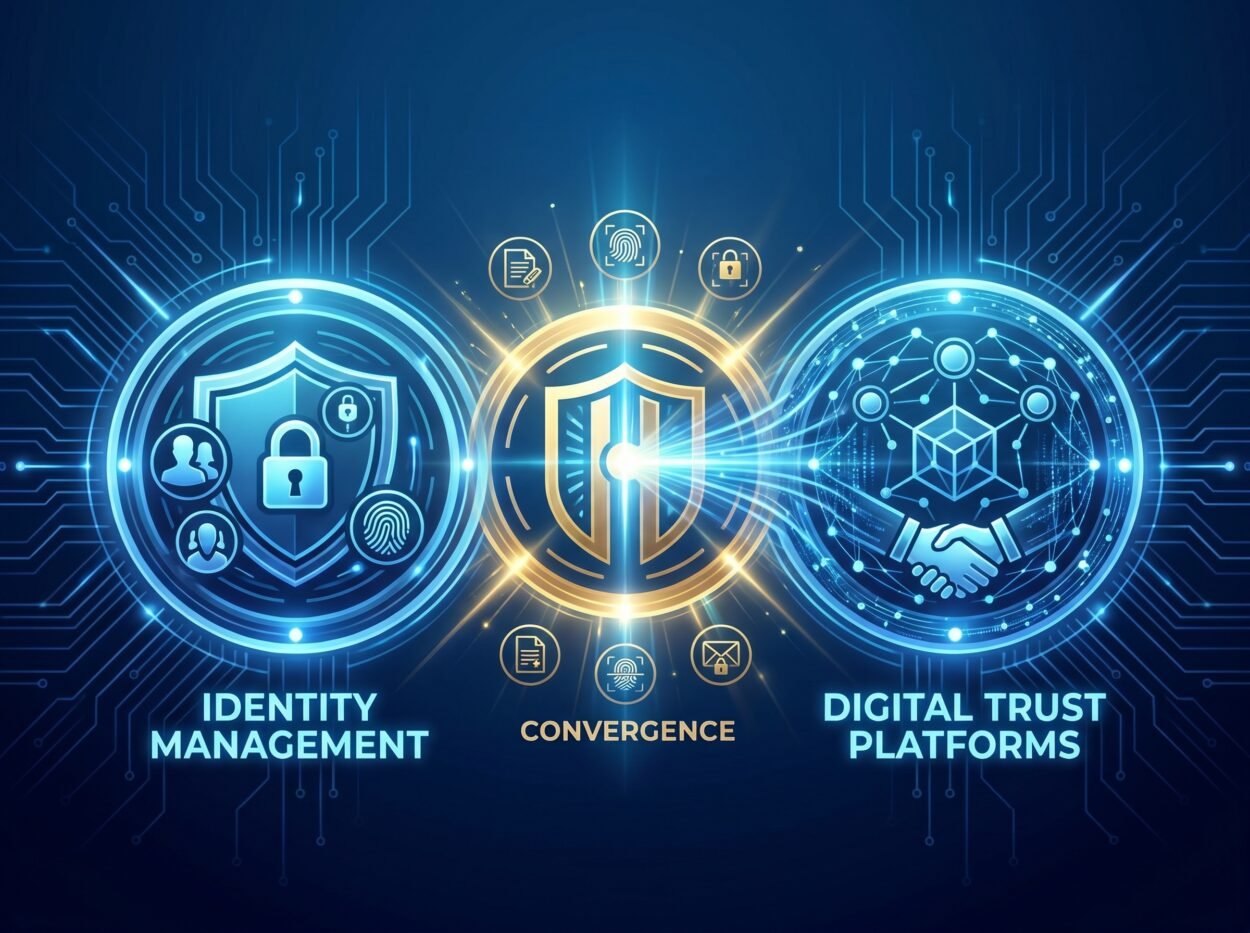
For a long time, identity systems were built to answer a narrow question: “Is this person allowed in?”
That was enough – until it wasn’t.
Because access is no longer the hard part.
Trust is.
Today, someone can pass authentication and still pose a risk. Credentials can be valid, yet misused. Sessions can start securely and drift into suspicious behavior minutes later.
That’s the gap modern systems are trying to close.
And it’s exactly why identity management is beginning to merge with something broader digital trust platforms.
Identity Used to Be a Gate. Now It’s a Signal.
In older systems, identity worked like a gate.
You verified once. The gate opened. Everything beyond it was assumed to be safe.
But in dynamic environments remote work, distributed systems, cross-platform access that model breaks down quickly.
Identity is no longer a single event. It’s a continuous signal.
Who the user is still matters. But so does:
- how they behave
- where they connect from
- what they’re trying to access
- whether anything feels out of pattern
This is where identity alone stops being enough and trust starts to take over.
Trust Stops Being an Add-On
For years, trust mechanisms were layered on top of identity systems.
Extra verification steps. Manual reviews. Compliance checks running in parallel.
They worked, but they were reactive.
What’s changing now is the integration. Trust isn’t something applied after identity – it’s becoming part of it.
Modern systems combine digital identity verification with contextual awareness and automation. They evaluate continuously instead of occasionally.
That’s the core idea behind a digital trust platform: not just confirming identity, but validating it in motion.
Credentials Are Becoming the Bridge
One of the clearest signs of this convergence is how digital credentials are being used.
Instead of repeatedly checking raw data, systems are starting to rely on verifiable credentials proofs that carry their own validity.
These credentials shift the conversation:
- from “show me your data”
- to “show me something already trusted”
With proper credential management, identity becomes reusable, not repetitive.
And once credentials can move across systems securely, identity and trust stop being separate layers. They start reinforcing each other.
The Invisible Role of Infrastructure
A lot of this shift is happening quietly in the background.
Technologies like digital identity blockchain aren’t visible to users, but they change how systems behave. With blockchain identity solutions, verification doesn’t depend on constant back-and-forth.
Trust is anchored, not requested.
At the same time, tools like identity proofing software and digital identity compliance automation software make sure this trust holds at scale especially in environments like digital government solutions, where millions of identities interact daily.
The result is less friction, but stronger validation.
Control Is Moving – Subtly
Another change, less technical but just as important, is where control sits.
With decentralized identity, users are no longer just entries in a system. They hold credentials, share them selectively, and reduce how much data they expose.
This doesn’t eliminate trust systems it improves them.
Because when users control what they share, systems can focus on verifying relevance, not collecting everything.
That’s a different kind of efficiency. And a stronger form of digital trust.
What This Convergence Really Means
It’s tempting to think of this as a technical upgrade.
It’s not.
It’s a shift in how systems think about identity.
From:
- identity as a checkpoint → identity as a continuous input
- trust as a layer → trust as a foundation
- verification as a process → verification as a built-in capability
When identity management and digital trust platforms converge, systems stop asking for proof repeatedly.
They start recognizing it.
Final Thought
The most interesting part of this shift is how subtle it is.
Users don’t see the architecture. They don’t notice the systems evaluating trust in real time. They just experience fewer interruptions, faster access, and more consistency.
And that’s the point.
When identity and trust truly converge, security doesn’t feel heavier.
It feels… invisible.
If you’re exploring how to bring identity and trust together in your systems, we’d love to work with you.
We help organizations design:
- Digital identity platforms
- Verifiable credential ecosystems
- Blockchain-backed identity verification systems
- Scalable, trust-driven infrastructures
👉 Connect with us to build systems where identity and trust work as one.


Sign up