



5 Axis Vertical Machining Centers and CNC Turning Center Integration
Modern manufacturing is rapidly evolving toward higher precision, faster cycle times, and more complex part geometries. Industries such as aerospace, automotive, and medical devices increasingly rely...

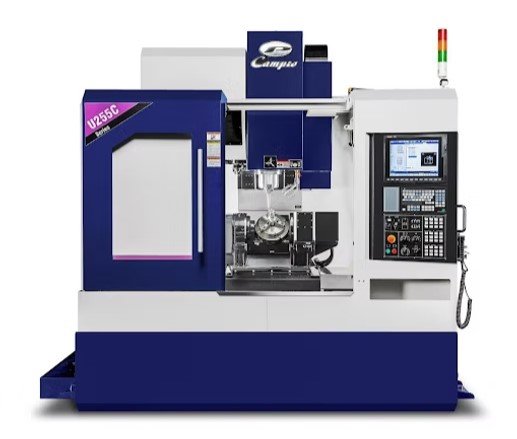
Modern manufacturing is rapidly evolving toward higher precision, faster cycle times, and more complex part geometries. Industries such as aerospace, automotive, and medical devices increasingly rely on advanced CNC systems to meet tight tolerances and production efficiency goals. In this context, the 5-axis vertical machining center has become a key technology for multi-surface machining, offering flexibility that traditional systems cannot match. At the same time, production environments are also integrating complementary systems, such as the turning center, to improve overall manufacturing efficiency and part accuracy.
Table Of Content
- What Is a 5 Axis Vertical Machining Center
- Key Advantages of 5 Axis Machining Technology
- Understanding CNC Turning Centers
- How CNC Turning Centers Complement 5 Axis Machines
- Industrial Applications of Combined CNC Systems
- Efficiency and Production Optimization
- Technological Advancements in CNC Systems
- Conclusion
What Is a 5 Axis Vertical Machining Center
A 5-axis vertical machining center is a CNC machine capable of moving a cutting tool or workpiece along five different axes simultaneously. The 5-axis systems add two rotational axes, which allow the tool to approach the workpiece from virtually any angle without repositioning. These 5-axis systems significantly reduce setup time and improve machining accuracy by eliminating multiple fixture changes. This makes them ideal for complex components such as turbine blades, medical implants, and precision molds.
Key Advantages of 5 Axis Machining Technology
One of the primary advantages of a 5-axis vertical machining center is its ability to complete complex parts in a single setup. This reduces human error and improves consistency across production batches. Research in CNC manufacturing also shows that multi-axis machining can reduce overall production time by up to 30–50% in certain applications due to fewer repositioning steps. Other benefits include improved surface finish quality, extended tool life, and enhanced capability to machine intricate geometries. These advantages make 5-axis systems a preferred choice for high-value, low-tolerance manufacturing industries.
Understanding CNC Turning Centers
A CNC turning center is a machine used primarily for producing cylindrical parts through a process called turning, where the workpiece rotates while a stationary cutting tool removes material. These machines are widely used in producing shafts, bolts, bushings, and other rotational components.
Unlike milling machines, turning centers excel in high-speed material removal for symmetrical parts. They are essential in industries where mass production of precision round components is required.
How CNC Turning Centers Complement 5 Axis Machines
While a 5-axis vertical machining center handles complex geometries and multi-surface parts, a CNC turning center is optimized for rotational components. Together, they form a highly efficient manufacturing ecosystem.
For example, a part may begin as a rough cylindrical shape produced on a turning center and then move to a 5-axis machine for detailed finishing, drilling, and contouring. This hybrid approach reduces production bottlenecks and ensures that each machine performs the task it is best suited for.
Industrial Applications of Combined CNC Systems
The integration of 5-axis machining and turning centers is common in advanced manufacturing sectors. Aerospace components often require both rotational symmetry and complex surface machining, making this combination essential.
Similarly, automotive industries use turning centers for engine shafts and then 5-axis machines for precision finishing of complex housings and structural parts. Medical device manufacturing also benefits from this combination, especially in producing implants and surgical tools that require both round and contoured features.
Efficiency and Production Optimization
One of the major trends in modern manufacturing is process optimization through machine integration. By combining a 5-axis vertical machining center with a CNC turning center, manufacturers can reduce idle time, improve workflow efficiency, and minimize material handling. Industry studies highlight that reducing part repositioning not only saves time but also improves dimensional accuracy by eliminating alignment errors.
Technological Advancements in CNC Systems
Modern CNC machines now incorporate advanced features such as automated tool changers, intelligent control systems, and real-time monitoring. These innovations allow both 5-axis and turning centers to operate with higher efficiency and reduced operator intervention.
Additionally, simulation software and digital twin technologies are increasingly used to optimize machining paths before production begins, further improving accuracy and reducing material waste.
Conclusion
The combination of a 5-axis vertical machining center represents a powerful approach to modern manufacturing. While 5-axis systems excel in complex, multi-surface machining, turning centers remain essential for producing high-precision cylindrical components. Along with a CNC turning center, they create a balanced production ecosystem that enhances efficiency, accuracy, and flexibility across industries, supporting the growing demand for advanced CNC manufacturing solutions.







No Comment! Be the first one.