


What Documents Are Required to Overcome an FDA Detention Quickly?
Introduction An FDA detention is one of the most disruptive events an importer or manufacturer can face when bringing regulated goods into the United States. It occurs when the U.S. Food and Drug...

Introduction
An FDA detention is one of the most disruptive events an importer or manufacturer can face when bringing regulated goods into the United States. It occurs when the U.S. Food and Drug Administration identifies a potential compliance issue and temporarily stops a shipment from entering U.S. commerce. While an fda detention does not automatically mean a product is unsafe or illegal, it does indicate that the FDA requires additional proof before allowing the goods to move forward.
Table Of Content
- Introduction
- Understanding How FDA Detention Works and Why Documents Matter
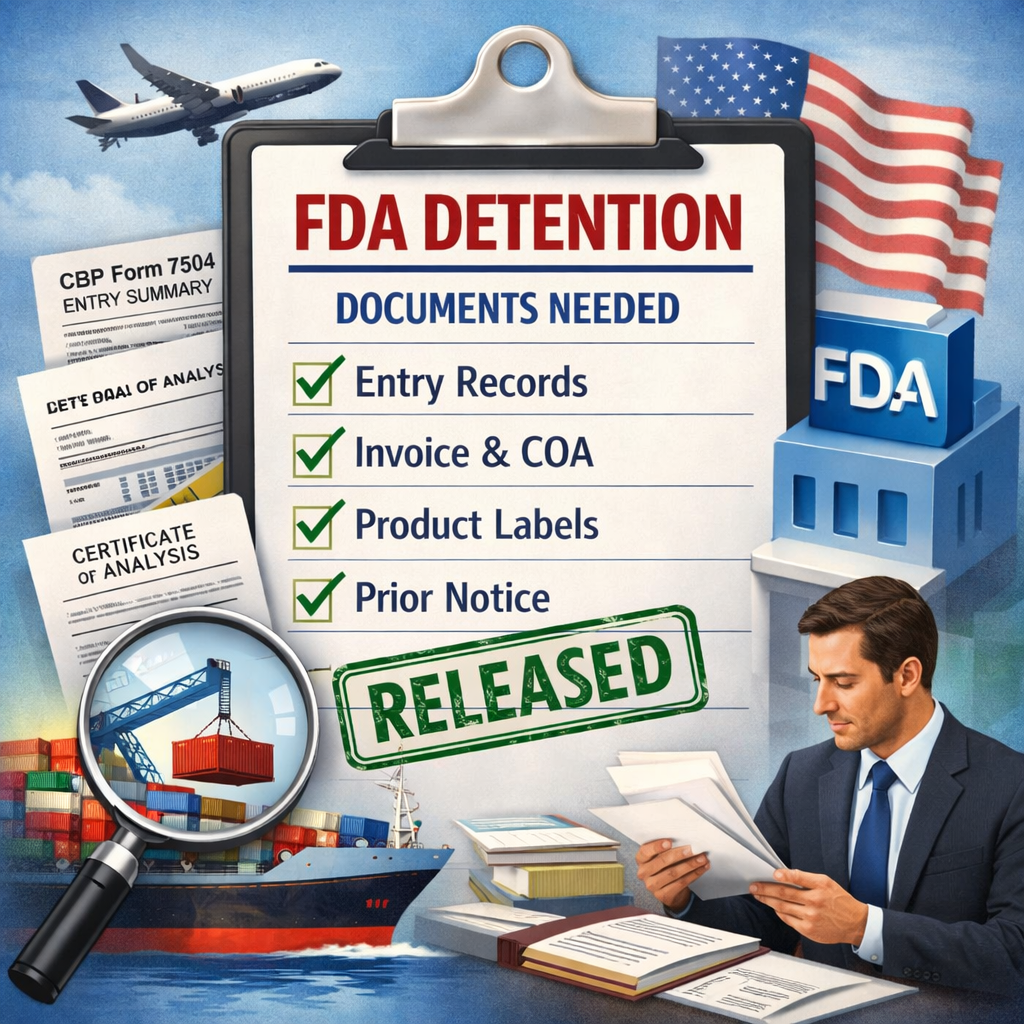
- Core Documents Required to Overcome an FDA Detention Quickly
- Entry Summary and Customs Filing Records
- Commercial Invoice and Transaction Details
- Packing List and Shipment Breakdown
- Bill of Lading or Air Waybill
- FDA Prior Notice Confirmation
- Product Labeling and Artwork Documentation
- Certificate of Analysis (COA)
- Manufacturing and Facility Compliance Records
- Industry-Specific Documentation Requirements
- Food and Beverage Products
- Dietary Supplements
- Cosmetics
- Pet Food and Animal Feed
- Step-by-Step Process to Respond to an FDA Detention
- Step 1: Analyze the Detention Notice
- Step 2: Gather Required Documents
- Step 3: Verify Consistency
- Step 4: Prepare a Formal Response
- Step 5: Communicate with FDA or Broker
- Common Mistakes That Delay FDA Detention Resolution
- Why Documentation Quality Determines FDA Detention Outcomes
- Role of FDA Compliance Professionals and Attorneys
- Conclusion: Proper Documentation Is the Fastest Path Out of FDA Detention
- Call to Action
For businesses involved in international trade, especially food, cosmetics, dietary supplements, pet food, or medical-related products, an fda detention can result in financial loss, supply chain delays, contract breaches, and reputational damage. In many cases, the difference between a quick release and a prolonged hold is documentation quality.
The FDA does not make decisions based on assumptions. Every fda detention must be supported or resolved through verifiable documentation. This means importers must be prepared to submit accurate, complete, and consistent records that clearly demonstrate regulatory compliance.
This article provides a comprehensive breakdown of what documents are required to overcome an fda detention quickly, how each document supports compliance, and how businesses can structure their response to minimize delays. It also explains common mistakes, industry-specific requirements, and how legal or regulatory support can improve outcomes.
Understanding How FDA Detention Works and Why Documents Matter
To understand why documentation is so important in an fda detention, it is necessary to understand how the process works behind the scenes.
When a shipment arrives at a U.S. port, it is screened electronically and sometimes physically inspected. If the FDA identifies a potential risk or inconsistency, the shipment is placed under fda detention. At this point, the product cannot be legally distributed or sold.
The FDA then issues a detention notice outlining the reason for the hold. The importer is given an opportunity to respond by submitting documentation that proves compliance. This stage is critical because the FDA’s decision to release, refuse, or destroy the shipment depends almost entirely on the quality of the response.
Common reasons behind an fda detention include:
- Missing or incorrect prior notice filings
- Labeling violations or misleading claims
- Ingredient concerns or unapproved substances
- Manufacturing facility compliance issues
- Inconsistent import data across documents
- History of prior violations by the supplier
The FDA operates under a risk-based framework. This means that documentation is used as evidence of safety, transparency, and regulatory compliance. If the documentation is incomplete or inconsistent, the fda detention is likely to continue or escalate.
Core Documents Required to Overcome an FDA Detention Quickly
Resolving an fda detention quickly depends on submitting a complete documentation package that addresses all regulatory concerns. The FDA evaluates consistency across trade, safety, and product-specific records.
Below are the essential documents required in nearly all fda detention responses.
Entry Summary and Customs Filing Records
The entry summary is one of the most important documents in an fda detention case because it establishes the legal import framework for the shipment.
This includes:
- CBP Form 7501 (entry summary)
- Entry number and filing confirmation
- Customs broker submission records
- Importer of record identification
These documents confirm that the shipment was properly declared. Any inconsistency between customs records and FDA submissions can delay the resolution of an fda detention.
For example, if the product description in customs records differs from the FDA prior notice filing, the FDA may suspect misbranding or misclassification, extending the fda detention review process.
Commercial Invoice and Transaction Details
The commercial invoice provides a detailed financial and product description of the shipment. It is a foundational document in any fda detention response because it connects the commercial transaction to the physical goods.
A compliant commercial invoice must include:
- Product name and detailed description
- Quantity and unit pricing
- Total shipment value
- Exporter and importer details
- Country of origin
- Payment terms and conditions
FDA officers carefully compare the invoice against physical inspection results. If discrepancies exist, such as mismatched product descriptions or unclear labeling, the fda detention may continue until clarification is provided.
Packing List and Shipment Breakdown
A packing list supports the invoice by providing a physical breakdown of the shipment. In an fda detention, this document is used to verify that the declared goods match the actual shipment contents.
A complete packing list includes:
- Number of cartons or pallets
- Weight per unit and total shipment weight
- Itemized product breakdown
- Packaging configuration
- Batch or lot references
Even minor inconsistencies in packaging details can raise concerns during an fda detention review, especially for high-risk categories like food or supplements.
Bill of Lading or Air Waybill
The bill of lading or air waybill is the official transport document for the shipment. It plays a key role in tracking and verifying logistics during an fda detention.
It typically contains:
- Carrier name and contact information
- Shipment route and port of entry
- Consignee and shipper details
- Shipment date and reference numbers
FDA uses this document to match transportation data with prior notice filings. If the shipping timeline or consignee information does not match other records, the fda detention may be extended for further investigation.
FDA Prior Notice Confirmation
Prior Notice is mandatory for most FDA-regulated imports. It is one of the most common failure points in an fda detention.
This document includes:
- Prior Notice Confirmation Number
- Product description and classification
- Importer and manufacturer details
- Arrival time and location
If prior notice is missing, inaccurate, or submitted late, the shipment is almost guaranteed to remain under fda detention until corrected documentation is provided.
Product Labeling and Artwork Documentation
Label compliance is one of the most heavily scrutinized areas in an fda detention. FDA reviews labels to ensure consumers are not misled and that regulatory requirements are met.
Required labeling documentation includes:
- Full product label (front and back)
- Ingredient list in correct format
- Nutrition facts or supplement facts panel
- Allergen declarations
- Claims verification (health or structure/function claims)
Label issues are one of the leading causes of fda detention, particularly when products are imported from countries with different labeling standards.
Certificate of Analysis (COA)
A Certificate of Analysis provides scientific proof of product safety and quality. In many fda detention cases, this document is essential for demonstrating that the product meets U.S. safety standards.
A COA may include:
- Microbiological testing results
- Heavy metal testing
- Chemical composition analysis
- Batch or lot traceability
FDA uses COAs to verify that the product does not pose health risks. A missing or incomplete COA often prolongs an fda detention significantly.
Manufacturing and Facility Compliance Records
FDA places strong emphasis on manufacturing conditions. If there is any concern about the facility, the shipment may remain under fda detention until compliance is verified.
Important documents include:
- Facility registration with FDA
- GMP (Good Manufacturing Practices) certification
- Audit reports and inspection records
- Production process documentation
These records demonstrate that the product was manufactured under safe and controlled conditions, which is critical for resolving an fda detention.
Industry-Specific Documentation Requirements
Different industries face different documentation expectations during an fda detention. Understanding these variations is essential for faster resolution.
Food and Beverage Products
Food imports are highly regulated and frequently subject to fda detention. Required documentation includes:
- Ingredient sourcing details
- Food safety certifications
- Allergen declarations
- Storage and transport conditions
- Shelf-life testing results
Food products are often detained due to contamination concerns or labeling inconsistencies. Strong documentation helps resolve fda detention more efficiently.
Dietary Supplements
Dietary supplements face strict scrutiny because of health claims and ingredient variability.
Required documents include:
- Supplement facts panel
- Ingredient verification reports
- Third-party lab testing results
- Scientific backing for claims
Many fda detention cases in this category result from unsupported claims or unapproved ingredients.
Cosmetics
Cosmetic products must demonstrate safety and transparency.
Required documents include:
- INCI ingredient listing
- Safety assessments
- Product formulation details
- Packaging compliance data
Even minor labeling inconsistencies can trigger or extend an fda detention.
Pet Food and Animal Feed
Pet food imports are increasingly regulated due to safety concerns.
Required documents include:
- Nutritional analysis reports
- Ingredient origin verification
- Veterinary safety certifications
- Manufacturing compliance records
Incomplete documentation frequently leads to fda detention in this category.
Step-by-Step Process to Respond to an FDA Detention
A structured response can significantly reduce fda detention duration.
Step 1: Analyze the Detention Notice
Identify the exact reason for the fda detention. This determines what documentation is required.
Step 2: Gather Required Documents
Collect all relevant records, ensuring consistency across:
- Customs filings
- FDA submissions
- Supplier documentation
Step 3: Verify Consistency
Ensure all product descriptions, quantities, and labeling match across documents. Inconsistencies are a major cause of prolonged fda detention.
Step 4: Prepare a Formal Response
Submit a structured response explaining compliance and attaching supporting documents.
Step 5: Communicate with FDA or Broker
Respond promptly to any FDA inquiries during the fda detention review process.
Common Mistakes That Delay FDA Detention Resolution
Many importers unintentionally extend an fda detention due to avoidable errors.
Common mistakes include:
- Submitting incomplete documentation
- Providing inconsistent product descriptions
- Ignoring labeling requirements
- Failing to submit prior notice correctly
- Using outdated certificates or reports
Each mistake increases the likelihood of prolonged fda detention or even refusal of admission.
Why Documentation Quality Determines FDA Detention Outcomes
The FDA relies heavily on documentation because it cannot physically test every shipment in detail. Instead, it evaluates compliance through records.
High-quality documentation:
- Reduces uncertainty
- Speeds up verification
- Demonstrates regulatory compliance
- Builds trust with regulators
Poor documentation leads to delays, repeated requests, and extended fda detention periods.
Role of FDA Compliance Professionals and Attorneys
An fda detention can become complex quickly, especially when multiple regulatory issues overlap. FDA compliance professionals and attorneys help by:
- Reviewing detention reasons
- Preparing complete documentation packages
- Ensuring regulatory accuracy
- Communicating with FDA officials
- Reducing risk of future detention
Their involvement is particularly valuable in repeated or high-value fda detention cases.
Conclusion: Proper Documentation Is the Fastest Path Out of FDA Detention
An fda detention can interrupt supply chains and create significant business challenges, but it is not insurmountable. In most cases, the speed of resolution depends entirely on how well the importer prepares and submits required documentation.
From entry summaries and invoices to COAs and labeling records, every document plays a role in demonstrating compliance. When these records are complete, accurate, and consistent, the FDA can quickly verify safety and release the shipment.
However, missing or inconsistent documentation almost always leads to delays or escalation. That is why understanding documentation requirements is essential for any importer dealing with regulated products.
Call to Action
If your shipment is currently under fda detention, or you want to prevent future import disruptions, the most effective step is ensuring your documentation is fully compliant before shipment. Working with experienced regulatory professionals can help you avoid costly delays, resolve fda detention faster, and maintain smooth access to the U.S. market.







No Comment! Be the first one.