


Netflix vs Amazon Prime Video vs Disney Plus: Which One Is Best?
You sit on the couch. Remote in hand. Ready to unwind. Then the dread hits. Which app do you open? Netflix vs Amazon Prime Video vs Disney Plus? They all demand your monthly fee. They all promise...

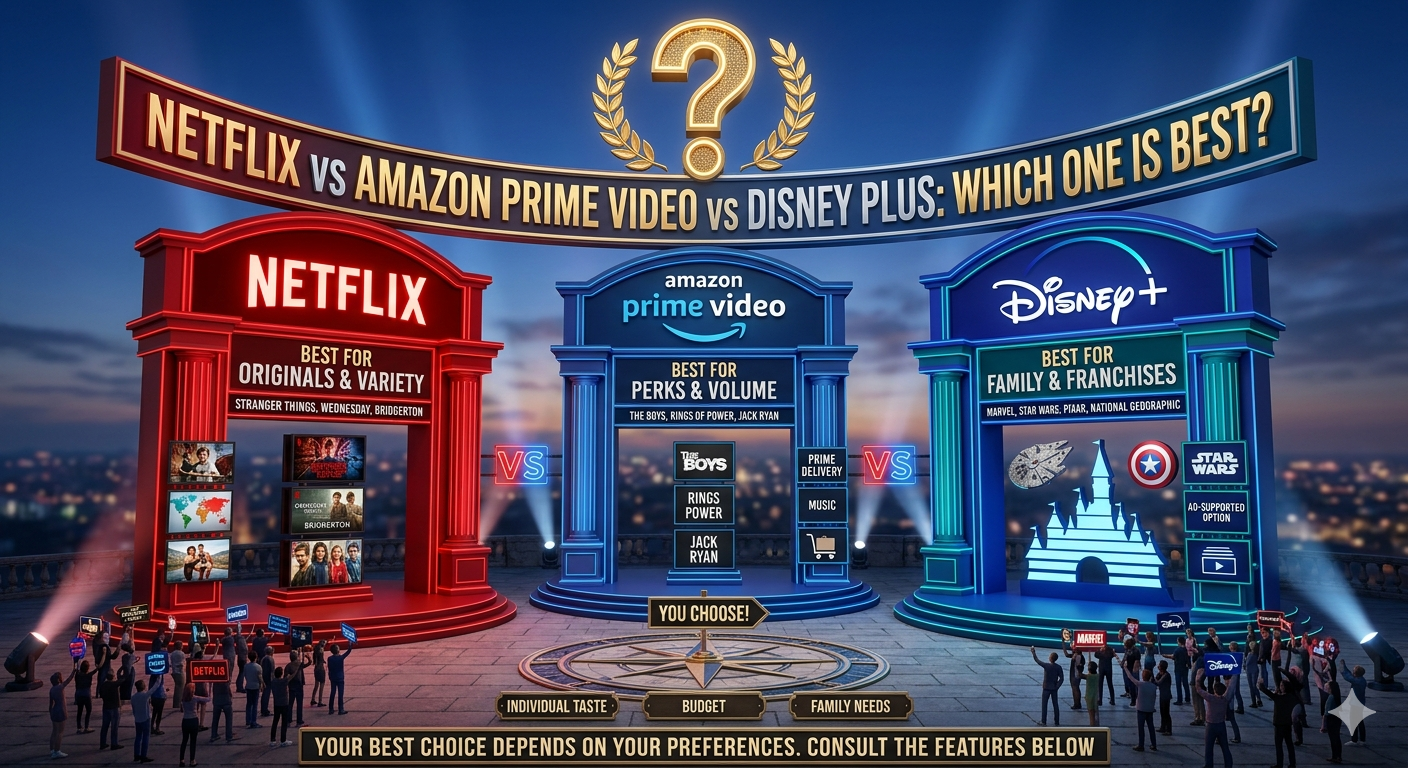
You sit on the couch. Remote in hand. Ready to unwind. Then the dread hits. Which app do you open? Netflix vs Amazon Prime Video vs Disney Plus? They all demand your monthly fee. They all promise endless entertainment. Yet they could not be more different. Choosing the wrong one feels like ordering a gourmet meal and getting fast food. It satisfies briefly. It leaves you wanting. This guide cuts through the marketing noise. We compare the three giants head-to-head. No fluff. No fanboy bias. Just honest answers about where your money goes furthest.
The Streaming Wars in 2026
Why Choosing Matters More Than Ever
Streaming stopped being cheap years ago. Remember when Netflix cost eight dollars? Those days died with dial-up. Now subscriptions pile up like unwatched shows in your queue. Netflix pushes premium tiers past twenty dollars. Disney Plus raised prices after promising they would not. Amazon bundles video with shipping you may not even need.
The average household juggles four streaming services. That is over sixty dollars monthly. For content you mostly scroll past. Picking the right primary service saves real money. It also saves you from decision fatigue. More options do not equal more happiness. They equal more stress.
The Hidden Cost of Subscription Overload
Each platform teases exclusive hits. You subscribe for one show. You forget to cancel. The charge hits again next month. This is the subscription trap. It is designed to catch you.
Rotating services monthly makes sense intellectually. Few people actually do it. We are creatures of habit. We like our queues waiting. We trust our recommendations. So we pay for three services and watch one. That is burning cash. Understanding which platform truly fits your lifestyle prevents this waste.
Content Libraries: Who Has What You Actually Watch
Netflix Originals and Global Catalog
Netflix spends billions on content. The result? A massive library that spans every genre imaginable. True crime documentaries. Korean thrillers. Reality dating shows. Stand-up specials. They fund it all. Their strategy is volume. Throw everything at the wall. See what sticks.
This creates a unique problem. Finding good content requires work. The algorithm helps. But the sheer size overwhelms. You spend twenty minutes browsing. You watch nothing. Netflix excels at global content though. No platform matches their international selection. If you love foreign films or subtitled series, they dominate.
Amazon Prime Video’s Diverse Mix
Prime Video feels like a digital flea market. Hidden treasures sit next to absolute junk. They license older movies aggressively. Their original series range from masterpieces to disasters. The Boys proves they can do edgy superhero content better than anyone. Rings of Power showed they can spend a billion and still divide audiences.
What sets Amazon apart is variety. They carry content Netflix ignores. Classic films. Niche documentaries. British crime dramas. Plus they rent new releases. If you want that movie that just left theaters, Amazon probably has it. For a fee of course.
Disney Plus and the Franchise Empire
Disney Plus plays a different game. They do not try to be everything. They own specific lanes. Superheroes. Space operas. Animated classics. National Geographic. Their library is smaller. It is also more focused. You know exactly what you are getting.
The Marvel and Star Wars catalogs alone justify subscriptions for millions. Add Pixar. Add Disney Animation. Add The Simpsons. You have decades of beloved content. But if you hate capes and cartoons? Disney Plus offers little. It is a specialty store in a mall of department stores.
Quantity vs Quality Debate
Netflix wins on quantity. Disney wins on curation. Amazon sits awkwardly between both. Your preference depends on mood. Do you want endless scrolling or guaranteed satisfaction? There is no wrong answer. Only your answer.
Pricing and Value for Money
Netflix Tiers Explained
Netflix offers multiple tiers. The standard plan with ads costs less. It interrupts your shows. The standard plan without ads costs more. Premium adds 4K and extra screens. Prices keep climbing. They justify it by cracking down on password sharing.
Is it worth it? If you share with family, maybe. If you watch alone in 1080p, probably not. Netflix charges premium prices for a premium experience. But that experience now includes ads on entry-level plans. Something feels backwards about that.
Amazon’s Bundle Strategy
Amazon bundles video with Prime membership. You get free shipping. You get music. You get video. The annual fee seems reasonable. Until you realize you are paying for services you never use.
Prime Video alone is not worth the full Prime price. But if you order packages weekly? The video becomes a bonus. A very good bonus. Amazon also sells channel add-ons. HBO. Showtime. Starz. These pile costs quickly. The base service stays affordable. The extras seduce you into spending more.
Disney Plus Pricing Evolution
Disney Plus launched cheap. They promised forever-affordable magic. Then reality struck. Prices doubled. They introduced ad-supported tiers. They bundled with Hulu and ESPN Plus. The standalone service still exists. It costs more than early adopters paid.
The bundle makes sense for many. Hulu adds mature content. ESPN Plus covers sports. Together they compete with Netflix’s breadth. Alone Disney Plus feels limited. Factor bundle costs into your decision.
The Real Cost Per View
Calculate this honestly. Divide your monthly fee by hours watched. Netflix at twenty-two dollars watched ten hours costs two dollars twenty per hour. Prime at fifteen dollars watched thirty hours costs fifty cents per hour. Disney at fourteen dollars watched five hours costs two dollars eighty per hour. The math reveals truth. We often pay more for less actual viewing.
User Experience and Interface
Netflix’s Algorithm Magic
Netflix knows you. Creepy well. It predicts your next binge before you do. The interface feels smooth. Thumbnails change based on your taste. Categories adapt to your mood. It is the best recommendation engine in streaming.
The downside? It traps you in bubbles. You see variations of what you already watched. Discovery suffers. The autoplay feature annoys everyone. Trailers blast unexpectedly. The mobile app works beautifully though. Downloads are reliable. Playback rarely stutters.
Amazon’s Clunky but Functional Design
Prime Video’s interface frustrates. Content mixes free and paid without clear separation. You click a movie. It wants rental money. You browse originals. Ads for other channels appear. The layout confuses.
Yet it functions. Search works. Playback works. The X-Ray feature rocks. It shows actors in scenes in real-time. It identifies songs. It adds trivia. No other platform offers this. Amazon prioritizes utility over beauty. Some users prefer that.
Disney Plus Simplicity
Disney Plus looks clean. Rows of branded tiles. Marvel. Star Wars. Pixar. National Geographic. Navigation is idiot-proof. Kids find their shows instantly. Adults reach their franchises quickly.
The simplicity limits discovery though. You will not stumble upon hidden gems. The algorithm is basic. It suggests more of the same franchise. The interface serves fans. It does not expand horizons.
Streaming Quality and Technical Performance
4K HDR and Audio Standards
Netflix charges extra for 4K. That stings. But their 4K quality is excellent. Dolby Vision and Dolby Atmos support impresses. Audio quality matches video. You need premium tier though. Budget users get compressed 1080p.
Amazon includes 4K in base Prime. No extra fee. This is huge. Their HDR implementation varies by title. Some look stunning. Some look flat. Audio supports Atmos on select devices. It is inconsistent but improving.
Disney Plus includes 4K at no extra charge. Their Marvel films look spectacular. Star Wars shines in HDR. The IMAX Enhanced feature expands aspect ratios. This is a genuine differentiator. If you own a high-end setup, Disney Plus delivers technical excellence without upselling you.
Device Compatibility
All three work everywhere. Smart TVs. Phones. Tablets. Game consoles. Streaming sticks. Netflix supports the most obscure devices. Amazon plays nice with Fire TV obviously. Disney Plus reaches nearly everything. Unless you own a decade-old box, compatibility should not decide your choice.
Family Features and Parental Controls
Profiles and Restrictions
Netflix profiles are mature. PIN protection locks adult profiles. Kids get dedicated spaces with age filters. Viewing history stays separate. Recommendations remain clean per user. It is family-friendly done right.
Amazon profiles exist but feel tacked on. Parental controls work. They lack Netflix’s polish. Disney Plus nailed this too. Kids profiles show only appropriate content. The interface becomes colorful and simple. Avatar restrictions keep children in safe zones.
Kids’ Content Curation
Disney Plus owns kids content. Full stop. Generations grew up on these films. New generations discover them daily. Netflix produces excellent kids shows too. Bluey lives on Disney Plus though. So does Spidey. For families with young children, Disney Plus often wins by default.
Exclusive Content Worth Paying For
Must-Watch Netflix Exclusives
Stranger Things changed television. Squid Game broke records. The Crown earned prestige. Netflix creates watercooler moments. Their originals generate conversation. They take risks. Some fail. The successes justify the subscription alone.
Documentaries shine here. True crime dominates. International content flourishes. If you want what everyone is talking about, Netflix delivers.
Prime Video Hidden Gems
The Boys redefined superhero media. Reacher proves action still works. Fleabag won hearts. Prime Video takes swings. They miss often. They hit hard when they connect.
Their movie selection surprises. Licensed classics fill gaps. Original films like Air show ambition. Prime Video rewards explorers. You must dig. The gold is there.
Marvel Star Wars and Beyond
Disney Plus built its house on franchises. WandaVision captivated. The Mandalorian defined streaming Star Wars. Loki expanded Marvel creatively. These are not shows. They are events.
Plus the back catalogs. Every Marvel Cinematic Universe film. Every Star Wars movie. Simpsons episodes numbering in hundreds. This is comfort viewing at scale. Nostalgia sells. Disney knows it.
International Availability and Localization
Regional Content Strengths
Netflix dominates globally. They produce local content in dozens of countries. Indian audiences get Bollywood. Korean viewers get K-dramas. Brazilian subscribers get Portuguese series. No platform matches this localization.
Amazon tries. They produce Indian originals. They license European content. It feels scattered. Disney focuses on American exports with local dubs. Their original local content grows slowly.
VPN Restrictions and Travel
Netflix fights VPNs aggressively. Amazon tolerates them somewhat. Disney Plus blocks many. Travelers face frustration. Your home catalog disappears abroad. Download before traveling. It is your only reliable option.
Ads and the New Normal
Ad-Supported Tiers Compared
Netflix introduced ads recently. Four to five minutes per hour. Amazon followed. Their ads feel more frequent. Disney Plus launched ad tiers too. All three now push cheaper ad options.
Netflix’s ad tier limits resolution. You get 720p. That is insulting on modern screens. Amazon includes ads in base Prime now unless you pay more. Disney Plus keeps 1080p with ads. Small mercy.
How Much Ads Disrupt Viewing
Ads kill immersion. You build tension. A commercial cuts it. You laugh at a joke. A product placement interrupts. Ad-supported tiers save money. They cost sanity.
If you watch casually, ads matter less. If you binge seriously, they torture. Consider your viewing style. Ad tolerance varies wildly.
Making Your Final Decision
The Budget-Conscious Choice
Amazon Prime Video wins here. The bundled shipping justifies the cost for shoppers. Video becomes essentially free. Even standalone, the base price undercuts competitors. You get 4K included. You get a massive licensed library. The interface annoys. Your wallet thanks you.
The Family Pick
Disney Plus takes this crown. Kids content is unmatched. Parental controls are excellent. Shared viewing works magically. Adults get Marvel and Star Wars. The bundle with Hulu covers mature tastes too. It is the safest household choice.
The Binge-Watcher’s Winner
Netflix remains king for serial viewers. The algorithm feeds your addiction. Originals drop weekly or seasonally. The library never ends. You pay more. You get more content to actually consume. For heavy users, cost per hour still favors Netflix despite pricing.
Conclusion
No single streaming service rules them all. Netflix offers volume and discovery. Amazon delivers value and variety. Disney Plus provides focus and family magic. Your ideal choice depends on what you watch, who watches with you, and how much you will actually use it.
Do not subscribe to all three blindly. Audit your viewing habits. Test free trials strategically. Rotate services quarterly if needed. The best platform is the one that gets opened. Not the one that sits forgotten on your home screen.
FAQs on Netflix vs Amazon Prime Video vs Disney Plus
Can I share my subscription with family members?
Netflix cracked down on password sharing severely. They charge extra for outside household users. Amazon allows sharing within Amazon Household. Disney Plus permits four simultaneous streams without location restrictions currently. Check each platform’s latest policy before sharing.
Which platform has the best video quality?
Disney Plus and Amazon include 4K HDR in base pricing. Netflix reserves highest quality for premium tiers. For pure technical excellence without extra fees, Disney Plus edges ahead with IMAX Enhanced content.
Is the ad-supported tier worth saving money?
If you watch occasionally, yes. If you binge weekly, the interruptions frustrate. Netflix limits ad tiers to 720p. That alone makes it hard to recommend for quality-focused viewers.
Which service is best for watching with young children?
Disney Plus dominates family viewing. Their kids profile is exceptional. Content is universally appropriate. Parental controls are intuitive. Netflix and Amazon offer kids sections but lack Disney’s curated depth.
Can I cancel and resubscribe easily?
All three allow instant cancellation online. No phone calls needed. Your access continues until the billing period ends. This makes rotation strategies practical. Cancel Netflix. Binge Disney. Switch back later. Your wallet benefits.





No Comment! Be the first one.