


Ethical AI in HR Management: How Fovero Helps Businesses Stay Human-Centric?
In 2018, Amazon quietly dismantled an internal AI hiring tool after engineers discovered it was systematically downgrading résumés from women. The algorithm had been trained on a decade of historical...

In 2018, Amazon quietly dismantled an internal AI hiring tool after engineers discovered it was systematically downgrading résumés from women. The algorithm had been trained on a decade of historical hiring data that reflected a male-dominated industry. The machine learned the bias perfectly. That was seven years ago. The stakes are higher now.
Table Of Content
- The AI Takeover in HR and Why It Demands Scrutiny
- What “Ethical AI” Actually Means in an HR Context?
- 1. Fairness
- 2. Transparency
- 3. Privacy
- 4. Accountability
- 5. Human oversight
- The Five Principles Fovero Is Built On
- 1. Explainability over black boxes
- 2. Proactive bias detection
- 3. Privacy by design
- 4. Human-in-the-loop workflows
- 5. Full audit trails and accountability
- Staying Human-Centric at Scale
- What HR Leaders Should Do Right Now?
- 1. Audit your current stack
- 2. Define your ethics criteria before you buy
- 3. Ask vendors the hard questions
- 4. Bring employees into the conversation
- 5. Treat ethics as ongoing
- Conclusion
Today, AI is no longer a fringe experiment in human resources. It is woven into applicant tracking systems, performance management tools, payroll engines, and employee engagement platforms. Businesses that once relied on gut instinct and spreadsheets now make decisions about people’s careers through software that scores, ranks, and recommends at a scale no human team could match.
The tension this creates is real. Speed and scale are genuinely valuable. But HR decisions on who gets hired, who gets promoted, and who gets let go carry profound consequences for real lives. Ethical AI in HR management isn’t about slowing down. It’s about building systems people can trust. Fovero was designed with that balance at its core.
The AI Takeover in HR and Why It Demands Scrutiny
The modern employee lifecycle is now touched by automation at nearly every stage. AI-powered HR software screens résumés before a human eye ever lands on them. Onboarding platforms assign training paths based on role classification. Performance management tools score employees against benchmarks generated by workforce algorithms. Compensation systems pull from market data models to suggest salary bands. Even offboarding is increasingly automated, with exit survey analysis handled by natural language processing.
The promise is real: faster decisions, reduced administrative burden, and data-driven insights that help HR teams work more strategically. A workforce management software platform that handles routine tasks frees HR professionals to focus on what matters most the people.
But the problem is equally real. HR data is among the most sensitive information a company holds. Health records, salary history, performance evaluations, engagement scores, and even sentiment data pulled from internal communications all of it flows through these systems. And biased inputs produce biased outputs. Always.
The HireVue controversy illustrated this vividly. The video interviewing platform used AI to assess candidates based on facial expressions and speech patterns, an approach that drew sharp criticism from researchers and civil rights groups who argued it encoded subjective, potentially discriminatory signals into an opaque scoring system. Stack-ranking performance systems, used by companies including Microsoft before it abandoned the practice, created toxic internal competition and systematically disadvantaged employees whose work was collaborative rather than individually measurable.
Before any business deploys AI-driven workforce management tools, it needs a framework for evaluating them ethically not just for efficiency.
What “Ethical AI” Actually Means in an HR Context?
Ethical AI is a phrase that gets used loosely. In the context of HR technology solutions, it needs to mean something concrete.
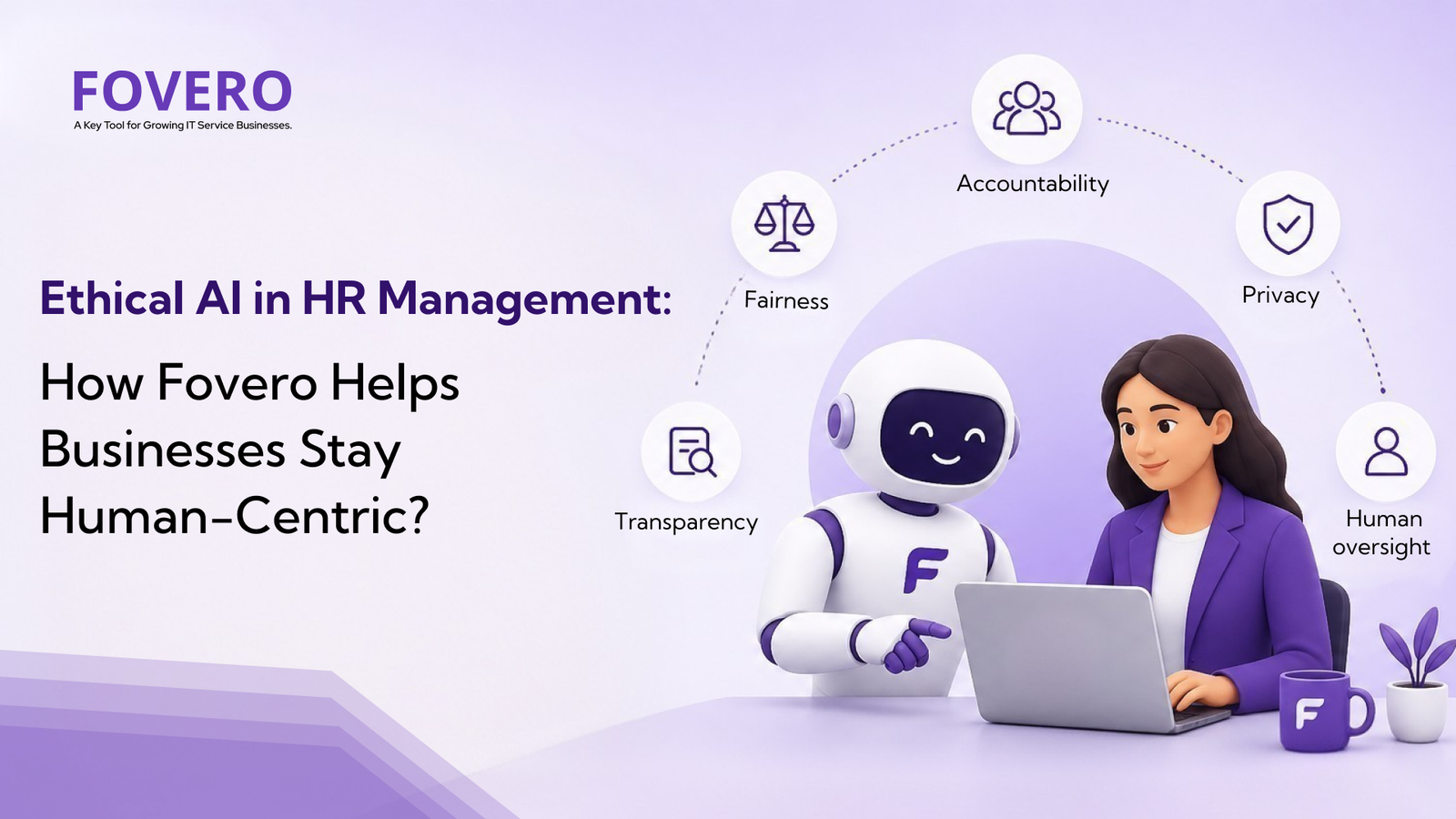
1. Fairness:
means AI models are tested and monitored for discriminatory patterns. A model trained on historical hiring data from a company that historically hired few women in leadership will, absent intervention, perpetuate that pattern. Unbiased hiring doesn’t happen automatically it requires deliberate design and ongoing auditing of the employee management system making or influencing those decisions.
2. Transparency:
means employees know when AI is influencing decisions about them and have some basis for understanding how. A candidate who is rejected by an AI screening tool deserves more than a form email. An employee whose promotion was flagged by a performance algorithm deserves an explanation a human can give. Human-centric HR solutions are built around this principle from the ground up.
3. Privacy:
means treating sensitive employee data with genuine respect not just legal compliance. An employee’s health disclosures, salary negotiations, or private feedback submitted in a pulse survey should be protected with the same seriousness a company applies to financial data. Responsible AI in HR requires data minimization and strict access controls, not data maximalism.
4. Accountability:
asks a hard question: when an AI-assisted decision causes harm, who is responsible? The vendor who built the model? The HR team that deployed it? The manager who acted on its recommendation without scrutiny? The answer has to be humans remain responsible. The algorithm doesn’t absorb liability. Smart HRMS software should be designed to reinforce that accountability, not obscure it.
5. Human oversight:
is the through-line. AI should augment human judgment, not replace it particularly for high-stakes decisions. These aren’t abstract values. Regulators are catching up fast. GDPR constrains how employee data can be processed. The EU AI Act classifies certain HR AI applications as high-risk, imposing strict transparency and testing requirements. EEOC guidance is evolving to address algorithmic discrimination. Ethical AI adoption is no longer optional it is increasingly a legal requirement.
The Five Principles Fovero Is Built On
Fovero HRMS software was built around a set of principles that operationalize ethical AI rather than simply endorsing it as a value.
1. Explainability over black boxes:
Fovero surfaces the reasoning behind its recommendations. When the platform produces a hiring score, flags a performance concern, or generates a compensation benchmark, managers can see why and employees can request that explanation. This eliminates the algorithmic anxiety that corrodes trust when people sense they’re being evaluated by systems they can’t see or question. A modern HR software for businesses should make AI legible, not opaque.
2. Proactive bias detection:
Rather than waiting for a discrimination complaint to reveal a pattern, Fovero audits hiring pipelines, performance review distributions, and pay data continuously. The platform flags statistically anomalous gaps by gender, age, ethnicity, or other protected characteristics before they become legal liability or cultural damage. This is the difference between reactive compliance and proactive equity. AI for workforce productivity only delivers real value when the data it acts on is clean and fair.
3. Privacy by design:
Fovero applies granular access controls: who sees what data, when, and for what purpose is logged. The platform practices data minimization, collecting what’s necessary to do the job, not everything that could theoretically be useful. Employees have self-service access to their own records, with the ability to view, correct, and understand what the system holds about them. In an era when employee experience management is a strategic priority, this level of transparency builds genuine trust.
4. Human-in-the-loop workflows:
In Fovero architecture, AI surfaces recommendations, and humans make decisions. High-stakes actions, performance improvement plans, promotions, and terminations require documented manager sign-off with explicit rationale. Escalation paths are built into the platform for edge cases that need human review. This isn’t just good ethics; it’s sound risk management. The HR automation platform is a tool in human hands, not an autonomous agent.
5. Full audit trails and accountability:
Every AI-influenced decision within Fovero is logged with a timestamp, the actor who acted on it, and the reasoning the system provided. This creates compliance-ready reporting for HR audits, legal review, or regulatory inquiry. Accountability doesn’t disappear into the algorithm. The HRMS Management System is designed so that when something goes wrong and sometimes it will there’s a clear, reviewable record of what happened and why.
Staying Human-Centric at Scale
There is a paradox at the heart of organizational growth. Startups feel human because everyone knows everyone, decisions are made in conversation, and culture is something people live rather than something they read in a handbook. Enterprises feel like systems because they must at a thousand employees, informal relationships can’t carry the load. AI often accelerates that shift from community to machinery.
Fovero design philosophy pushes back against that acceleration. The goal of a business productivity platform in HR should not be to make the organization feel more like a machine. It should be to give managers the information they need to remain genuinely attentive to the people they lead.
In practice, that looks like onboarding workflows that adapt to the individual not just the role. A new sales hire in a remote region has different needs than a new engineer at headquarters, and Fovero onboarding engine reflects that distinction rather than flattening it. It looks like the manager nudges that surface when an individual employee’s engagement signals shift not just aggregate team scores, but a specific person whose pulse survey responses have changed over two consecutive weeks. It looks like qualitative analysis of open-ended survey responses, not just a net promoter score that tells you something is wrong without telling you what.
The philosophy is straightforward: data should help a manager be a better manager, not replace the relationship. Employee management system design that centers this principle produces something measurably different lower attrition, stronger onboarding retention, and a culture that survives the transition from small to large.
What HR Leaders Should Do Right Now?
Ethical AI adoption is not a procurement decision. It’s an ongoing organizational commitment. Here is where to start.
1. Audit your current stack:
Which of your existing tools use AI? Do you actually know how? Are the models explainable? Many HR technology solutions embed AI in ways that aren’t disclosed in sales conversations. Ask directly.
2. Define your ethics criteria before you buy:
What are your fairness metrics? What transparency requirements do you hold vendors to? What are your data handling standards? Having answers to these questions before you evaluate platforms forces vendors to meet a bar rather than set one.
3. Ask vendors the hard questions:
How is your model trained, and on what data? What bias testing have you conducted, and what were the results? Who bears liability when an AI-assisted decision causes harm? A vendor that can’t answer these questions clearly is a vendor whose AI you shouldn’t trust.
4. Bring employees into the conversation:
Disclose which AI tools are in use and what they influence. Create feedback mechanisms so employees can flag concerns. The workforce’s willingness to trust AI-driven workforce management tools depends heavily on whether they feel consulted or surprised.
5. Treat ethics as ongoing:
AI systems drift. Models trained on last year’s data reflect last year’s world. Regulations evolve. What was compliant in 2023 may not be compliant in 2026. Fovero is designed as a platform for iteration not a plug-and-play solution that you deploy and forget.
Conclusion
AI in HR is here to stay. The question is not whether it will influence who gets hired, how performance is measured, or what compensation looks like. It already does, across most organizations operating at scale. The question is whether it serves people or merely processes them.
The businesses that get this right will earn something real: lower attrition among employees who feel fairly treated, a stronger culture that survives growth, regulatory resilience as AI legislation tightens, and the kind of trust that turns an employee management system into a genuine competitive advantage.
Fovero North Star is straightforward. Technology should make HR more human, not less. Every explainability feature, every bias audit, every human-in-the-loop workflow checkpoint exists in service of that goal.
The best HR systems don’t make people feel managed. They make people feel seen.
Ready to see what human-centric HR looks like in practice? Book a demo and explore Fovero ethical AI framework in action.



No Comment! Be the first one.