



Introduction
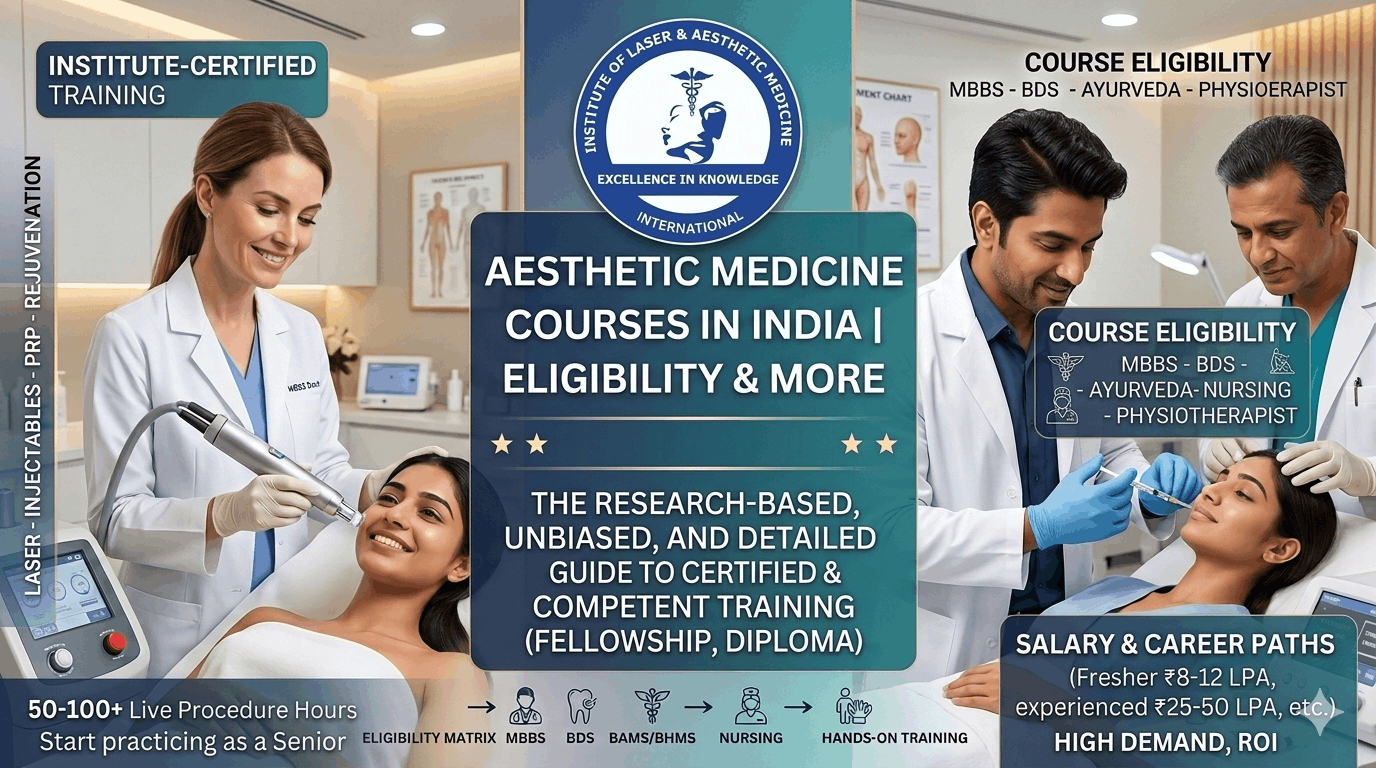
The medical aesthetics business worldwide is expanding at a fast rate. For example, in India, non-surgical cosmetic procedures are gaining more demand than in the last five years. Specifically, procedures like Botox injections, dermal fillers, laser hair removal, and skin rejuvenation are no longer limited to the metropolitan cities- they are also being demanded even in the small towns.
Table Of Content
- Introduction
- What is Aesthetic Medicine?
- Why Aesthetic Medicine? Demand in the Indian Market.
- Best Reasons to study Aesthetic Medicine Courses in India.
- What to do to become an Aesthetic Doctor in India? (Step-by-Step)
- Who is Eligible to Aesthetic Medicine? (Complete Eligibility Table)
- Is it possible to have MBBS Doctors Practice Aesthetic Medicine?
- Is it possible to open an Aesthetic Clinic with an MBBS Doctor?
- Would I Be Able to Inject Botox When I am not a Nurse? (Legal Clarity)
- What is the Salary of an Aesthetic Doctor in India? (Data-Backed)
- Future of Aesthetic medicine in India?
- How to become an Aesthetic Practitioner? (Step-by-Step Checklist)
- Institutes located in India that provide Aesthetic Medicine Courses.
- Frequently Asked Questions (FAQ) – Neutral, Simple Answers.
- Action Plan – Final for Aspiring Aesthetic Medicine Professionals.
- Conclusion
Consequently, this increasing demand has resulted in a subsequent demand of trained and certified and competent professionals in the field of aesthetic medicine. Therefore, whether you are an MBBS doctor, a dentist, an Ayurvedic practitioner, or a nurse, you may be wondering: What are the best Aesthetic Medicine Courses in India? And more to the point, who has the right to enroll in them?
Thus, the article is a research-based, unbiased, and detailed guide to aesthetic medicine training in India. It provides the answer to such common questions, explains the criteria of eligibility, discusses career opportunities, and lists well-known training providers, such as ILAMED (Institute of Laser and Aesthetic Medicine) and the thoughts of practitioners, including Dr. Ajay Rana, as examples, rather than recommendations.
What is Aesthetic Medicine?
Aesthetic medicine is a healthcare branch aimed at enhancing the appearance of a patient by using minimally or non-invasive medical procedures. However, aesthetic medicine is not associated with extensive surgical cuts as in the case of plastic surgery. Common procedures include:
- Injections of botulinum toxin (Botox).
- Dermal fillers (hyaluronic acid, calcium hydroxylapatite)
- Laser hair reduction
- Skin rejuvenation (MNRF, HIFI, PRP therapy)
- Dermabrasion and chemical peels.
- Thread lifts
- Removal of scars and tattoos.
Since these procedures demand use of medical equipment, prescription-only medications, and other possible complications (bruising, infection, vascular occlusion), formal training is necessary. Accordingly, in India, no medical practitioner ought to carry out aesthetic operations without having gone through a recognized certification course.
Why Aesthetic Medicine? Demand in the Indian Market.
A 2023 report by the International Society of Aesthetic Plastic Surgery (ISAPS) suggests that India is one of the top 10 countries to have non-surgical aesthetic procedures. For instance, in the last reported year, doctors performed more than 1.2 million botulinum toxin procedures and almost 800,000 hyaluronic acid filler procedures in India.
The Indian medical aesthetics market holds an estimated value of approximately ₹1.2 billion in 2023 and will likely reach $3.5 billion by 2030, with a compound annual growth rate (CAGR) of 16.5% (Source: Market Research Future, 2024).
The reasons behind this growth are:
- Greater knowledge of aesthetic treatments.
- Rising disposable incomes
- Social media influence
- Access to non-surgical and affordable alternatives.
On the part of medical practitioners, incorporation of aesthetic medicine into practice can go a long way in boosting earning potential. However, this needs guidance from well-known institutes.
Best Reasons to study Aesthetic Medicine Courses in India.
| Reason | Details |
|---|---|
| Good earning potential | Entry-level aesthetic doctors have an earning potential of ₹8-12 LPA; experienced practitioners have an earning potential of ₹25-50 LPA. |
| Work-life balance | The majority are outpatient-based with no night shifts or emergency responsibilities. |
| Increasing patients population | Both men and women aged 25-60 years old are seeking aesthetic treatments. |
| Addition of aesthetics can be offered by dermatologists, gynecologists and general physicians. | |
| International visibility | Indian trained professionals are also sought in the Gulf, UK and the south east of Asia. |
What to do to become an Aesthetic Doctor in India? (Step-by-Step)
| Step | Action | Duration |
|---|---|---|
| 1 | MBBS (or equivalent) | 4-5 years |
| 2 | Get a permanent registration with MCI/NMC or state medical council | 12 months -6 months |
| 3 | Take a certified course of aesthetic medicine (e.g., fellowship or diploma) | 3 months to 1 year |
| 4 | Full practical training on live patients (at least 50-100 procedures) | Varies |
| 5 | Obtain certification and start practicing independently or under a senior | – |
| 6 | Engage in lifelong learning (CME) and postgraduate courses |
Critical point: India does not yet have a separate, independently recognized, and authorized medical doctorate degree in aesthetic medicine or a similar title. Nevertheless, the diploma and fellowship programs of the private institutes are readily acceptable by hospitals and clinics to be employed.
Who is Eligible to Aesthetic Medicine? (Complete Eligibility Table)
This is one of the most commonly addressed questions: Who is a candidate of aesthetic medicine? The following is a factual, objective eligibility matrix as per the present Indian medical laws and policies of the institute.
| Qualification | Is eligible to Aesthetic Medicine Course? | Allowed to Inject Botox/Fillers? | Is able to perform Laser Procedures? |
|---|---|---|---|
| MBBS (registered by MCI/NMC) | Yes | Yes (after certified training) | Yes |
| BDS (Dentist) | Yes (facial aesthetics only) | Yes (below the eyes and lower part of the face) | |
| BAMS / BHMS (Ayurveda/Homeopathy) | Yes | (only non-invasive lasers) | |
| GNM / B.Sc Nursing | Yes | (cannot inject; can assist) | Yes (under supervision) |
| Physiotherapist | Yes (only laser and machines) | No | Yes (non-injectable devices) |
| Non-medical (B.Sc, diploma, beautician) | No | No (except non-medical cosmetology courses) |
Expert opinion (to reference): Dr. Ajay Rana, founder of ILAMED, has claimed in public interviews that MBBS doctors have the broadest scope, dentists can do their perioral aesthetics, and Ayurvedic doctors should consult the state medical council guidelines before injecting Botox. These views align with various training institutions in India.
Is it possible to have MBBS Doctors Practice Aesthetic Medicine?
Yes. MBBS doctors constitute the major practicing aesthetic medicine group in India. After completing an MBBS degree and obtaining registration with the National Medical Commission (NMC), an MBBS doctor can legally:
- Perform injectables (Botox, fillers)
- Operate Class 4 laser devices
- Establish a freestanding aesthetic clinic.
- Prescribe topical anesthetics and medications for pre/post-procedure care
But one very important thing exists about this: The mere fact that you have an MBBS degree does not mean that you can inject Botox. You will have to undergo a recognized, practical training program by an established institute.
Some examples of reputable course types that MBBS doctors can do include:
- Clinical Aesthetics (6 to 12 months) fellowship.
- Aesthetic medicine Diploma (1 year)
- Certified Botox/Filler Training (3-5 days intensive)
Such programs are offered in many institutes in India. A famous case is ILAMED (Institute of Laser & Aesthetic Medicine), which founder Dr. Ajay Rana established and which has trained thousands of doctors. Nevertheless, many other institutes (e.g., AAAM, IADVL workshops, and programs at universities) also provide similar training. Therefore, we recommend that readers research various options.
Is it possible to open an Aesthetic Clinic with an MBBS Doctor?
Yes. An MBBS doctor may legally establish an aesthetic clinic in India, provided that:
- The clinic is incorporated in the Clinical Establishments Act (which applies in most states).
- The physician has undertaken an approved aesthetic medicine program in an approved institution.
- The clinic has adequate informed consent forms, emergency plan and adverse event management plans.
- The physician has medical indemnity insurance on aesthetic surgeries.
Neutral advice: Ideally, before setting up a clinic, have a minimum of 6-12 months of experience working under a senior aesthetic physician. Moreover, begin with leased equipment instead of buying costly lasers. Always have emergency medication (e.g., hyaluronidase in the case of fillers) on-site.
Would I Be Able to Inject Botox When I am not a Nurse? (Legal Clarity)
This is a high intent legal question. The simple answer: No, unless you are a qualified medical doctor (MBBS) or a dentist (BDS) with certified training in injectables.
- Nurses (GNM, B.Sc Nursing) – They cannot independently inject Botox or fillers in India; they can assist a registered doctor.
- Physiotherapists – The law does not allow them to inject.
- Beauticians or cosmetologists – They legally cannot inject any substance into the skin.
Violations may cause:
- Indictment (causing hurt by rash act -IPC Section 337)
- Cancellation of medical/nursing license
- Patient injury civil liability.
Thus, to do injections, you must complete MBBS or BDS first and then undertake a certified course in aesthetic medicine that covers injection training.
What is the Salary of an Aesthetic Doctor in India? (Data-Backed)
According to a survey of the Indian Association of Aesthetic Medicine (IAAM) and placement data of several private institutes (including ILAMED):
| Level of experience | Monthly wages (Clinic/Chain) | Independent Practice Income |
|---|---|---|
| Fresher (0–1 year) | ₹60,000 – ₹90,000 | ₹1.5 – ₹3 lakhs |
| Mid-level (2–4 years) | ₹1.2 – ₹2 lakhs | ₹4 – ₹8 lakhs |
| Senior (5+ years) | ₹2.5 – ₹4 lakhs | ₹10 – ₹25 lakhs |
Laser technicians (non-medical) earn ₹25,000–₹45,000 per month. As a result, aesthetic physicians (MBBS + certification) earn much higher rewards.
Note: These numbers vary according to the city, reputation of the clinic and personal competence. In large cities (Mumbai, Delhi, Bangalore), salaries are higher compared to small towns.
Future of Aesthetic medicine in India?
The future of aesthetic medicine in India seems bright. Key trends include:
- Market Growth – Projected to reach $3.5 billion by 2030 (CAGR 16.5%).
- Technology Integration – AI-assisted face recognition, robotics in hair transplants, and ultrasound-guided filler injections.
- Male Aesthetic Medicine – A 40 percent year-on-year growth is estimated in male aesthetic medicine.
- Regulatory Evolution – The NMC is exploring another super-specialty in the field of aesthetic medicine. This may benefit early trained professionals.
- Medical Tourism – India is turning into a destination for affordable and high-quality aesthetic solutions, attracting patients from Bangladesh, Sri Lanka, Africa and the Middle East.
Practical suggestion: You can now obtain a certified course and be in a better position when formal recognition comes.
How to become an Aesthetic Practitioner? (Step-by-Step Checklist)
- Step 1: Have a valid medical/dental/nursing degree (as per eligibility above).
- Step 2: Select a known institute. Research factors include hands-on hours, faculty credentials, and the acceptance of certification.
- Step 3: Join a full-course education that includes anatomy, pharmacology, patient selection, complication management, and hands-on training.
- Step 4: Accomplish at least 50 supervised procedures (Botox, fillers, lasers).
- Step 5: Obtain certification from your institute.
- Step 6: Become a member of a professional organization (e.g., IAAM or AAM).
- Step 7: Obtain medical malpractice insurance.
- Step 8: Start practicing under mentorship or in a reputed clinic.
Institutes located in India that provide Aesthetic Medicine Courses.
To assist you in your research, the following are some known names in the field. This is not an advertisement but an informational list.
| Institute Name | Common Courses being offered | Locations |
|---|---|---|
| ILAMED (Institute of Laser & Aesthetic Medicine) | Fellowship in Clinical Aesthetics, Diploma in Aesthetic Medicine, Certified Botox & Filler Training | Delhi, Mumbai, Bangalore, Hyderabad, Pune, Kolkata |
| AAAM (American Academy of Aesthetic Medicine) – India Chapter | Certificate courses in Botox, fillers, lasers | Multiple cities |
| IADVL (Indian Association of Dermatologists, Venereologists & Leprologists) | Workshops and fellowships for dermatologists | National |
| PG Diploma in Aesthetic Medicine (limited seats) | Karnataka, etc. |
One such individual in this field is Dr. Ajay Rana (founder of ILAMED), who has more than 25 years of experience in this field. His institute claims to have trained more than 8,000 doctors representing 15 countries. Therefore, we advise aspirants to check such statements themselves and compare various institutes prior to enrolling.
Frequently Asked Questions (FAQ) – Neutral, Simple Answers.
1. What can we do to be aesthetic doctors in India?
Complete MBBS, register with MCI/NMC, complete a certified aesthetic medicine course, gain practical training, and then start practicing.
2. Do MBBS doctors practice aesthetic medicine?
Yes. MBBS doctors are legally permitted to practice aesthetic medicine once they complete a certified course in Botox, fillers and lasers.
3. Who is entitled to aesthetic medicine?
MBBS, BDS, BAMS, BHMS, and nursing graduates (with limitations on injections). Injectable training does not apply to non-medical professionals.
4. What should one do to become an aesthetic practitioner?
Finish a recognized training program, conduct supervised operations, obtain certification, and earn CME credits.
5. Can I inject Botox if I am not a nurse?
No. Only MBBS and BDS doctors with certified Botox injection training can perform Botox injections in India. Nurses can assist but cannot inject independently.
6. What is the salary of an aesthetic doctor in India?
Freshers earn ₹60,000–₹90,000 per month. Experienced doctors earn ₹2–4 lakhs per month or ₹10–25 lakhs per month in independent practice.
7. What does the future hold for aesthetic medicine?
The market is growing at a 16% CAGR. Demand is increasing due to new technologies and male aesthetics.
8. Can an MBBS doctor establish an aesthetic clinic?
Yes. The law allows an MBBS doctor to establish an aesthetic clinic.
Action Plan – Final for Aspiring Aesthetic Medicine Professionals.
If you are thinking of a career in aesthetic medicine, follow this neutral step-by-step action plan:
- Self-verify – Check your eligibility (MBBS/BDS/BAMS/BHMS/Nursing).
- Research programs – Compare several institutes based on parameters such as hands-on hours, faculty experience, certification validity, and cost.
- Shortlist 3-4 institutes – Include names such as ILAMED, AAAM India, IADVL workshops, and any other program in your state affiliated with a university.
- Complete counseling/information sessions – Talk to alumni where possible.
- Complete training – Spend 3-12 months undergoing intensive training.
- Start practicing – Fill an independent practice after gaining experience or join a chain clinic (e.g., VLCC, Kaya).
Conclusion
Aesthetic medicine is a valid and emerging medical specialty in India. It offers healthcare professionals the chance to enhance their clinical acumen, improve patient outcomes, and develop a fulfilling career. However, success in this area depends entirely on the quality and legitimacy of your training.
The ideal Aesthetic Medicine Courses in India are those that prioritize patient safety, offer comprehensive practical training, are delivered by a team of highly experienced professors, and award certification that employers recognize. Whichever provider you choose – ILAMED, AAAM, IADVL, or any other – ensure they have proper credentials and offer live patient training hours (not only weekend sessions that lack depth).
Finally, this guide has provided answers to all significant questions regarding eligibility, remuneration, scope of work, and future opportunities. You can use it as a solid yardstick to make an informed judgment about your aesthetic medicine education.



No Comment! Be the first one.