


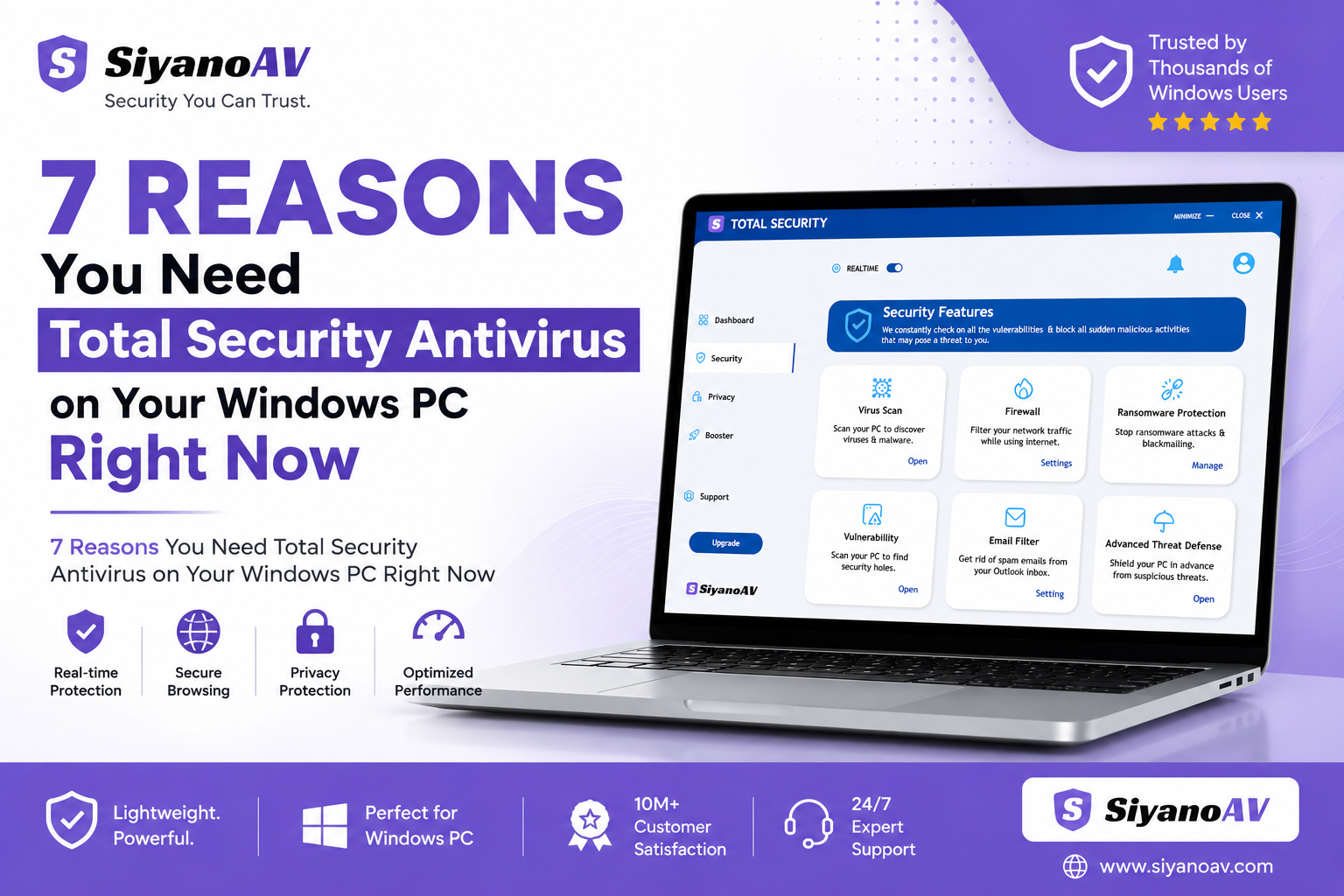
7 Reasons You Need Total Security Antivirus on Your Windows PC Right Now
Introduction If you use a Windows PC every day, there’s a good chance you’ve already ignored at least one suspicious pop-up this week. Maybe it was a fake update warning. Maybe some random file...

Introduction
If you use a Windows PC every day, there’s a good chance you’ve already ignored at least one suspicious pop-up this week.
Table Of Content
- 1. Windows PCs Are Still the Biggest Target
- 2. Real-Time Protection Actually Matters Now
- 3. Public Wi-Fi Is Way More Dangerous Than People Think
- 4. Fake Websites Are Getting Scarily Convincing
- 5. Your Personal Data Is Worth More Than You Think
- 6. Performance Problems Often Start With Hidden Threats
- 7. Basic Free Protection Has Limits
- Expert Insight
- A Small Suggestion Before You Ignore Security Again
- FAQs
- Is Total Security Antivirus better than free antivirus?
- Can Windows Defender replace Total Antivirus software?
- Does antivirus slow down a PC?
- Is antivirus still necessary in 2026?
- Can antivirus stop phishing websites?
- What’s the biggest threat for Windows users right now?
- How often should I scan my PC?
- Conclusion
Maybe it was a fake update warning. Maybe some random file downloaded itself after clicking a weird link. Happens more often than people admit honestly.
A lot of users still think Windows Defender alone is “good enough.” And look… for very basic use, maybe it is. But the internet changed fast. Scams got smarter. Malware got quieter. Most threats now don’t scream for attention anymore — they sit silently in the background.
That’s exactly why people are moving toward Total Security Antivirus instead of relying on basic protection.
In this article, I’ll break down the actual reasons it matters right now, not the fake marketing promises antivirus brands keep repeating everywhere. Some of those blog posts online seriously make security software sound magical. It’s not magic. It’s just necessary.
1. Windows PCs Are Still the Biggest Target
Here’s the thing.
Windows dominates the desktop market, so hackers naturally focus on it more. That’s just practical for them. If malware works on millions of systems, they’ll keep building for it.
And modern attacks aren’t always dramatic ransomware screens anymore.
Sometimes it’s:
- Password stealing
- Browser hijacking
- Crypto mining in the background
- Fake login pages
- Silent spyware
A proper Total Antivirus setup catches a lot of this before users even notice something’s wrong.
Without active protection, many people only realize they were infected after their PC becomes painfully slow or accounts start getting compromised.
2. Real-Time Protection Actually Matters Now
A few years ago, people used antivirus mostly for manual scans.
That’s outdated thinking now.
Modern threats spread incredibly fast. You click one fake PDF attachment and boom — something installs in seconds. Real-time monitoring is honestly the main reason good security software exists today.
Good Total Security Antivirus tools constantly watch:
- Downloads
- Browser activity
- USB devices
- Running processes
- Suspicious file behavior
And yes, behavior monitoring matters more than signature detection now. That’s where most free tools fall behind.
That’s something generic blogs rarely explain properly.
3. Public Wi-Fi Is Way More Dangerous Than People Think
Coffee shops. Airports. College campuses.
People connect everywhere without thinking twice.
Now let’s be real for a second. Public Wi-Fi is convenient, but it’s also messy. You have no idea who’s monitoring traffic on unsecured networks.
Some advanced Total Antivirus suites include:
- VPN protection
- Network threat alerts
- Unsafe website blocking
Not every user needs enterprise-level protection. But basic network security? Yeah, that’s becoming essential.
Especially if you do banking or save passwords in browsers.
4. Fake Websites Are Getting Scarily Convincing
Honestly, this one worries me the most.
Phishing sites used to look obviously fake. Bad grammar. Weird colors. Broken layouts.
Not anymore.
Now some scam websites look cleaner than legitimate businesses. AI-generated phishing pages are becoming ridiculously convincing, and beginners fall for them constantly.
A reliable Total Security Antivirus solution can block malicious websites before they fully load. That tiny warning screen can literally save your accounts.
And trust me, recovering hacked email access is a headache nobody enjoys.
5. Your Personal Data Is Worth More Than You Think
A lot of people say:
“I don’t have anything important on my computer.”
That’s usually false.
Your browser probably stores:
- Saved passwords
- Email access
- Banking sessions
- Personal photos
- Documents
- Payment details
That information has value. Even small data leaks create huge problems later.
Good Total Antivirus software helps reduce the chances of silent data theft running in the background for weeks without detection.
People underestimate quiet malware way too much.
6. Performance Problems Often Start With Hidden Threats
Not every slow PC is “old.”
Sometimes malware eats system resources constantly while pretending to be normal background activity.
I’ve seen systems where users blamed Windows updates for months when the actual problem was hidden crypto-mining malware running silently.
That’s why decent Total Security Antivirus tools include:
- Performance scanning
- Startup monitoring
- Resource usage alerts
It’s not just about viruses anymore. It’s about system stability too.
7. Basic Free Protection Has Limits
This part usually annoys people, but it’s true.
Free antivirus tools are okay for very casual users. But many of them lack layered protection. Some miss phishing defense. Others barely monitor browser threats properly.
Here’s a simple comparison.
| Feature | Basic Free Antivirus | Total Security Antivirus |
|---|---|---|
| Real-time threat monitoring | Limited | Stronger |
| Phishing protection | Basic | Advanced |
| Ransomware defense | Sometimes missing | Usually included |
| VPN or network tools | Rare | Often included |
| Device optimization | Minimal | Better tools |
| Multi-layer security | Limited | More complete |
Not every premium tool is amazing obviously. Some are bloated honestly. But stronger layered protection usually makes a noticeable difference.
Expert Insight
“Most people don’t get hacked because they’re careless. They get hacked because modern threats look normal now. That’s what makes them dangerous.”
That’s something IT technicians say all the time, and honestly… they’re right.
A Small Suggestion Before You Ignore Security Again
Look, nobody wakes up excited to install antivirus software.
But once malware hits your PC, recovery becomes way more stressful than prevention ever was.
If your computer stores work files, personal accounts, payment information, or even years of photos, using a proper Total Antivirus setup is just common sense at this point.
Not paranoia. Just practical.
FAQs
Is Total Security Antivirus better than free antivirus?
Usually yes. Paid security tools often include better phishing, ransomware, and privacy protection.
Can Windows Defender replace Total Antivirus software?
For light usage maybe. But layered security software usually catches more advanced threats.
Does antivirus slow down a PC?
Bad antivirus can. Good modern tools are much lighter than older antivirus programs.
Is antivirus still necessary in 2026?
Absolutely. Cyber threats are evolving faster than most users realize.
Can antivirus stop phishing websites?
Many modern antivirus tools can block suspicious or known malicious websites.
What’s the biggest threat for Windows users right now?
Phishing attacks and credential theft are honestly among the biggest problems today.
How often should I scan my PC?
Weekly scans are usually enough if real-time protection is enabled.
Conclusion
At the end of the day, most people don’t think about cybersecurity until something goes wrong. That’s normal.
But Windows threats are getting quieter, smarter, and honestly harder to notice without proper protection running in the background.
A solid Total Security Antivirus setup won’t make you invincible, and no honest person should promise that. What it does do is reduce risk in a very real way.
And these days, that matters a lot more than people think.
If your PC handles important files, accounts, or daily work, it’s probably worth taking security a bit more seriously now instead of later.
Source: https://open.substack.com/pub/ananyanegi5/p/the-ultimate-guide-to-antivirus-pro?r=8bzb9l&utm_campaign=post-expanded-share&utm_medium=web




No Comment! Be the first one.