


What Happens During a Train Ambulance Journey from Delhi to Chennai?
When a family decides to shift a patient from Delhi to Chennai for advanced treatment, the biggest concern is rarely the destination—it is the journey itself. A transfer of more than 2000 kilometers...

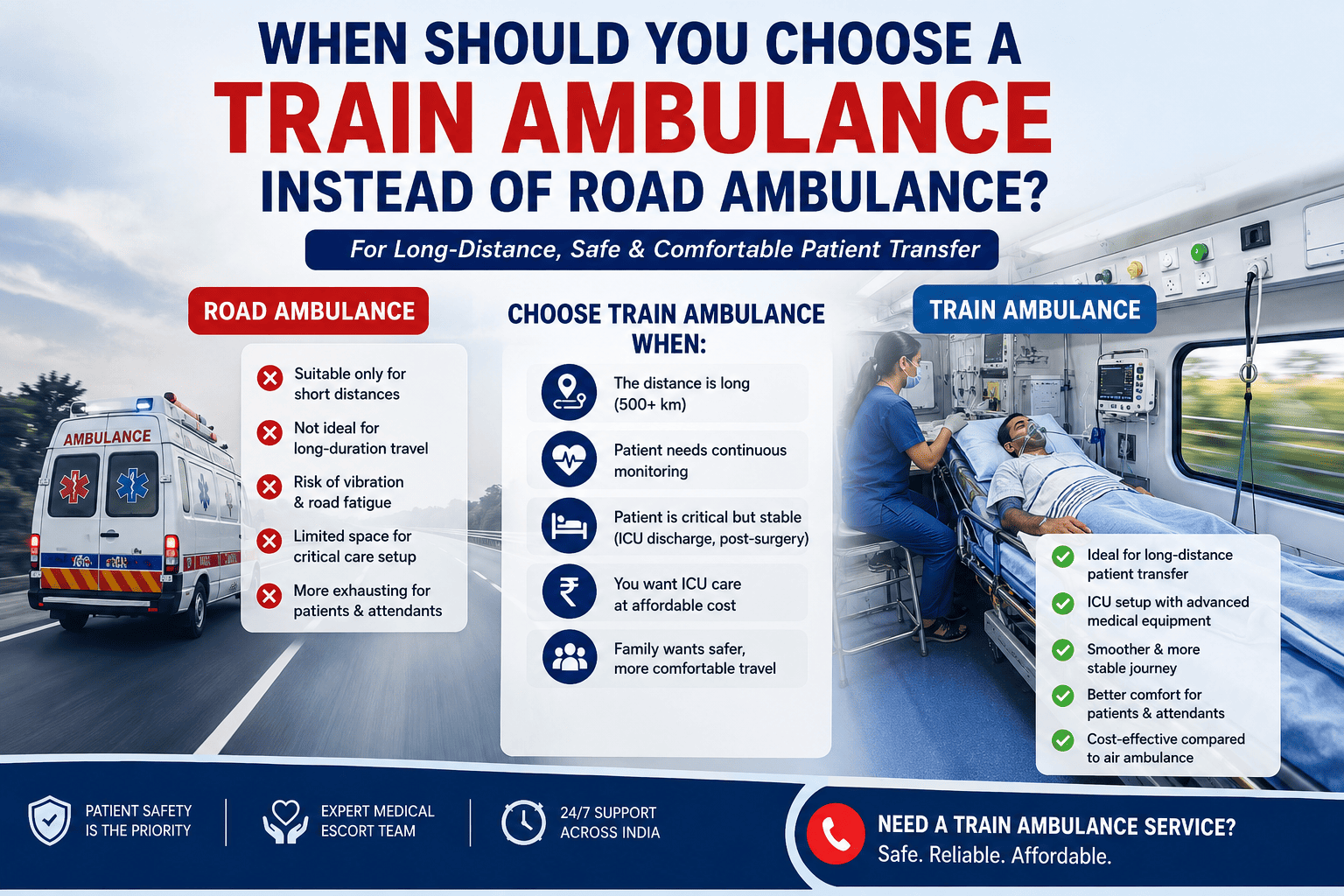
When a family decides to shift a patient from Delhi to Chennai for advanced treatment, the biggest concern is rarely the destination—it is the journey itself.
Table Of Content
- Understanding How a Train Ambulance Works
- What is a Train Ambulance?
- Medical Equipment Available Inside
- Who Travels with the Patient?
- Before the Journey Begins – Medical Preparation
- Medical Evaluation
- Planning the Transfer
- Preparing the Patient Before Departure
- Hospital-to-Station Transfer in Delhi
- What Happens Inside the Train Ambulance During the Journey?
- Medication and ICU Care During Transit
- Comfort and Stability Compared to Road Travel
- How Families Travel Alongside the Patient
- Handling Medical Emergencies During the Journey
- Arrival in Chennai – What Happens Next?
- Safe Deboarding Process
- Transfer to the Hospital
- Handover to the Receiving Medical Team
- Why Many Families Prefer Train Ambulance from Delhi to Chennai
- Who Should Consider a Train Ambulance?
- Common Myths About Train Ambulance
- “Train ambulance is slow.”
- “There is no real ICU setup inside.”
- “Doctors do not travel with patients.”
- “Train ambulance is only for emergency cases.”
- Questions Families Should Ask Before Booking
- Conclusion
A transfer of more than 2000 kilometers can feel emotionally overwhelming, especially when the patient is already weak, recovering from surgery, or dependent on medical support. Families often ask questions like:
- “What if the patient’s condition changes during travel?”
- “Will medical staff remain with the patient throughout the journey?”
- “How is ICU care managed inside a train?”
These fears are common among families relocating patients for:
- Advanced cardiac treatment
- Cancer care and chemotherapy
- Organ transplant consultation
- Neuro and spine procedures
- Rehabilitation after ICU discharge
In such situations, a train ambulance service from Delhi to Chennai becomes more than just transportation. It becomes a medically supervised continuation of patient care designed to keep the patient stable during long-distance travel.
Today, many families choose an ICU train ambulance Delhi to Chennai because it offers a balance of safety, affordability, and continuous monitoring throughout the journey.
Understanding How a Train Ambulance Works
What is a Train Ambulance?
A train ambulance is a specially arranged medical transport system where train berths are converted into an ICU-like setup for patient transfer.
Unlike ordinary travel, the environment inside a train ambulance is medically managed. The patient remains under supervision while traveling long distances comfortably.
This setup combines:
- Long-distance train travel
- ICU-level medical support
- Continuous patient monitoring
For patients who are stable but still require care during transit, train ambulances provide a safer alternative to exhausting highway journeys.
Medical Equipment Available Inside
Most professionally managed train ambulance services include:
- Oxygen cylinders and backup oxygen support
- Cardiac monitors
- Ventilator setup (if required)
- Infusion pumps
- Suction machine
- Emergency medicines
- BP and pulse monitoring devices
The objective is to maintain patient stability throughout the journey without interrupting medical care.
Who Travels with the Patient?
One of the biggest misconceptions families have is that patients travel alone inside the train.
In reality, a train ambulance journey usually includes:
- A doctor (depending on medical condition)
- Trained paramedics
- Medical assistant support if required
- A family attendant accompanying the patient
This provides emotional reassurance not only to the patient but also to the family members traveling alongside.
Before the Journey Begins – Medical Preparation
Medical Evaluation
Before confirming the transfer, the medical team evaluates whether the patient is fit for train travel.
This assessment includes:
- Current medical condition
- Stability of vital signs
- Oxygen dependency
- Risk during long-distance travel
The purpose is not just transportation planning—it is risk management.
Planning the Transfer
Once approved, the coordination process begins.
This includes:
- Selecting the most suitable train route
- Booking appropriate berths
- Arranging ICU setup
- Scheduling ambulance pickup
- Coordinating arrival timing in Chennai
Families often feel more confident when they realize the transfer is professionally planned rather than managed casually.
Preparing the Patient Before Departure
Before the journey starts, the medical team focuses on stabilizing the patient.
Preparation may include:
- Medication planning
- Oxygen setup
- Monitoring blood pressure and pulse
- Preparing emergency medicines
- Ensuring patient comfort before travel
This step is extremely important for cardiac, neuro, and post-surgical patients.
Hospital-to-Station Transfer in Delhi
The journey actually begins before boarding the train.
A ground ambulance transfers the patient safely from:
- Hospital to railway station
or
- Home to railway station
During this phase:
- Medical monitoring continues
- The patient is handled carefully during movement
- Railway coordination is managed professionally
- Boarding assistance is arranged in advance
Families are usually most anxious during transitions, but trained coordination teams help reduce physical stress and unnecessary delays.
What Happens Inside the Train Ambulance During the Journey?
Continuous Monitoring Throughout the Journey
Once the train departs, patient monitoring continues throughout the transfer.
Medical staff regularly check:
- Blood pressure
- Oxygen saturation
- Pulse rate
- Breathing condition
- Overall patient response
This is especially important for:
- Cardiac patients
- Stroke recovery patients
- Oxygen-supported cases
- Post-surgery transfers
The goal is to detect complications early and maintain patient stability during the long journey.
Medication and ICU Care During Transit
Medical treatment does not stop once the patient boards the train.
During the journey:
- Medicines are given on schedule
- Oxygen levels are managed continuously
- Ventilator support is maintained if required
- Fluid intake and output are monitored
- Patient condition is reassessed regularly
Families gain peace of mind knowing the patient remains under active medical supervision rather than passive transport.
Comfort and Stability Compared to Road Travel
One major reason families choose a train ambulance service from Chennai to Delhi is comfort.
Compared to long highway travel, train movement usually causes:
- Less vibration
- Reduced body stress
- Better sleeping conditions
- Lower fatigue levels
For weak or recovering patients, reduced physical strain can significantly improve overall comfort during transit.
How Families Travel Alongside the Patient
Long-distance patient transfer is emotionally difficult, and most families do not want to leave the patient alone.
Train ambulance arrangements often include:
- Berths for attendants
- Easier movement during travel
- Better rest conditions than highways
- Emotional support throughout the journey
This becomes especially valuable during lengthy medical transfers.
Handling Medical Emergencies During the Journey
Many families fear sudden complications during travel.
Professionally managed train ambulance services prepare for this by keeping:
- Emergency medicines onboard
- Backup oxygen support available
- Experienced medical escorts ready
- Coordination systems active at major stations if needed
Train ambulance transfer is medically supervised—not ordinary passenger travel.
Arrival in Chennai – What Happens Next?
Safe Deboarding Process
Once the train reaches Chennai:
- Medical staff carefully assist the patient during deboarding
- Monitoring equipment remains active during transfer
- Patient movement is minimized as much as possible
Transfer to the Hospital
A ground ambulance is usually arranged in advance at the station.
The patient is then transferred directly to:
- Hospital
- Rehabilitation center
- or
- Specialized treatment facility
This ensures continuity of care without unnecessary waiting.
Handover to the Receiving Medical Team
The transfer process concludes with a medical handover.
This includes:
- Sharing patient vitals
- Updating medical history
- Informing doctors about the journey
- Continuing treatment immediately
For families, this smooth transition provides major emotional relief.
Why Many Families Prefer Train Ambulance from Delhi to Chennai
Families increasingly choose train ambulances because they offer:
- Better affordability than air ambulance
- Safer long-distance patient transfer
- ICU-level support during travel
- Reduced physical stress
- More comfort for both patient and attendants
For planned medical relocation, these advantages become highly important.
Who Should Consider a Train Ambulance?
A train ambulance is especially suitable for:
- Cardiac patients
- Cancer patients
- Elderly patients
- Neuro rehabilitation cases
- ICU discharge patients
- Patients requiring monitored long-distance transfer
It is ideal when the patient is stable but still medically dependent.
Common Myths About Train Ambulance
“Train ambulance is slow.”
For many long-distance routes, continuous train travel can actually be more practical and less exhausting than nonstop road movement.
“There is no real ICU setup inside.”
Modern train ambulance services include advanced monitoring systems, oxygen support, and emergency medical equipment.
“Doctors do not travel with patients.”
Depending on the patient’s condition, doctors and paramedics often accompany the patient throughout the journey.
“Train ambulance is only for emergency cases.”
Many patients use train ambulance services for planned treatment transfer and rehabilitation movement.
Questions Families Should Ask Before Booking
Before choosing a provider, families should ask:
- Is ICU setup available inside the train?
- Will medical staff travel with the patient?
- Is oxygen support available throughout the journey?
- How long will the transfer take?
- What happens if the patient’s condition changes during travel?
These questions help families make safer and more informed decisions.
Conclusion
A train ambulance journey from Delhi to Chennai is not simply about moving a patient from one city to another. It is a carefully managed medical transfer process designed to maintain patient stability throughout the journey.
For long-distance treatment relocation, a professionally arranged ICU train ambulance Delhi to Chennai offers:
- Continuous medical care
- Safer long-duration travel
- Better affordability
- Reduced physical strain
- Greater peace of mind for families
When handled properly, the journey itself becomes an extension of patient care—not a disruption to it.



No Comment! Be the first one.