


Vietnam Exports Growth, Top Products & Trade Partners 2025
In recent years, Vietnam has rapidly emerged as one of Asia’s most dynamic and fast-growing economies. With its strategic geographic location, cost-effective labor force, and strong manufacturing...

In recent years, Vietnam has rapidly emerged as one of Asia’s most dynamic and fast-growing economies. With its strategic geographic location, cost-effective labor force, and strong manufacturing capabilities, the country has positioned itself as a global trade powerhouse. The consistent rise in Vietnam exports highlights the nation’s increasing importance in international supply chains and global commerce.
Table Of Content
- Vietnam Exports Overview and Economic Significance
- Top Vietnam Export Products by HS Code
- 1. Electrical Machinery & Equipment (HS Code 85)
- 2. Footwear (HS Code 64)
- 3. Machinery & Mechanical Appliances (HS Code 84)
- 4. Knit Apparel (HS Code 61)
- 5. Non-Knit Apparel (HS Code 62)
- 6. Furniture and Bedding (HS Code 94)
- 7. Fish and Seafood (HS Code 03)
- 8. Wood and Wood Articles (HS Code 44)
- 9. Coffee, Tea, and Spices (HS Code 09)
- 10. Rubber and Articles (HS Code 40)
- Vietnam Exports by Country: Key Trade Partners
- United States
- China
- South Korea
- Japan
- European Union
- Other Markets
- Leading Exporters Driving Vietnam’s Trade Growth
- Historical Growth of Vietnam Exports
- Trade Policies, Tariffs, and Challenges
- Opportunities for Buyers and Suppliers
- For Buyers
- For Suppliers
- Future Outlook for Vietnam Exports
- Conclusion
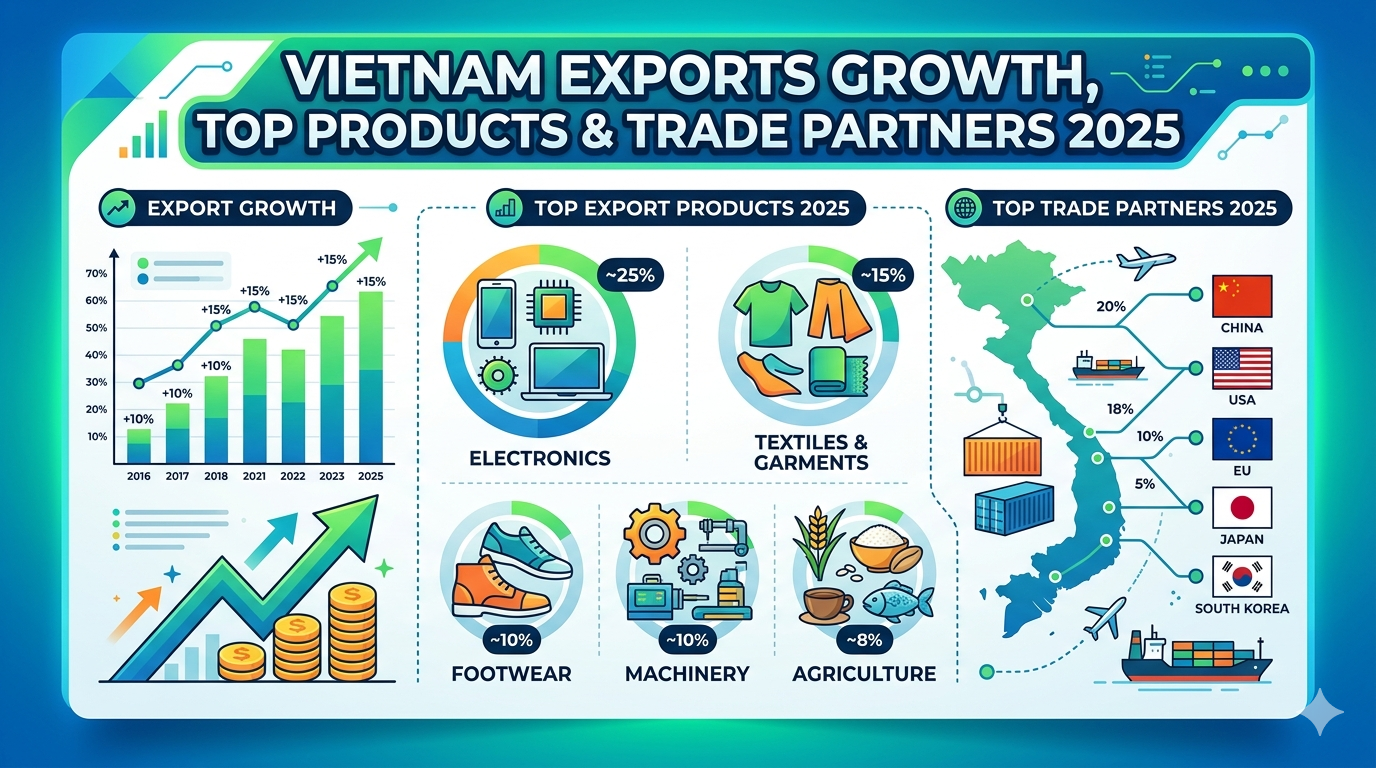
According to the latest Vietnam export data and insights derived from Vietnam customs data, the total value of exports reached approximately $403.2 billion in 2024, reflecting a 6.4% year-over-year increase. This growth trajectory has placed Vietnam among the top exporters globally, ranking as the 21st largest exporter worldwide. As per Vietnam shipment data, exports in the first quarter of 2025 alone reached $102.8 billion, showcasing a remarkable 10.6% increase compared to the same period last year.
This article provides a comprehensive overview of Vietnam exports, including top export products, major trading partners, leading exporters, and future outlook based on Vietnam trade data.
Vietnam Exports Overview and Economic Significance
Vietnam’s export-driven economy has been the backbone of its rapid economic transformation. The country has leveraged free trade agreements, foreign direct investment (FDI), and industrial diversification to strengthen its global trade position. Today, manufacturing and processing industries account for nearly 88% of total exports, emphasizing the country’s industrial strength.
The steady rise in Vietnam exports by country reflects strong international demand, particularly from major markets such as the United States, China, and the European Union. Additionally, Vietnam’s participation in trade agreements like CPTPP, EVFTA, and RCEP has enhanced its export competitiveness by reducing tariffs and expanding market access.
Top Vietnam Export Products by HS Code
Vietnam is known for its diverse portfolio of export goods, ranging from high-tech electronics to agricultural commodities. Based on Vietnam exports products analysis, the following sectors dominate the export landscape:
1. Electrical Machinery & Equipment (HS Code 85)
This category leads Vietnam exports, with a value of $121.7 billion, accounting for nearly 29.5% of total exports. The presence of global giants like Samsung and Intel has significantly boosted this sector.
2. Footwear (HS Code 64)
Vietnam is a global leader in footwear exports, with shipments valued at $25.4 billion. The country serves as a major manufacturing hub for international brands.
3. Machinery & Mechanical Appliances (HS Code 84)
Exports in this category reached $23.5 billion, highlighting Vietnam’s growing capabilities in industrial manufacturing.
4. Knit Apparel (HS Code 61)
Textiles remain a core export industry, with knitwear exports totaling $21.2 billion.
5. Non-Knit Apparel (HS Code 62)
Non-knit garments contributed $19.7 billion, reinforcing Vietnam’s status as a global textile powerhouse.
6. Furniture and Bedding (HS Code 94)
Vietnam has become a key supplier of furniture globally, exporting products worth $14.2 billion.
7. Fish and Seafood (HS Code 03)
Seafood exports reached $9.8 billion, driven by strong demand for shrimp and fish products.
8. Wood and Wood Articles (HS Code 44)
Exports of wood products stood at $6.5 billion, supported by robust manufacturing capabilities.
9. Coffee, Tea, and Spices (HS Code 09)
Vietnam is a leading exporter of coffee and spices, with exports valued at $5.6 billion.
10. Rubber and Articles (HS Code 40)
This category contributed $4.3 billion to total exports.
These figures underline the diversity and strength of Vietnam exports products, which range from high-value electronics to traditional agricultural goods.
Vietnam Exports by Country: Key Trade Partners
The growth of Vietnam exports by country demonstrates the country’s strong trade relationships across the globe. Here are the top export destinations:
United States
The U.S. is the largest importer of Vietnam exports, with trade valued at $113.9 billion. Key products include electronics, textiles, and footwear.
China
China ranks second, importing goods worth $60.7 billion. Major exports include machinery, agricultural products, and electronics.
South Korea
Exports to South Korea reached $28.2 billion, driven by electronics and industrial goods.
Japan
Japan imports goods worth $26.8 billion from Vietnam, including seafood and automotive components.
European Union
Countries like Germany, the Netherlands, and the UK are significant markets for textiles, furniture, and machinery.
Other Markets
Hong Kong, Thailand, and India also play vital roles in supporting Vietnam exports by country, contributing to overall trade diversification.
Leading Exporters Driving Vietnam’s Trade Growth
Vietnam’s export success is largely fueled by a mix of multinational corporations and domestic enterprises. According to Vietnam trade data, the top exporters include:
- Samsung Vietnam – The largest exporter, contributing over $65 billion in electronics exports
- Intel Products Vietnam – Major semiconductor exporter
- LG Group Vietnam – Specializing in display panels and electronics
- Foxconn Vietnam – Key player in electronics assembly
- Vinamilk – Leading exporter in dairy products
- Intimex Group – Prominent coffee exporter
These companies play a critical role in boosting Vietnam exports and strengthening the country’s global trade footprint.
Historical Growth of Vietnam Exports
Over the past decade, Vietnam exports have shown consistent growth:
- 2014: $150.2 billion
- 2018: $243.7 billion
- 2021: $335.8 billion
- 2024: $403.2 billion
This steady upward trend highlights the country’s resilience and ability to adapt to global market changes. The rise in Vietnam shipment data further indicates increasing trade volumes and improved logistics infrastructure.
Trade Policies, Tariffs, and Challenges
Despite strong growth, Vietnam exports face several challenges, particularly related to tariffs and global trade tensions. U.S. tariffs on steel and aluminum, along with potential reciprocal tariffs, could impact export costs.
Additionally, environmental regulations such as the EU’s deforestation rules and Carbon Border Adjustment Mechanism (CBAM) may affect certain export sectors like wood and metals.
However, Vietnam continues to mitigate these risks through trade diversification, improved compliance, and strategic use of free trade agreements.
Opportunities for Buyers and Suppliers
For Buyers
- Secure long-term contracts to manage price fluctuations
- Leverage FTA benefits for cost savings
- Monitor Vietnam customs data for sourcing trends
For Suppliers
- Expand into emerging markets beyond the U.S.
- Improve product quality and compliance standards
- Focus on value-added manufacturing
The insights derived from Vietnam trade data and Vietnam shipment data can help businesses make informed decisions and optimize their supply chains.
Future Outlook for Vietnam Exports
The future of Vietnam exports looks promising, with projections suggesting total exports could surpass $450 billion in 2025. Continued foreign investment, technological advancements, and trade agreements will further strengthen the country’s position.
Vietnam’s role in global supply chain diversification, especially amid U.S.-China trade tensions, provides significant growth opportunities. However, maintaining competitiveness will require ongoing innovation, sustainability efforts, and market diversification.
Conclusion
Vietnam has firmly established itself as a global export leader, driven by strong industrial growth, diversified product offerings, and strategic trade partnerships. From electronics and textiles to agriculture and furniture, Vietnam exports continue to expand across international markets.
The analysis of Vietnam exports by country, combined with insights from Vietnam export data, highlights the country’s growing influence in global trade. As Vietnam continues to evolve and adapt to changing market dynamics, it is well-positioned to achieve even greater success in the years ahead.
For businesses looking to explore new opportunities, understanding Vietnam exports products, market trends, and trade patterns through reliable Vietnam customs data and Vietnam shipment data is essential for staying competitive in the global marketplace.





No Comment! Be the first one.