


The Dermatology Research Behind Tattoo Aftercare: What Skin Healing Studies Actually Reveal About Wound Recovery
Tattoo aftercare advice has traditionally passed through the industry by word of mouth, artist to client, collector to newcomer, studio to social media. Some of that advice is solid. Some of it is...

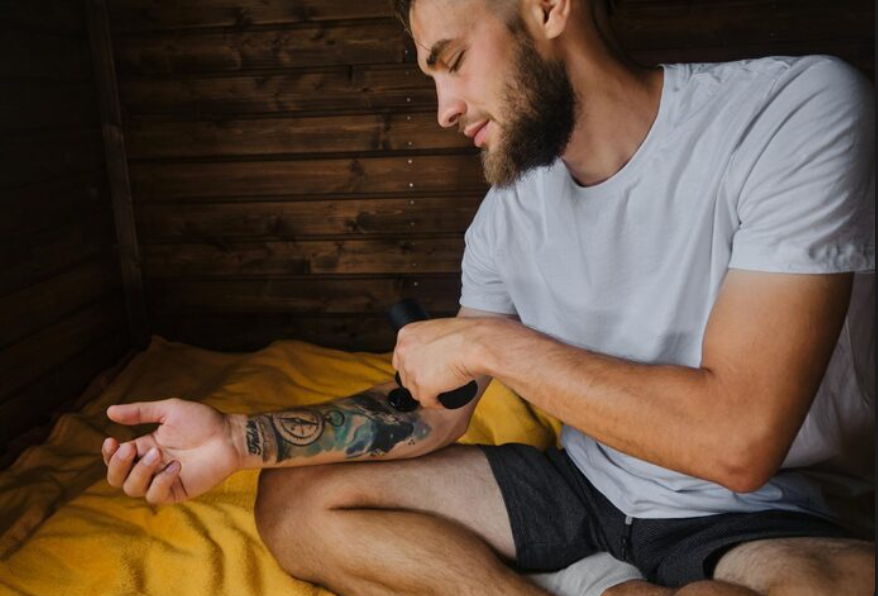
Tattoo aftercare advice has traditionally passed through the industry by word of mouth, artist to client, collector to newcomer, studio to social media. Some of that advice is solid. Some of it is outdated. And increasingly, there’s a body of dermatological and wound healing research that either validates or contradicts the conventional wisdom. Knowing what the science actually says helps put aftercare recommendations on firmer ground.
How Dermatology Classifies a Fresh Tattoo
The starting point for any research-informed discussion of tattoo aftercare is how dermatology classifies a fresh tattoo. In clinical terms, a new tattoo is an open wound, specifically, it shares characteristics with abrasion wounds and partial-thickness wounds in terms of the skin structures affected and the repair mechanisms the body deploys.
This classification is not just academic. It determines which wound healing research is relevant to tattoo aftercare, and it means that the clinical literature on optimal wound healing environments applies directly to what should and shouldn’t go on fresh ink.
What Wound Healing Research Says About Moisture
One of the most consistently replicated findings in wound healing research is the advantage of moist wound healing over dry wound healing. Studies going back to the 1960s, beginning with George Winter’s foundational work on epidermal repair, established that wounds maintained in a moist environment heal faster and with better outcomes than wounds allowed to dry and form heavy crusts.
The mechanism is well understood. Keratinocytes, the cells responsible for rebuilding the skin surface, migrate across the wound more efficiently in a moist environment. In a dry wound, the crust that forms forces these cells to migrate deeper to find viable tissue before they can move laterally across the wound. The result is slower surface closure and more significant scabbing.
For tattoo aftercare, this research directly supports the recommendation to keep a healing tattoo consistently moisturized. The heavy scabbing that develops on unmoisturized tattoos is not a normal or benign part of healing, it’s the result of a suboptimal healing environment, and it has consequences for ink retention when those crusts eventually lift.
Skin Barrier Research & Tattooed Skin
Research specifically examining tattooed skin has found that the tattooing process permanently alters the skin’s barrier function to a measurable degree. Studies using transepidermal water loss measurements, a standard dermatological method for assessing barrier integrity, have found higher water loss rates in tattooed skin compared to adjacent untattooed skin, even after the tattoo has fully healed.
The implication for aftercare is significant. Tattooed skin loses moisture through the surface more readily than untattooed skin, not just during healing but over the long term. This research provides a dermatological basis for the recommendation to moisturize tattooed skin consistently beyond the healing period, the barrier alteration that drives increased moisture loss is permanent, and the skin benefits from ongoing external hydration as a result.
Inky Duck’s aftercare formulation approach aligns with this research directly. Products built on oil and wax bases that provide lasting moisture retention address the increased transepidermal water loss that tattooed skin experiences more effectively than water-based lotions that evaporate quickly.
What Research Reveals About Ingredient Safety on Healing Wounds
Dermatological research on wound healing consistently identifies fragrance compounds as among the most common causes of contact dermatitis on healing or compromised skin. The impaired barrier in a healing wound allows fragrance compounds to penetrate more deeply than they would on intact skin, increasing both the concentration and the likelihood of an inflammatory response.
This research foundation underlies the industry consensus that fragrance-free products are appropriate for healing tattooed skin. It’s not a preference or a marketing position, it’s based on documented patterns of fragrance-induced contact reactions on compromised skin barriers.
Research on petroleum-based occlusives in wound care has similarly shifted. While early wound healing studies used petroleum-based products as a standard moist healing medium, subsequent research found that fully occlusive barriers increase bacterial colonization in wounds compared to semi-occlusive or breathable dressings. The clinical trend in wound care moved toward semi-occlusive dressings, products that maintain moisture while allowing some vapor transmission, which maps to the formulation approach of a good tattoo aftercare balm.
UV Research & Long-Term Ink Preservation
Photobiology research on tattoo ink behavior under UV exposure confirms what artists and collectors observe empirically, UV radiation causes measurable photodegradation of tattoo pigment molecules. The rate of degradation varies by pigment type, with lighter colors degrading faster than dark pigments, but all ink is affected by cumulative UV exposure.
Research on sunscreen efficacy for tattoo protection supports the use of broad-spectrum products with both UVA and UVB coverage. UVA radiation, which penetrates more deeply into the dermis where ink is deposited, causes more significant pigment degradation than UVB despite receiving less attention in general sun protection conversations.
The research consensus supports the two-phase aftercare approach, supporting healing during the active wound phase with appropriate semi-occlusive, fragrance-free moisture, and transitioning to UV protection as the primary ongoing maintenance tool once the surface has healed.
Where Research Gaps Remain
Tattoo-specific clinical research is still a relatively small field compared to general wound healing literature. Most studies have small sample sizes and focus on specific aspects of healing rather than all inclusive aftercare protocols. The direct clinical evidence base for specific product recommendations in tattoo aftercare is thinner than practitioners in the field sometimes imply.
What the research does provide is a solid foundation for the principles that the best aftercare advice is built on, moist healing environments, fragrance-free formulations, semi-occlusive rather than fully occlusive barriers, and long-term UV protection. These principles are well-supported by dermatological and wound healing science even where tattoo-specific studies are limited.







No Comment! Be the first one.