



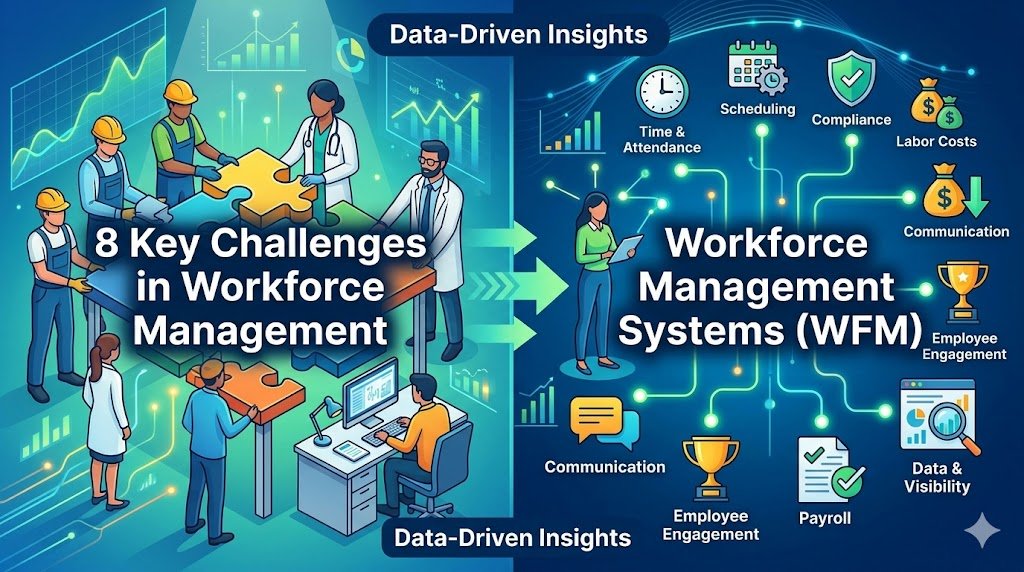
Managing a workforce is no small feat. From tracking attendance to ensuring compliance, businesses of all sizes face daily operational hurdles that slow down growth and drain resources. The good news is that workforce management systems are designed to tackle these challenges head-on, saving time, cutting costs, and keeping teams aligned.
Table Of Content
- 1. Scheduling Conflicts and Gaps
- 2. Inaccurate Time and Attendance Tracking
- 3. High Labor Costs
- 4. Compliance and Labor Law Violations
- 5. How Workforce Management Systems Fix Poor Team Communication
- 6. Low Employee Engagement and High Turnover
- 7. Inefficient Payroll Processing
- 8. Lack of Workforce Data and Visibility
- Final Thoughts
Here are 8 of the biggest challenges that workforce management systems help solve.
1. Scheduling Conflicts and Gaps
One of the most common headaches for managers is building schedules that work for everyone. Workforce management systems automate the entire scheduling process by considering key factors such as:
- Employee availability and preferences
- Required skill sets for each shift
- Labor laws and overtime regulations
- Peak business hours based on historical data
With data-driven insights built into the system, managers can predict busy periods and staff accordingly. The result is conflict-free schedules built in minutes rather than hours.
2. Inaccurate Time and Attendance Tracking
Manual timesheets are prone to errors, buddy punching, and disputes. Workforce management systems track time and attendance in real time using tools such as:
- Digital time clocks
- Mobile check-in apps
- Biometric verification
- GPS-based tracking for field teams
Data-driven insights from attendance patterns also help managers identify recurring issues like chronic lateness or absenteeism before they become bigger problems.
3. High Labor Costs
Overstaffing, excessive overtime, and poor shift planning all contribute to ballooning labor costs. Workforce management systems give managers real-time visibility into labor spend through features like:
- Live labor cost dashboards
- Overtime alerts and warnings
- Shift optimization recommendations
- Budget vs actual spending comparisons
Backed by data-driven insights, businesses can pinpoint exactly where money is being wasted and make smarter decisions that keep labor costs under control.
4. Compliance and Labor Law Violations
Staying compliant with ever-changing labor laws is a full-time job in itself. Non-compliance can result in hefty fines and serious legal trouble. Workforce management systems simplify compliance by automatically managing:
- Mandatory break schedules
- Maximum working hour limits
- Overtime calculation rules
- Region-specific labor regulations
Data-driven insights surface compliance risks before they escalate, alerting managers the moment a potential violation is detected and keeping the business legally protected at all times.
5. How Workforce Management Systems Fix Poor Team Communication
When managers and employees rely on phone calls, sticky notes, or group chats to share information, important updates get lost. Workforce management systems solve this with built-in communication tools that handle:
- Instant shift change notifications
- Leave request approvals
- Team-wide announcements
- Direct messaging between staff and managers
Combined with data-driven insights on team engagement and response rates, managers can refine how and when they communicate to keep everyone on the same page.
6. Low Employee Engagement and High Turnover
Employees who feel overworked or stuck with unfair schedules are more likely to quit. High turnover is costly and disruptive to any business. Workforce management systems boost engagement by offering employees access to:
- Self-service shift swapping
- Easy time-off requests
- Transparent schedule visibility
- Fair workload distribution tracking
Data-driven insights into shift fairness and workload balance help managers spot disengaged employees early, improving satisfaction and reducing turnover significantly.
7. Inefficient Payroll Processing
Running payroll manually across multiple locations or shift types is time-consuming and error-prone. Miscalculations damage employee trust and waste valuable HR hours. Workforce management systems streamline payroll by automatically syncing:
- Total hours worked per employee
- Overtime and double-time calculations
- Approved leave and absence records
- Bonuses and shift differentials
Data-driven insights also flag payroll anomalies and discrepancies before they hit employee paychecks, making the entire process faster, cleaner, and virtually error-free.
8. Lack of Workforce Data and Visibility
Without proper reporting, managers are forced to make decisions based on gut feeling rather than facts. This leads to poor planning and missed opportunities. Workforce management systems provide powerful dashboards that deliver data-driven insights across areas such as:
- Employee productivity and performance
- Absenteeism and tardiness trends
- Overtime usage and patterns
- Team-level workload distribution
With the right data-driven insights at your fingertips, every decision becomes smarter, faster, and more impactful for the entire organization.
Final Thoughts
Whether you run a small business or a large enterprise, the challenges of managing a workforce are real but they do not have to be permanent. Workforce management systems offer a smarter and more reliable way to handle everything from scheduling and compliance to payroll and communication.
With data-driven insights built into every feature, you are not just managing your workforce but continuously improving it. Investing in the right workforce management systems today means fewer headaches tomorrow and a more productive, engaged, and cost-efficient team for years to come.





No Comment! Be the first one.