


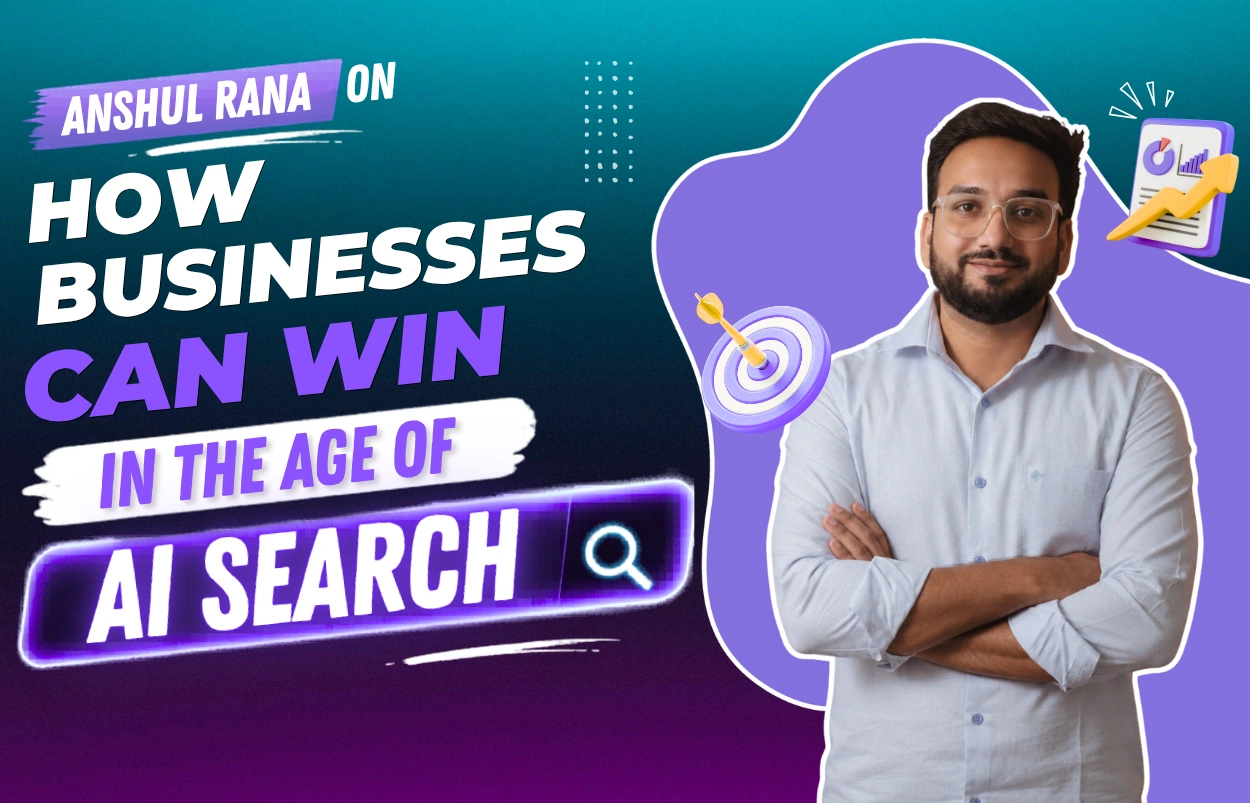
Anshul Rana on How Businesses Can Win in the Age of AI Search
Most of the calls I take from founders in 2026 start the same way. They have read about AI search. They have seen their traffic shift. They want to know what to actually do. The conversation usually...

Most of the calls I take from founders in 2026 start the same way. They have read about AI search. They have seen their traffic shift. They want to know what to actually do. The conversation usually drifts to tactics. I try to pull it back to basics because the businesses winning in AI search are not the ones with the cleverest tactics. They are the ones with the cleanest fundamentals.
Table Of Content
Here is the framing I use with clients, in the order I usually give it.
Start by understanding what you are competing for
For two decades, businesses competed for ten blue links on Google. That competition still exists, but a new one has been layered on top the competition to be the answer inside a Claude, ChatGPT, Perplexity, or Gemini response.
The two competitions overlap, but they are not the same. A page can rank in the top three on Google and not get cited inside an AI answer. A page can earn frequent AI citations without ever cracking the top ten on Google. The signals that drive each are different.
If your team is still measuring success purely on keyword rankings in 2026, you are looking at part of the picture and missing the rest.
Get your technical base right
This is the unglamorous part, and it is non-negotiable.
AI bots ClaudeBot, GPTBot, PerplexityBot, and Google-Extended need access to your content. If your robots.txt is blocking them, you are invisible to that side of the internet. If your pages take eight seconds to load, the crawl budget gets eaten. If your canonicalization is messy, your authority gets diluted across duplicates.
Most of the technical work I do for clients in 2026 is not glamorous. It is checking access, fixing duplication, cleaning up internal linking, and getting structured data right. It is also where the biggest gains come from.
Build entity clarity, not just keyword presence
An AI system that does not understand who your brand is and what it does cannot recommend you. That is the core idea behind entity SEO.
Practical steps include implementing Organization, Person, and LocalBusiness schema where relevant; making sure your “About” content is unambiguous; building a clean Wikidata entry if your brand qualifies; and ensuring your business is described consistently across third-party sources.
When clients ask me to compare this approach to traditional keyword targeting, I usually point them to the practical breakdown on SEO vs AEO vs GEO it explains why entity clarity now sits at the foundation of visibility.
Restructure content for direct answers
Most business content is written to inform a reader scrolling through a page. AI systems do not scroll. They extract.
If a page does not have a clean, direct answer to the question it is implicitly addressing, that page will not be cited. The fix is not to dumb down the content. It is to lead with the answer, then expand into the reasoning, then close with context. This structure suits human readers, too; they get the point faster, and it suits AI extraction by design.
A practical audit of this is what I usually run first. The methodology is on the blog under how to Audit Content for answer engine readiness, and most teams find that 30% to 60% of their existing content can be restructured for AI readiness without rewriting from scratch.How
Earn third-party brand mentions
This is the area most Indian businesses underinvest in.
Brand mentions across Reddit, LinkedIn, G2, Trustpilot, industry publications, and trade media are now correlating roughly three times more strongly with AI citations than backlinks do. This does not mean backlinks stopped mattering they did not. It means mentions are doing heavier work than most marketing teams are budgeting for.
The investment here is in real PR, real community participation, and real reviews. Not paid placements that look generic, not bought reviews that get filtered out, not Reddit accounts that get banned. The signals that AI systems trust are the ones that look like authentic user behaviour, because that is what they are trained on.
Pick the right partner
Most agencies in India repositioned existing services under “AI SEO” labels in 2024 and 2025. Few rebuilt the actual execution. The work below the surface still looks like keyword reports and blog posting calendars.
If you are evaluating partners, the criteria-based list of Indian AI SEO experts for 2026 is a useful frame. It explains the six evaluation criteria that separate real AEO and GEO practitioners from rebranded generalists, and it gives examples of what to ask in a sales call. Whether or not you end up hiring anyone on that list, the questions in it are the right questions.
The honest summary
You will not win AI search by stacking new tactics on broken foundations. You win it by getting the basics right at depth technical hygiene, entity clarity, direct-answer content, real brand presence and then sustaining that work for long enough that compounding kicks in.The businesses that started this work in 2024 are already pulling ahead. The ones that start in 2027 will spend longer catching up than they expect.





No Comment! Be the first one.