


Modular OT & Operating Room Layout — A Comprehensive Guide
Many of the projects within a hospital spend months in identifying what is the ideal surgical equipment, which vendor to choose, and at what cost. Then, almost as an afterthought someone draws a...

Many of the projects within a hospital spend months in identifying what is the ideal surgical equipment, which vendor to choose, and at what cost. Then, almost as an afterthought someone draws a rectangle over some floor plan and tags it the operation theatre.
Table Of Content
That rectangle–the size of that rectangle and what is inside it, where its walls are in relation to important adjacencies elsewhere in the operating room suite–will determine every surgery that gets done inside it for twenty years.
Problems derived from a poorly designed operation theatre layout will not be fixed by expensive equipment. Surgeons bump into trolleys. Nurses walked across contaminated zones to access the sterile supplies. Anaesthesia workstations block emergency access. Doors open the wrong way.
There is a layout issue at the root of every one of these problems — and each one increases infection risk, delays procedures and adds to clinician frustration.
The Core Principles of a Good OT Layout
Zoning: You must design the plan around the four-zone model —protective, clean, sterile and disposal — so that there is no overlap between traffic flows of clean and contaminated.
Dedicated corridors : Clean supply corridors must be physically separated from dirty disposal corridors. It is a prerequisite for infection control and NABH compliance, hence non-negotiable.
Adjacency planning — OT should be directly next to the Central Sterile Supply Department (CSSD), ICU and PACU minimizing the distance sterile instruments and post-op patients travel.
Integration of services: Medical gas outlets, electrical panels, HVAC diffusers, and pendant arms (if equipped) should all be located around the operating table — not as an afterthought but right at the top of the layout.
Emergency access — Each OT set-up will include ready access for a crash cart and other personnel to quickly reach the patient, in several angles as needed
Standard Operation Theatre Dimensions
The best OT is generally bigger, but size matters only up — yes, generally. An excessively large OT results in prolonged cleaning time, increased HVAC load, and higher maintenance costs without any clinical benefit. One that is too small creates a perilous backup.
Minor OT
20 – 25 sq. metres
General Surgery OT
36 – 42 sq. metres
Cardiac / Neuro OT
50 – 60 sq. metres
Orthopaedic OT
42 – 50 sq. metres
Your operating table should be positioned in the centre of the room with a minimum clearance of at least 1.5 metres at all sides for staff and equipment movement.
What is a modular OT and how does modular OT work?
A modular OT is a pre-fabricated, factory-made operation theatre which are constructed with interlocking wall and ceiling panels — usually coated steel, aluminium or composite material — that are built on-site in an existing shell structure.
In contrast to a traditional OT constructed with plastered walls, screed floors and site-applied finishes, a modular OT is delivered as an off-site precision-engineered kit. Every panel joint is sealed. All surfaces are smooth, non-porous and easy to disinfect. The ceiling comprises an integrated system for the HEPA filtered laminar airflow surgical lighting and pendant arms.
The Reason Hospitals Are Opting for Modular OTs
How are our OTs better: 1. Benchtop Material-modular OT panels are non absorbent and join-less ensuring that they remain hygienic through-out the lifetime of the theatre.
Quicker construction: Modular OT can be put together in 4 to 8 weeks versus 4 to 6 months for traditional building. This speed is operationally critical for hospitals either increasing capacity, or through the replacement of ageing OTs.
Integrated systems — Everything from HVAC, surgical lights to pendants and medical gas outlets are preplanned, factory-fitted, reducing coordination errors on-site, with every system working together as a single entity the first day in action.
As NABH and JCI ready: Modular OT is truly ready for accreditation with inbuilt features — right ACH rates, positive pressure within the zone, temperature & humidity control insulated into the design so that retrofitting becomes impossible.
Simple maintenance: Instead of having to replace different panels you can just change the parts that are damaged without building the entire OT from scratch. This results in decreased downtime and maintenance costs over the years.
What should look about Modular OT Layout
Infection Control Providers An IP typically sits at the helm of a complete operation theatre layout which encompasses:
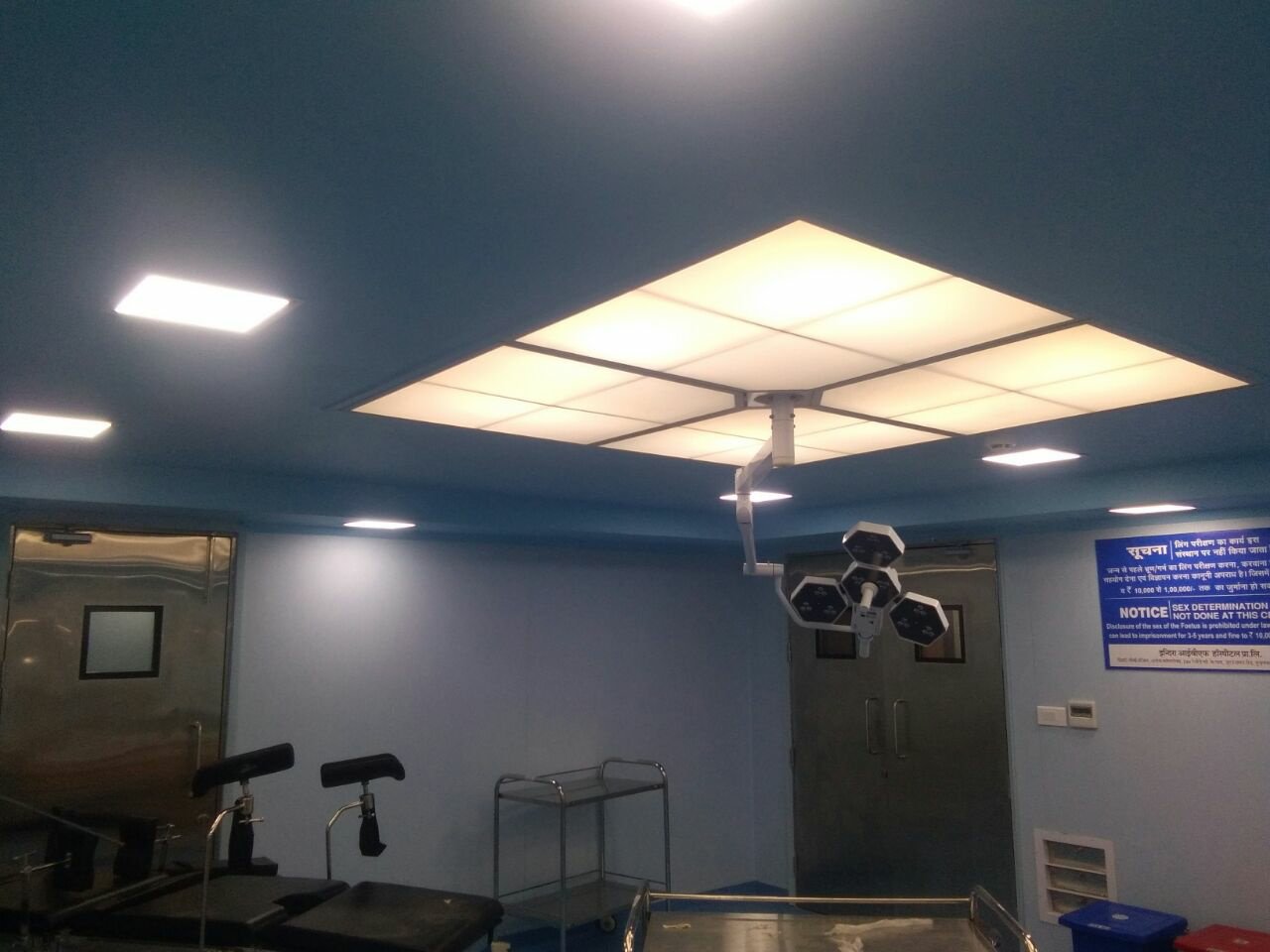
The Operating Room (OR): It is the central sterile environment. Unit with Laminar Air Flow ceiling integrated above the table. The pendant arms are on either side and hold an anaesthesia workstation, monitor, and medical gas outlets. Recessed LED OT lights overhead.
Scrub Area: Just outside the OR entry. Elbow or sensor-operated taps on scrub sinks, so that any staff who have just scrubbed can push straight into the OT without touching anything.
Anaesthesia Room: Small anteroom where patients are anaesthetised prior to entering the OR reducing anaesthetic time inside the sterile field and improving OT turnover.
Equipment Store / Sterile Store: A sterile store is ready to keep sterile consumable, implants and backup instruments in a clean climate-controlled room adjacent to the OR.
Disposal Corridor: An exit route for contaminated waste, soiled linen and used instruments – in its own corridor away from the entry paths of staff and patients.
Mistakes in planning the layout of nursing stations in OT
This occurs even to experienced hospital planners without due diligence:
- Locating the OT poorly from ICU increases risk through post op transfers
- Dirty and clean corridors are shared — the top infection control blunder in OT design
- Crossover of small scrub regions — forming bottlenecks in between cases
- No anaesthesia room — which means the requirement to load anaesthetic within the sterile field – this brings down OT efficiencies.
Such errors are challenging to rectify once the construction has been completed. Avoidable with the right foresight.
Conclusion
A great operation theatre layout is not about beauty — it is about making a place where your clinical teams work at their best together, infection does not just gets prevented to a minimum through dedicated marketing efforts but structured out of the design, and every workflow feels instinctively self-evident. That environment is delivered quicker, with more reliability and to a high standard by a modular OT than traditional construction.
The layout and construction methodology deserves equal attention along with the equipment that goes inside – be it if you are constructing a new hospital, expansion or simply replacing an ageing OT.






No Comment! Be the first one.