


Contract Manufacturing Alcohol India: Cost & Compliance
India is the third-largest spirits market in the world, with annual consumption exceeding 370 million cases. For many brands, owning a distillery is neither practical nor cost-effective. Contract...

India is the third-largest spirits market in the world, with annual consumption exceeding 370 million cases. For many brands, owning a distillery is neither practical nor cost-effective. Contract manufacturing alcohol in India allows brand owners to produce IMFL and potable alcohol through licensed third-party distilleries without building their own plant. This post covers how the model works, what it costs, which licences apply, and what quality controls matter. By the end, you will have a clear picture of what contract alcohol manufacturing in India actually involves.
Table Of Content
- What Is Contract Manufacturing in the Alcohol Industry?
- How the Production Process Works
- Franchise Bottling vs. Contract Manufacturing
- What Raw Materials Are Used
- How Is Alcohol Manufacturing Regulated in India?
- State Excise Licensing Requirements
- FSSAI Compliance for Alcohol Producers
- Central Excise and GST Implications
- What Are the Costs Involved in Contract Alcohol Manufacturing in India?
- How Volume Affects Pricing
- Hidden Costs to Account For
- Comparing Production States on Cost
- What Licences Are Required for Alcohol Contract Manufacturing in India?
- Label Registration Process
- Trademark and IP Considerations
- How Do Brands Ensure Quality in Contract Alcohol Production?
- Key Parameters to Specify in the Agreement
- Sensory and Lab Testing Protocols
What Is Contract Manufacturing in the Alcohol Industry?
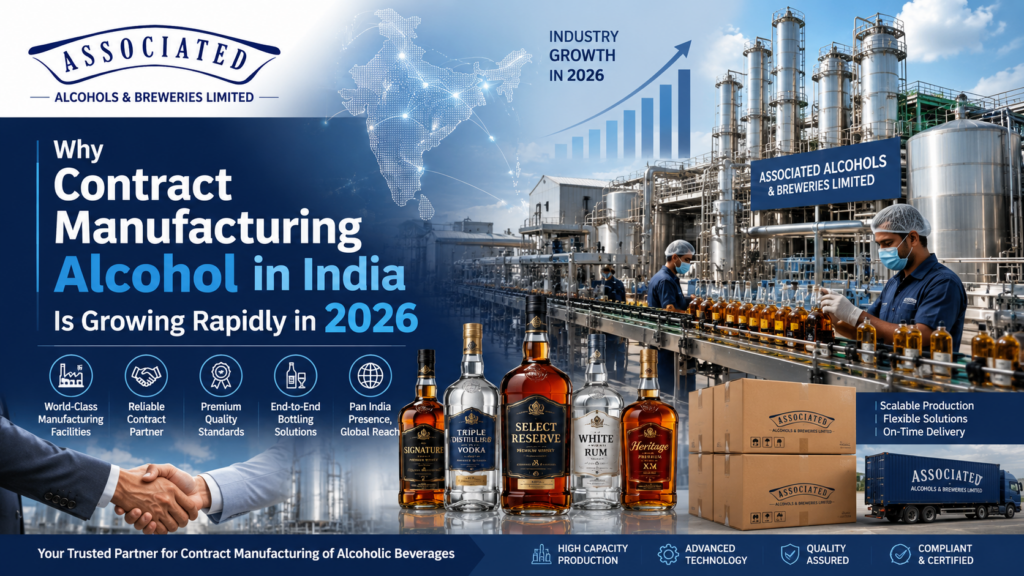
Contract manufacturing in the alcohol industry means a brand owner hires a licensed distillery to produce, blend, and bottle spirits on their behalf. The brand retains ownership of the recipe and label. The manufacturer provides the facility, equipment, raw materials, and production labour under an agreed specification.
This model suits new entrants who cannot invest in plant infrastructure, as well as established brands expanding into new states without setting up fresh production units. It also works for international brands that want local Indian production to reduce import duties and stay competitive on shelf price.
How the Production Process Works
The brand owner provides the product formulation, flavour profile, and packaging specifications. The contract distillery sources Extra Neutral Alcohol (ENA), carries out blending, adds permitted flavourings or matured spirit, and bottles the finished product under the brand’s label. The brand owner typically retains approval rights over each production batch before dispatch.
Franchise Bottling vs. Contract Manufacturing
These two terms are often confused but they differ in one key way. In a franchise or licence agreement, a distillery is authorised to produce an existing brand under a formal franchise arrangement usually with a parent company like a large multinational. In contract manufacturing, the client is typically an independent brand owner commissioning production of their own recipe. The regulatory pathway for both runs through state excise authorities, but franchise arrangements often carry additional trademark and quality audit obligations from the parent brand.
What Raw Materials Are Used
Most IMFL production in India uses ENA derived from sugarcane molasses or grain. Grain-based ENA produced from maize, wheat, or broken rice is preferred for premium whisky and vodka categories because it yields a cleaner, more neutral spirit base. Molasses-based ENA remains common for economy segment products. The contract manufacturer typically sources ENA directly, though some brand owners specify a preferred ENA supplier in the agreement.
How Is Alcohol Manufacturing Regulated in India?
Alcohol manufacturing in India falls under state jurisdiction, not central government control. Each state runs its own excise department, which issues distillery licences, sets production quotas, approves label registrations, and collects excise duty. This means a contract manufacturer licensed in Madhya Pradesh cannot automatically bottle for brands in Maharashtra separate state approvals are needed.
Central oversight exists only at specific points. FSSAI sets food safety standards for potable alcohol, including permissible additives and labelling requirements. The Bureau of Indian Standards (BIS) publishes quality benchmarks for IMFL categories such as whisky, rum, brandy, and vodka.
State Excise Licensing Requirements
A contract manufacturer must hold a valid distillery or bottling licence from the state excise authority. This licence specifies the approved premises, permitted production volumes, and the categories of alcohol that can be produced. Brand owners must separately register their labels with each state excise department where the product will be sold. Label registration typically requires submitting product specifications, packaging artwork, and proof of ownership of the brand trademark.
FSSAI Compliance for Alcohol Producers
Under FSSAI regulations, all alcoholic beverages sold in India must meet standards defined in the Food Safety and Standards (Alcoholic Beverages) Regulations, 2018. These cover permitted ingredients, maximum limits for contaminants like methanol and heavy metals, and mandatory label declarations. Contract manufacturers must maintain FSSAI registration and ensure their production processes pass routine inspections.
Central Excise and GST Implications
Alcohol for human consumption falls outside the ambit of GST in India and remains taxed through state excise duty. However, ENA used as an input for non-potable industrial alcohol does attract GST. This creates a complex dual-taxation environment that contract manufacturers must manage carefully, particularly when the same facility handles both potable and industrial alcohol production.
What Are the Costs Involved in Contract Alcohol Manufacturing in India?
The total cost of contract manufacturing alcohol in India depends on four main factors: the ENA price, conversion charges, packaging material costs, and state excise duty. ENA prices fluctuate based on sugarcane and grain crop cycles and can vary between ₹35 and ₹55 per litre depending on the source state and feedstock type.
Conversion charges the fee the contract distillery charges for blending and bottling typically range from ₹8 to ₹20 per case, depending on production volume, bottle size, and complexity of the formulation. Premium packaging, such as moulded glass bottles or embossed closures, adds further cost. State excise duty is by far the largest cost component and differs widely across states.
How Volume Affects Pricing
Contract manufacturers usually offer tiered pricing. A brand committing to 5,000 cases per month will pay a higher per-case conversion fee than one committing to 50,000 cases. Most contract distilleries set a minimum viable run typically 1,000 to 2,000 cases per production batch to justify the changeover and cleaning time between product runs.
Hidden Costs to Account For
Beyond production, brand owners must budget for label registration fees (which vary by state and can range from a few thousand to several lakh rupees per label per state), freight from the plant to the state warehouse, and breakage or rejection allowances. Some states also require a certain percentage of production to be sold through the CSD (Canteen Stores Department) channel at controlled prices, which affects net realisation.
Comparing Production States on Cost
Madhya Pradesh, Telangana, and Uttar Pradesh are among the more cost-competitive states for contract alcohol manufacturing due to lower excise duty structures and strong ENA availability. States like Maharashtra and Tamil Nadu have higher duty burdens, which push up the landed cost. Brands with national distribution ambitions often work with contract manufacturers in multiple states to manage freight and duty costs efficiently. Detailed information on how leading distilleries structure these arrangements is available on this contract manufacturing overview for the Indian spirits sector.
What Licences Are Required for Alcohol Contract Manufacturing in India?
A contract alcohol manufacturer in India needs at minimum a state distillery or blending and bottling licence, FSSAI registration, and a valid label registration for each brand produced. The brand owner needs a separate manufacturer’s licence or a No Objection Certificate (NOC) from the state excise authority, even if they do not own the production facility.
Some states require the brand owner to hold a “ghost distillery” licence a licence that authorises brand ownership and sales without requiring the holder to own physical production infrastructure. Other states allow production under a sub-contracting arrangement tied directly to the licensed distillery’s own permit.
Label Registration Process
Label registration is state-specific. The brand owner submits the artwork, product formula, and a declaration of compliance with FSSAI standards to the state excise commissioner. Approval timelines range from 30 days in some states to over 90 days in others. Rejections often occur due to claims on the label that violate advertising norms for example, health-related language or comparative claims about competing products.
Trademark and IP Considerations
Before entering a contract manufacturing agreement, the brand owner should have a registered trademark for the brand name and label design. Without registered IP, the contract manufacturer technically has access to all the brand’s formulation and packaging details. Including clear IP assignment and confidentiality clauses in the manufacturing agreement is standard practice and protects both parties.
How Do Brands Ensure Quality in Contract Alcohol Production?
Quality control in contract alcohol production depends on clearly written specifications in the manufacturing agreement, regular on-site audits, and independent laboratory testing of each batch. The agreement should define accepted ranges for key parameters alcohol strength, colour, clarity, methanol content, and sensory profile along with the rejection procedure for non-conforming batches.
Many brand owners appoint a dedicated quality representative at the contract distillery’s plant for large-volume runs. For smaller volumes, third-party laboratory testing before dispatch is standard. Accredited labs under NABL (National Accreditation Board for Testing and Calibration Laboratories) provide credible third-party verification.
Key Parameters to Specify in the Agreement
The manufacturing agreement should cover batch size tolerances, approved raw material suppliers, permitted ENA sources, blending ratios, water quality standards, and bottling line hygiene protocols. Any deviation from approved parameters should trigger a defined escalation process. Vague or incomplete specifications are the most common cause of quality disputes between brand owners and contract manufacturers.
Sensory and Lab Testing Protocols
Sensory evaluation taste, nose, and finish assessment by a trained panel remains important for premium products even when all lab parameters pass. Some brand owners require a retained sample from every batch, stored for a defined period in case of consumer complaints. Maintaining a signed Certificate of Analysis (CoA) for each batch is both a regulatory requirement and a practical quality record.
Conclusion
Contract manufacturing alcohol in India is a well-established model that gives brand owners access to licensed production infrastructure without the capital cost of building a distillery. The key variables state excise compliance, licence structure, ENA sourcing, and conversion costs all require careful planning before entering an agreement. As India’s spirits market grows and more premium and regional brands enter the space, the demand for compliant, scalable contract manufacturing alcohol partnerships will only increase. The real question for brands is not whether to use contract manufacturing, but how to choose the right manufacturing partner for their specific state, category, and volume ambitions.
We strictly comply with all applicable Government of India excise laws, FSSAI regulations, and state licensing requirements for alcohol manufacturing and distribution.



No Comment! Be the first one.