



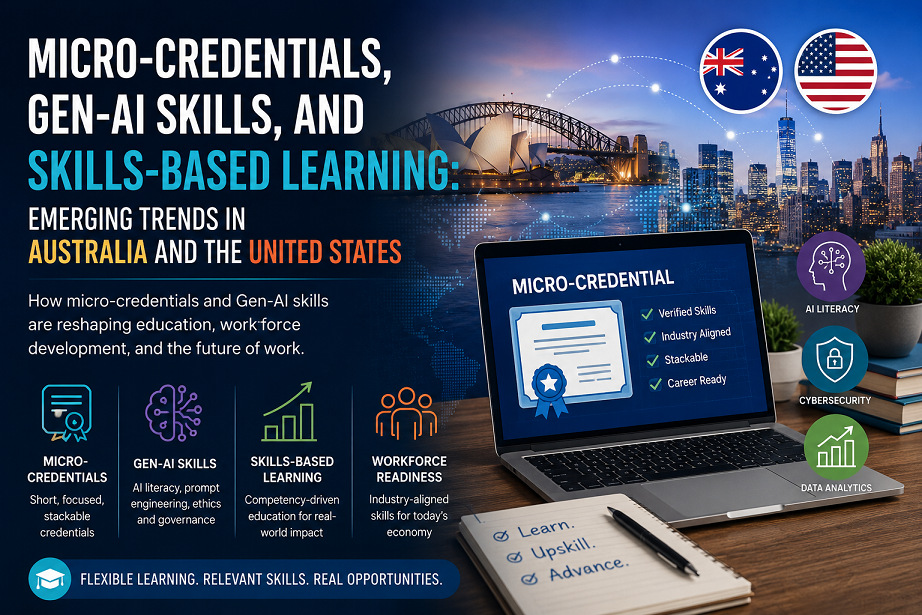
Artificial intelligence has become one of the most powerful forces shaping education and employment. As generative AI tools move from novelty to necessity, learners are looking for faster ways to develop relevant skills. Traditional degree programs still provide valuable foundations, but they often struggle to keep pace with technological change. This gap has created a surge in demand for micro-credentials that focus on practical, job-ready capabilities. Research from Australia and the United States shows that learners increasingly see AI-related skills as essential for future career success.
Table Of Content
The result is a new learning model built around flexibility, specialization, and continuous skill development.
The AI Skills Gap Is Expanding
Employers across industries are investing heavily in AI technologies. Yet many organizations face a shortage of workers who can effectively use these tools. The challenge is not simply technical knowledge. Businesses need professionals who understand how AI fits into workflows, decision-making processes, and organizational strategy.
Generative AI has introduced entirely new skill categories. Prompt design, AI-assisted research, data interpretation, automation management, and ethical AI oversight are now appearing in job descriptions that barely mentioned artificial intelligence a few years ago. According to findings highlighted in the report, students increasingly recognize this shift and are actively seeking learning opportunities that build these capabilities.
This growing skills gap explains why short, focused credentials are gaining momentum. They allow learners to acquire relevant expertise quickly while remaining connected to changing industry requirements.
Why Micro-Credentials Fit the AI Era
The speed of technological innovation creates a challenge for traditional education models. By the time a lengthy curriculum review process is completed, some technologies may already have evolved significantly.
Micro-credentials offer a more responsive alternative. Educational institutions, industry organizations, and technology companies can develop targeted programs that address emerging workforce needs in months rather than years. These credentials focus on specific competencies and measurable outcomes, making them particularly well suited to rapidly changing fields.
A learner interested in artificial intelligence does not necessarily need another four-year degree. They may need a specialized credential in AI ethics, machine learning fundamentals, cybersecurity, or data analytics. Micro-credentials provide a practical pathway to gain those skills without interrupting employment or existing studies.
This flexibility makes them especially attractive to working professionals seeking career advancement or transitions into new roles.
Students Want Career-Aligned Learning
One of the strongest themes emerging from recent research is the growing demand for career-focused education. Students increasingly evaluate learning opportunities based on their ability to improve employment outcomes.
Australian surveys cited in the report reveal that more than 80% of students view generative AI skills as important for workplace success. Interest in alternative credentials, industry certifications, and short online programs has risen sharply as learners seek qualifications that directly support career growth.
Many students now see micro-credentials as a practical complement to traditional degrees. Instead of replacing formal education, these programs enhance it by adding specialized skills that employers actively seek.
Platforms delivering professional certificates in data analytics, project management, cybersecurity, and digital technologies have experienced significant growth because they align closely with labor market demand. Learners want credentials that clearly demonstrate their readiness for real-world challenges. For students exploring advanced technologies and emerging digital careers, platforms like Expertsmind.com that connect learners with verified subject experts can also provide additional guidance when building expertise in specialized areas such as AI, data science, and technology-driven business disciplines.
Beyond Technical Skills: The Rise of AI Literacy
The conversation around AI education is evolving rapidly. Early training focused primarily on learning how to use new tools. Today’s employers expect a broader set of competencies.
AI literacy now includes understanding how systems generate outputs, recognizing bias, evaluating information quality, and applying ethical judgment. As AI-generated content becomes more common, the ability to verify information has become a critical workplace skill. Research discussed in the report highlights growing concerns among students about misinformation, deepfakes, privacy issues, and trust in AI-generated content. These concerns are driving demand for educational programs that combine technical knowledge with critical thinking and responsible decision-making.
In many ways, AI literacy resembles learning to drive a car. Understanding how to operate the vehicle matters, but understanding road rules, safety practices, and potential risks matters just as much. The same principle applies to artificial intelligence.
What Universities Must Do Next
Higher education institutions face both opportunities and challenges as micro-credentials become more popular. Students increasingly expect flexible learning pathways that connect directly to employment outcomes while still contributing toward larger qualifications.
Many universities are responding by integrating micro-credentials into existing degree programs. Some offer them as standalone credentials, while others allow students to earn academic credit that contributes toward certificates, diplomas, or degrees.
Successful integration requires careful planning. Institutions must ensure that micro-credentials maintain academic quality, align with learning outcomes, and provide meaningful value to employers. They must also develop clear systems for recognizing credentials earned through external providers and industry partners.
The goal is not to replace traditional education but to create a more adaptable ecosystem that supports lifelong learning.
The Future Belongs to Continuous Learning
The rise of generative AI is accelerating a shift that was already underway. Education is moving away from a one-time event and toward an ongoing process of skill development. Workers can no longer rely solely on qualifications earned early in their careers. They must continuously update their knowledge as technology and industries evolve.
Micro-credentials provide a practical framework for this new reality. They offer focused learning, faster skill acquisition, and stronger alignment with workforce needs. At the same time, they support the development of critical competencies such as AI literacy, ethical reasoning, and information verification. As artificial intelligence continues to reshape the global economy, the most successful learners will not necessarily be those with the longest list of qualifications. They will be the individuals who can continuously acquire new skills, validate their expertise, and adapt confidently to change.




No Comment! Be the first one.