


From the Blue Ridge Mountains to Self-Discovery: A Coming-of-Age Story Rooted in Resilience
In her memoir Because He Loved Me, Margie Crowe Wildblood tells a story that begins far from the traditional image of academic confidence or social ease. Her journey starts in the Blue Ridge...

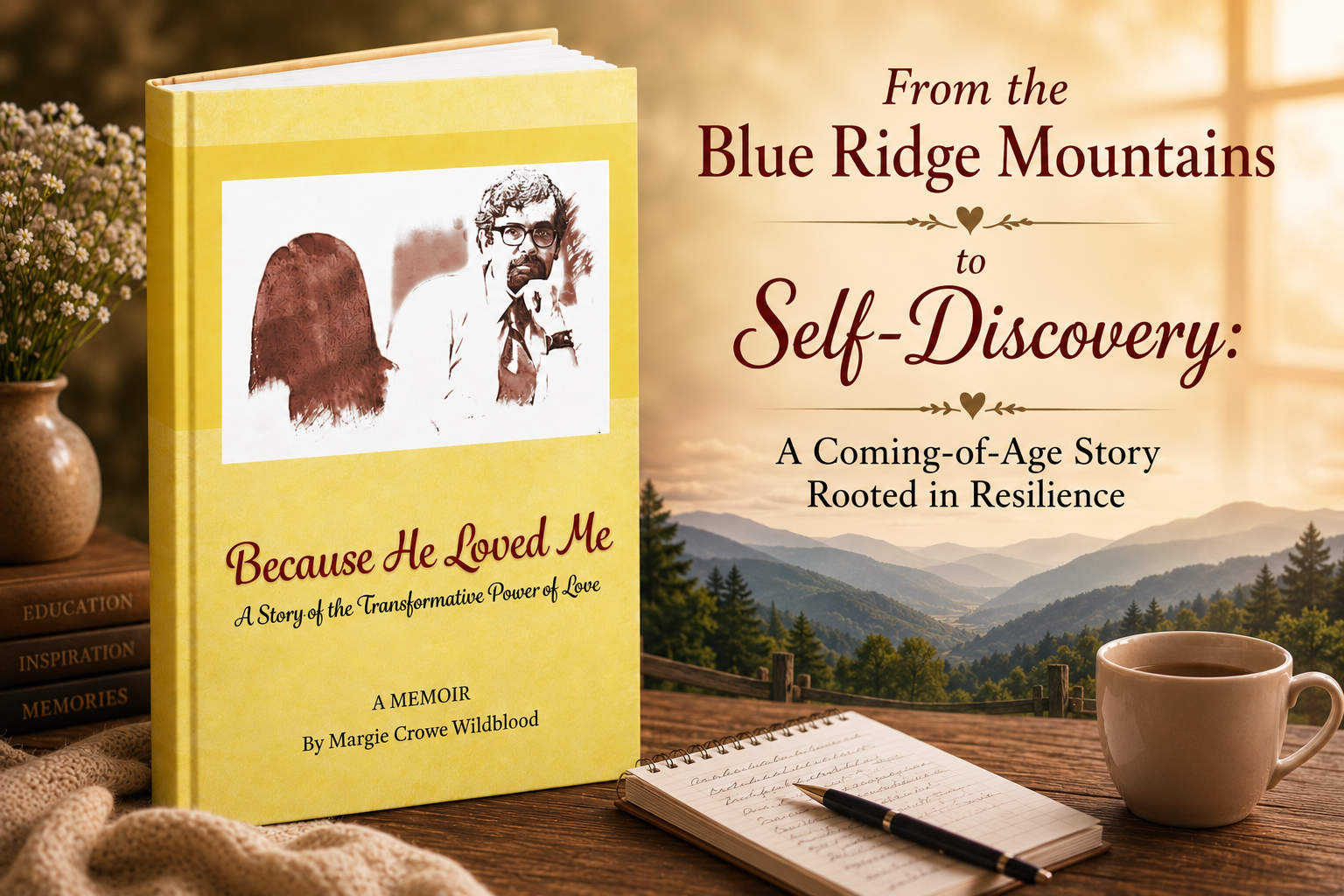
In her memoir Because He Loved Me, Margie Crowe Wildblood tells a story that begins far from the traditional image of academic confidence or social ease. Her journey starts in the Blue Ridge Mountains, in a large family shaped by hard work, limited resources, and deeply rooted expectations. From those early beginnings, she carries forward not only resilience, but also a quiet belief that her place in the wider world is uncertain at best.
This sense of displacement follows her into college. As a student at Radford College in the early 1970s, Margie finds herself surrounded by peers who seem more confident, more prepared, and more at ease in their environment. While she performs well academically, internally she wrestles with a persistent question: does she truly belong here? It’s a question that echoes throughout the memoir and serves as one of its most powerful threads.
Margie’s upbringing plays a significant role in shaping this mindset. Raised in a household where money was scarce and practicality was essential, she learned early to be cautious about stepping beyond perceived boundaries. Her mother, strong and devoted, instilled in her children both pride and a sense of limitation—an understanding that there were social and economic lines not easily crossed. While this guidance was meant as protection, it left Margie feeling hesitant to claim space in environments that seemed reserved for others.
Despite these internal struggles, Margie’s story is not one of defeat. Instead, it is a gradual unfolding of awareness. College becomes a place not only of academic learning, but of emotional and personal discovery. Through classes, friendships, and moments of reflection, she begins to examine the beliefs she has carried with her for so long.
One of the most significant influences during this time is her connection with a psychology professor who encourages open conversation and self-exploration. Through their discussions, Margie is prompted to look more closely at her past—her family dynamics, her fears, and the quiet assumptions that have shaped her sense of identity. These conversations do not offer easy answers, but they create a space where she can begin to question the idea that she is somehow less than those around her.
Equally important is Margie’s relationship with her own voice. Writing becomes a central part of her journey, not simply as an academic exercise, but as a means of understanding herself. Through poetry and personal reflection, she explores emotions that she has long kept hidden—feelings of inadequacy, longing, and hope. In doing so, she begins to recognize that her perspective has value, that her experiences are not something to hide but something to examine and, ultimately, to share.
The memoir also captures the cultural atmosphere of the time, a period marked by social change and shifting expectations. Against the backdrop of the Vietnam War and evolving attitudes toward independence and identity, Margie’s personal journey takes on added depth. She is not only navigating her own internal conflicts, but also finding her place in a world that is itself in transition.
What makes Because He Loved Me particularly compelling is its honesty. Margie does not present her growth as a straightforward path. There are moments of doubt, hesitation, and emotional conflict. She questions her beliefs, her decisions, and her sense of self. Yet, it is precisely this uncertainty that makes her journey relatable. Rather than offering a polished version of personal development, the memoir presents growth as it often is—uneven, complicated, and deeply personal.
Her relationships with others further shape this evolution. Friendships with her roommates expose her to new perspectives and experiences, helping her step outside the boundaries of her upbringing. At the same time, her reflections on family reveal both love and tension, highlighting the ways in which support and limitation can exist side by side.
As the narrative progresses, Margie begins to see herself differently. The question of belonging does not disappear entirely, but it loses some of its power. She starts to understand that her worth is not defined by her background or by comparison to others. Instead, it is found in her willingness to reflect, to learn, and to grow.
Because He Loved Me is ultimately a story of quiet resilience. It does not rely on dramatic transformation or sweeping declarations. Instead, it shows how change can happen gradually, through moments of insight and connection. It is a reminder that self-discovery is often less about becoming someone new and more about recognizing the value of who you have been all along.
For readers who have ever felt out of place, uncertain of their worth, or hesitant to step beyond their comfort zone, Margie’s story offers both understanding and hope. It speaks to the courage it takes to question long-held beliefs and to the possibility of finding a sense of belonging—not by changing who you are, but by learning to see yourself more clearly.
Contact:
Author: Margie Crowe Wildblood
Amazon: Because He Loved Me: A Story of the Transformative Power of True Love





No Comment! Be the first one.