


Your HVAC May Not Be Blast-Ready
Walk through most industrial facilities and you will find HVAC systems that are meticulously maintained — filters changed on schedule, airflow balanced, temperatures controlled. Yet ask the facility...

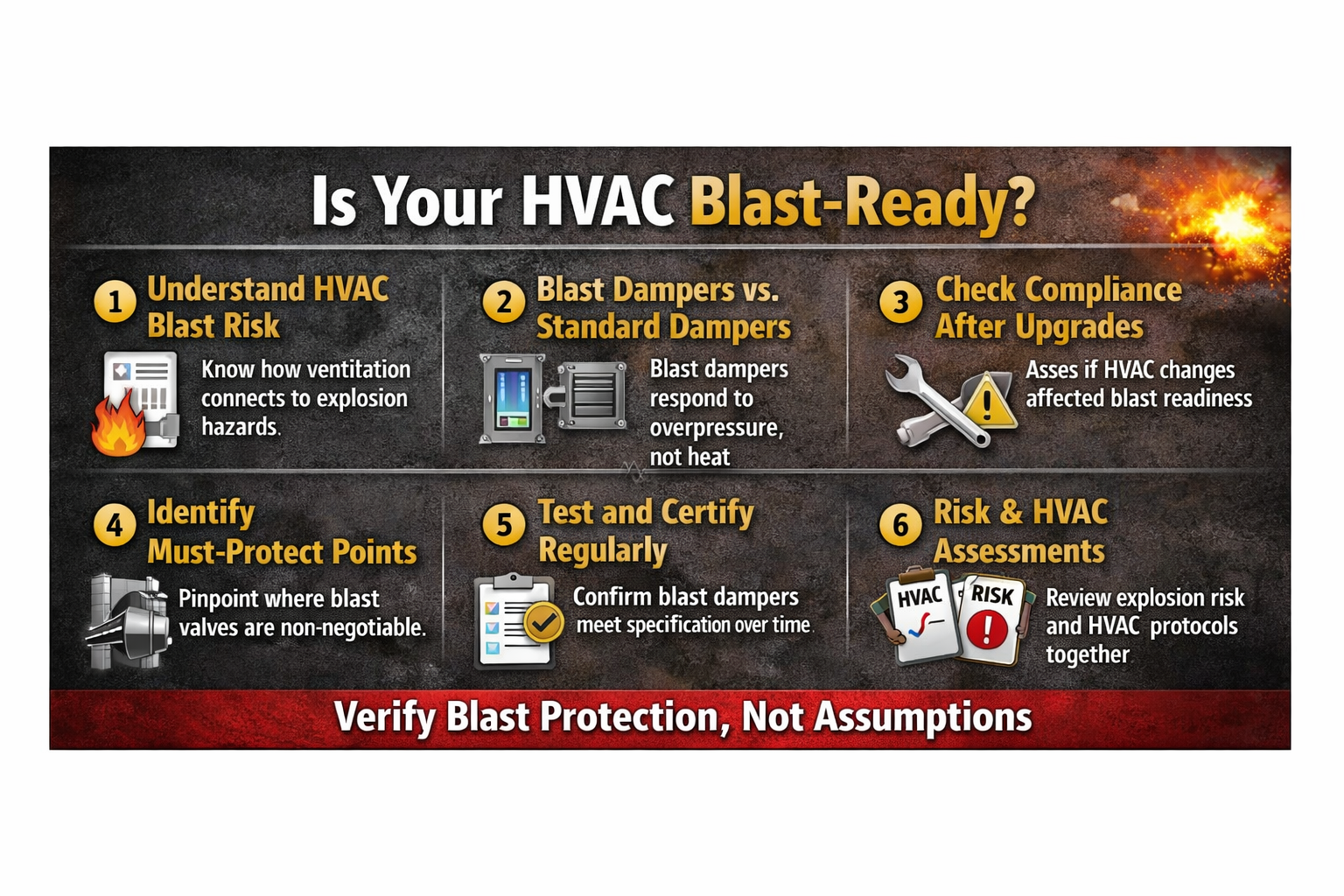
Walk through most industrial facilities and you will find HVAC systems that are meticulously maintained — filters changed on schedule, airflow balanced, temperatures controlled. Yet ask the facility manager whether those same systems are blast-ready, and the answer is often uncertain. That uncertainty is a serious problem.
Table Of Content
- 1. HVAC and Explosion Risk Are More Connected Than You Think
- 2. What a Blast Damper Actually Does in an HVAC System
- 3. Upgrades and Renovations Often Break Blast Compliance
- 4. Standard HVAC Components Are Not Designed for Blast Events
- 5. Where Blast Valves Are Needed Most
- 6. Testing and Certification Are Not Optional
- 7. The Cost of Getting It Wrong
- Conclusion
A blast valve is one of the most critical — and most overlooked — components in any facility where explosion risk exists. Integrated into ventilation ductwork, it closes automatically during an overpressure event, preventing destructive pressure waves and flame from travelling through the HVAC system and into occupied or sensitive areas. Without it, your ventilation network becomes a channel for disaster rather than a comfort system.
The reality is that many HVAC systems in high-risk industrial environments were not designed with explosion protection in mind — or were upgraded over time in ways that compromised their original blast-readiness. Here is what you need to know.
1. HVAC and Explosion Risk Are More Connected Than You Think
Most people associate HVAC systems with temperature control and air quality. In industrial settings, however, ventilation networks run directly through zones where flammable gases, combustible dust, or pressurised materials are present.
In the event of an explosion, pressure waves travel fastest through enclosed pathways — and ductwork is exactly that. Without proper blast dampers installed at strategic points, a single incident in one zone can propagate damage across an entire facility through the ventilation system itself.
2. What a Blast Damper Actually Does in an HVAC System
A blast damper is a pressure-activated device fitted within ductwork that remains open during normal operation and closes instantly when an overpressure wave is detected. Unlike standard fire dampers — which respond to heat — blast dampers respond to pressure, making them the appropriate line of defence in explosion scenarios.
They are a core component of HVAC safety design in facilities such as petrochemical plants, pharmaceutical manufacturing sites, grain processing facilities, and underground infrastructure. If your HVAC system lacks them, or if installed units have not been tested recently, your system may offer far less protection than you assume.
3. Upgrades and Renovations Often Break Blast Compliance
One of the most common ways HVAC systems lose their blast-readiness is through incremental upgrades. A new wing is added. Ductwork is extended. Fan capacity is increased. Each change seems routine — but collectively, they can push blast dampers outside their rated operating conditions.
Blast valve systems are specified for particular pressure differentials, airflow velocities, and duct geometries. When those parameters change, previously compliant installations may no longer perform as designed. If your facility has undergone significant HVAC modifications without a corresponding safety review, it is worth evaluating whether your explosion protection measures are still fit for purpose.
Evaluate your current safety systems to ensure your HVAC modifications have not compromised blast compliance.
4. Standard HVAC Components Are Not Designed for Blast Events
This is a point that surprises many facility operators. Standard HVAC dampers, louvres, and duct sections are engineered for airflow management — not overpressure resistance. They will not hold under the forces generated by an industrial explosion.
Specifying the correct industrial blast valve solutions requires understanding the specific risk profile of each zone, the expected overpressure levels, and the required closure speed. These are not decisions that standard HVAC contractors are typically equipped to make without specialist input. Getting it wrong means installing equipment that provides a false sense of security.

5. Where Blast Valves Are Needed Most
Not every section of an HVAC system requires blast protection — but certain locations are non-negotiable. Key installation points include:
- Duct penetrations through blast walls or barriers, where pressure containment is essential
- Supply and return air intakes in zones with explosion risk
- Connections between protected and unprotected areas, preventing cross-zone propagation
- Ventilation shafts in underground or enclosed facilities, where pressure build-up is most dangerous
Identifying these points requires a systematic review of both the HVAC layout and the facility’s explosion risk assessment. If these two documents have never been reviewed together, that gap itself is a vulnerability.
6. Testing and Certification Are Not Optional
A blast damper that has never been functionally tested is an unknown quantity. Many facilities install certified units at commissioning and then assume they remain compliant indefinitely. They do not.
Seals degrade. Actuators lose responsiveness. Corrosion builds in environments with humidity or chemical exposure. Industrial safety systems — including HVAC blast protection — require periodic functional testing to confirm that closure times and pressure ratings still meet specification. Regulatory frameworks in most jurisdictions require documented evidence of this testing. Without it, your facility faces both safety and compliance exposure.
Consider proactive testing schedules to enhance industrial safety and maintain regulatory standing.
7. The Cost of Getting It Wrong
An HVAC system that fails during a blast event does not just sustain equipment damage — it actively worsens the outcome. Pressure propagation through unprotected ductwork can extend the zone of destruction, compromise evacuation routes, and expose personnel in areas far from the original incident.
Beyond the human cost, the regulatory and financial consequences of a preventable failure are significant. Facilities found to have inadequate explosion protection face penalties, operational shutdowns, and substantial liability. The investment in proper blast damper specification and maintenance is negligible by comparison.
Conclusion
HVAC systems are often the last place facility managers look when reviewing explosion protection — and that oversight can have serious consequences. Blast valves and blast dampers are not add-ons to an HVAC system; they are fundamental safety components that determine whether your ventilation network contains or accelerates an emergency.
If your facility has never formally assessed its HVAC system for blast-readiness, now is the time to act. Review your installation against current risk assessments, verify that all blast dampers are correctly specified and recently tested, and consult specialists where system changes have occurred.
Explore additional insights on explosion protection systems — because blast-readiness is not a feature to retrofit after an incident. It is a responsibility to build in from the start.






No Comment! Be the first one.