


Matching the Right Encapsulation Technology to Your Active Compound: A Formulator’s Guide
The premise sounds straightforward: choose an encapsulation technology, apply it to your active, and realize the benefits of improved stability, bioavailability, or taste masking. In practice,...

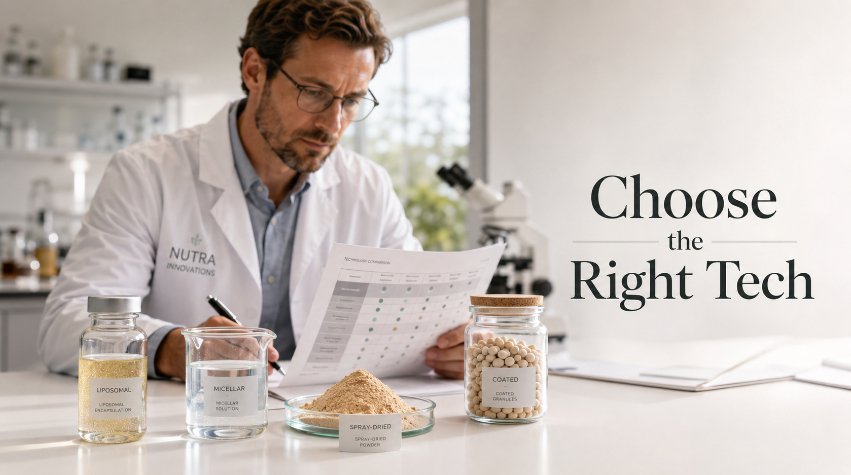
The premise sounds straightforward: choose an encapsulation technology, apply it to your active, and realize the benefits of improved stability, bioavailability, or taste masking. In practice, selecting the wrong encapsulation method for a specific active is one of the most expensive formulation mistakes a development team can make — not because the failure happens immediately, but because it often takes 12 to 18 months of stability data and a finished product launch before the incompatibility becomes undeniable.
Table Of Content
- The ingredient properties that drive technology selection
- Water solubility and partition coefficient
- Molecular weight and thermal sensitivity
- Degradation mechanism and the target protection requirement
- Technology-by-technology evaluation: what each method actually does
- Phospholipid liposomes
- Nano-micelles and micellar concentrates
- Spray-drying with wall material encapsulation
- Fluid-bed coating and Wurster processing
- Cyclodextrin complexation
- A structured evaluation framework for development teams
This guide is organized around the decision the active compound forces on you, not around the capabilities of any particular technology provider. The first question is never ‘which encapsulation technology is best?’ It is ‘what are the properties of this active that determine which technologies are viable?’
The ingredient properties that drive technology selection
Before evaluating any encapsulation method, a formulation team needs to characterize the active on four axes. These properties define which technologies are viable and which are contraindicated.
Water solubility and partition coefficient
The octanol-water partition coefficient (log P) is the most important single property for encapsulation technology selection. A log P above 3 indicates a strongly hydrophobic compound — curcumin (log P approximately 3.2), CoQ10 (log P above 10), vitamin K2-MK7 (log P above 13) — that is a natural candidate for lipid-based delivery systems. Micelles, liposomes with lipophilic cores, and lipid nanoparticles all work by providing a nonpolar environment that is compatible with the active’s chemistry.
A log P below 0 indicates a hydrophilic compound — ascorbic acid, glutathione, certain B vitamins — that will not load into a lipid interior. For these actives, liposomal encapsulation in the aqueous core is the appropriate lipid-based approach, or non-lipid encapsulation methods (spray-drying with hydrophilic wall materials, cyclodextrin complexation) may be more suitable depending on the application.
Getting this wrong has consequences. Applying micellar encapsulation to a hydrophilic active like glutathione is a technical error that produces a lipid suspension with the glutathione dissolved in the aqueous phase rather than encapsulated in any protective structure. The CoA may show the correct active content. The encapsulation claim on the label is false.
Molecular weight and thermal sensitivity
Large, structurally complex molecules — proteins, glycoproteins, peptides — require encapsulation methods that do not expose them to high-shear mechanical forces or elevated temperatures. Lactoferrin (molecular weight approximately 80 kDa) is susceptible to denaturation above 65°C and to shear-induced structural damage from high-pressure homogenization at excessively high pressures. Liposomal encapsulation of proteins requires low-temperature processing protocols and validated pressure ranges that preserve tertiary structure.
Spray-drying, a common and cost-effective encapsulation method for many actives, exposes the feed material to inlet temperatures of 150 to 200°C, with outlet temperatures typically in the range of 60 to 90°C. For most small molecules, this is tolerable. For temperature-sensitive proteins and certain heat-labile vitamins, this is a significant degradation risk that needs to be managed through rapid evaporative cooling, protective excipients like maltodextrin or trehalose, or alternative drying methods including freeze-drying.
Degradation mechanism and the target protection requirement
Matching the encapsulation technology to the degradation mechanism is the most direct way to evaluate whether a technology addresses the actual problem. The relevant degradation mechanisms for common nutraceutical actives are: oxidation (omega-3 fatty acids, astaxanthin, CoQ10), enzymatic hydrolysis in the GI tract (lactoferrin, glutathione, certain peptides), hydrolysis by water contact during storage (beta-glucan, some polysaccharides), photodegradation (riboflavin, vitamin A, chlorophyll), and taste-driven palatability failure (iron, zinc, certain botanicals with intense bitterness).
A wall material chosen for oxygen barrier properties (zein protein, shellac) does not provide the same protection as one chosen for gastric acid resistance (enteric methylcellulose derivatives, shellac at appropriate thickness). A microencapsulated iron ingredient using a fat-based wall material for taste masking will not provide gastric bypass unless the fat melts above 37°C — which is the normal design intent for sustained-release lipid matrices, but requires validation of the melt behavior at body temperature, not just at room temperature.
Technology-by-technology evaluation: what each method actually does
Phospholipid liposomes
Best suited for: water-soluble actives requiring protection from gastric degradation (glutathione, lactoferrin, vitamin B12 in high-dose formats), and hydrophilic actives where intracellular or trans-mucosal delivery is the mechanistic premise. The aqueous core carries the water-soluble active; the phospholipid bilayer provides the protective structure and the cellular interaction mechanism.
Genuine constraints: liposomal encapsulation is the most process-intensive method on this list. High-pressure homogenization, cryo-TEM validation, multi-timepoint stability monitoring, and scale-up process qualification are all necessary for a commercially reliable product. Unit costs are higher than most other encapsulation methods. Do not use for strongly hydrophobic actives that will partition into the membrane rather than the aqueous core — this produces pseudo-liposomal structures that behave differently from true aqueous-core encapsulation.
Nano-micelles and micellar concentrates
Best suited for: fat-soluble vitamins and lipophilic actives (vitamins D, E, K, CoQ10, curcumin, astaxanthin) where the primary formulation requirement is water dispersibility and improved intestinal solubilization. The simplest and most commercially accessible lipid-based delivery technology for clean-label liquid applications.
Genuine constraints: micelles are not appropriate for hydrophilic actives. They provide solubilization and absorption enhancement but do not provide the same gastric protection mechanism as a liposome. For actives that are primarily degraded enzymatically rather than absorbed poorly, micellar delivery addresses the wrong problem. The critical micelle concentration creates a dilution threshold below which the structure dissociates — a formulation variable that must be validated at the finished product use concentration.
Spray-drying with wall material encapsulation
Best suited for: oxidation-sensitive oils and lipid-soluble actives requiring powder format (omega-3 oils, fat-soluble vitamins for tablet or capsule incorporation), volatile flavor compounds, and iron in applications where taste masking in a dry format is the primary requirement. Highly scalable, well-understood, and cost-effective for appropriate applications.
Genuine constraints: the thermal exposure during spray-drying limits application to thermally stable actives. Encapsulation efficiency and wall integrity vary significantly with wall material selection, feed viscosity, and drying parameters — a spray-dried omega-3 powder from a supplier with a validated process is a different product from one from a supplier treating it as a commodity. Moisture management in the finished product is critical: many spray-dried encapsulates are sensitive to high humidity, which can cause wall material plasticization and active migration.
Fluid-bed coating and Wurster processing
Best suited for: granules, pellets, and multiparticulates in tablet or capsule formats requiring modified release (enteric coating, extended release), taste masking on a particle-by-particle basis, or moisture barrier protection. The standard pharmaceutical approach for oral solid dosage form encapsulation.
Genuine constraints: requires a substrate particle of sufficient size (typically above 100 microns) for coating adhesion. Not directly applicable to molecular or nano-scale encapsulation. Capital-intensive equipment. Most relevant for finished dosage form manufacturers rather than bulk ingredient suppliers.
Cyclodextrin complexation
Best suited for: volatile compounds requiring stabilization, poorly soluble actives where inclusion complex formation increases apparent water solubility without lipid excipients (relevant for clean-label or vegan formulations where phospholipid sources are restricted), and actives with solubility challenges in specific pH ranges.
Genuine constraints: cyclodextrin availability and regulatory status vary by market. Beta-cyclodextrin has restricted use in some jurisdictions due to renal accumulation concerns at high doses. Hydroxypropyl beta-cyclodextrin (HPbCD) has broader regulatory acceptance but higher cost. Complexation efficiency depends on the geometric compatibility of the active with the cyclodextrin cavity — it works well for some molecules and poorly for others, and cannot be assumed without experimental confirmation.
A structured evaluation framework for development teams
When a new active compound enters the development pipeline, the evaluation sequence that produces the fewest expensive surprises is: first, determine log P and water solubility; second, identify the primary degradation mechanism in the intended application context; third, map the relevant technology options against both; fourth, request stability data from suppliers using those technologies under conditions that simulate the finished product environment, not just bulk storage; fifth, conduct compatibility testing in the formulation matrix before committing to a bulk supplier.
The step that most development teams skip is the fourth — requesting stability data under finished-product conditions rather than bulk conditions. Samarth Biorigins, working from a pharmaceutical process validation framework, routinely provides this data for both their liposomal and microencapsulation platforms because the pharmaceutical industry normalized it. In nutraceutical ingredient supply, it remains an exception rather than a standard. Asking for it distinguishes a technically rigorous procurement process from one that will discover compatibility problems at the stability monitoring stage of finished product development. Bio-encapsulation processes that work are not interchangeable. They are engineered choices. The formulator who understands why a specific technology was selected for a specific active — and can defend that choice against an alternative with specific data — is the one whose products hold up when the clinical claim meets the consumer’s body.





No Comment! Be the first one.