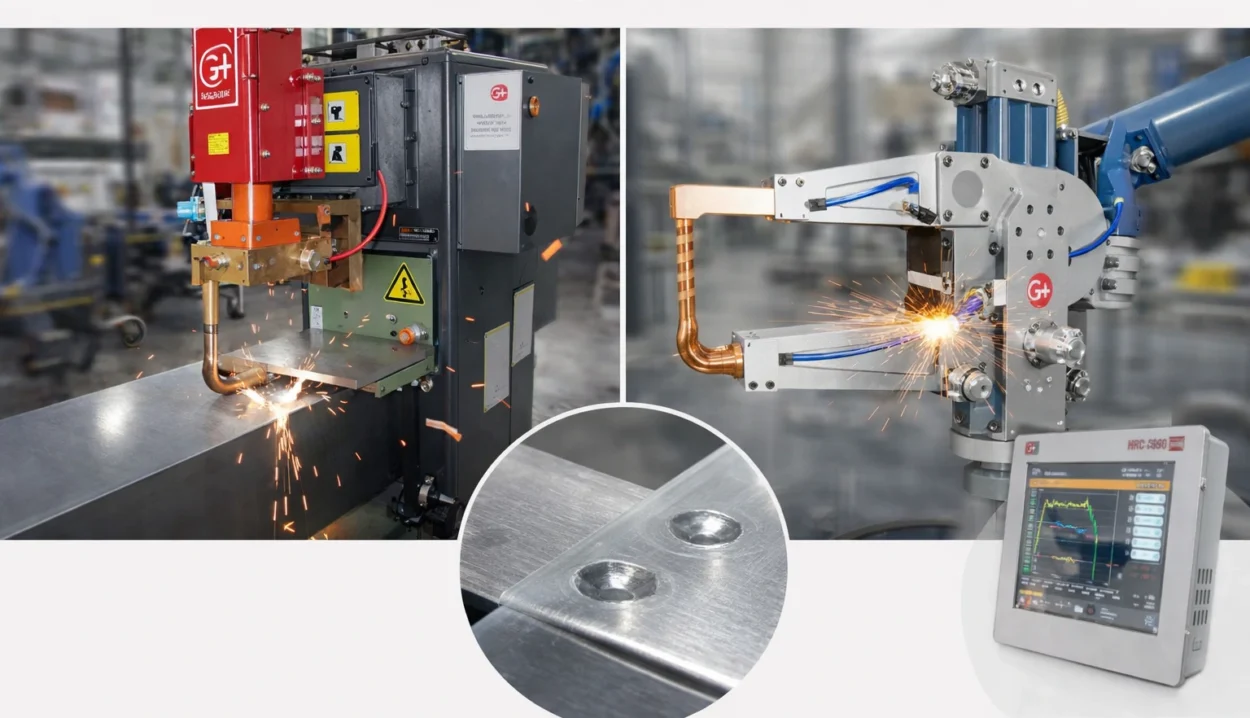
In modern manufacturing, joining speed, consistency, and repeatability are critical factors that define production efficiency. Among the most widely used metal joining technologies, the spot resistance welder stands out as a backbone process for high-volume industries such as automotive, appliances, HVAC, and sheet metal fabrication.
A spot resistance welder enables fast, localized joining of metal sheets using controlled electrical current and pressure—delivering strong, clean, and repeatable welds with minimal thermal distortion. For OEMs and automation-driven factories, it remains one of the most cost-efficient and scalable welding solutions.
At Heron Welder, advanced resistance welding systems are engineered to meet the evolving demands of smart manufacturing, robotics integration, and high-strength material joining.
What is a Spot Resistance Welder?
A spot resistance welder is a type of resistance welding machine that joins two or more overlapping metal sheets by applying:
- High electrical current
- Controlled electrode pressure
- Precise time-based energy input
The weld is formed at a localized “spot” where electrical resistance is highest. Heat is generated according to Joule’s law (Q = I²Rt), melting the interface material and forming a solid metallurgical bond as pressure is maintained.
This process is widely used because it is fast, repeatable, and highly suitable for automation lines.
Working Principle of Spot Resistance Welding
The working principle is based on resistance heating and pressure fusion:
1. Clamping Phase
Two copper electrodes press the metal sheets together under controlled force.
2. Current Application
A high-amperage current passes through the contact point.
3. Heat Generation
Electrical resistance at the interface produces intense localized heat.
4. Nugget Formation
Metal melts at the joint area, forming a molten “weld nugget.”
5. Solidification
Once current stops, pressure is maintained briefly, allowing the weld to solidify.
The entire cycle often takes only milliseconds, making it ideal for mass production environments.
Key Components of a Spot Resistance Welder
A modern industrial spot resistance welder typically includes:
- Welding transformer or MFDC inverter power supply
- Copper alloy electrodes
- Pneumatic or servo force system
- Welding controller (time, current, force control)
- Cooling system (air or water-cooled)
Advanced systems such as MFDC (Medium Frequency Direct Current) technology enable faster current rise, stable output, and improved weld consistency.
Industrial Applications of Spot Resistance Welders
Spot resistance welders are widely used across multiple industries where sheet metal joining is required:
Automotive Manufacturing
- Car body-in-white assembly
- Door panels, chassis, reinforcements
- High-volume robotic welding lines
Electrical & Electronics
- Battery tabs (Li-ion packs)
- Metal enclosures
- Busbars and terminals
HVAC & Appliances
- Air conditioning panels
- Refrigeration units
- Washing machine and appliance frames
Metal Fabrication
- Cabinets and enclosures
- Steel furniture
- Industrial sheet assemblies
The process is particularly valuable in automotive production where thousands of spot welds are used in a single vehicle body.
Advantages of Spot Resistance Welding
1. High Production Speed
Each weld takes milliseconds, making it ideal for automated production lines.
2. Minimal Material Distortion
Heat is concentrated only at the joint, reducing warping.
3. Easy Automation
Fully compatible with robotic arms and CNC production systems.
4. No Filler Material Required
The process does not require additional consumables.
5. Consistent Quality
Stable parameters ensure repeatable weld strength across batches.
Spot Resistance Welder vs Other Welding Methods
While arc welding and laser welding are also widely used, spot resistance welding offers unique advantages for sheet metal joining:
- Faster cycle time compared to TIG/MIG welding
- Lower operational complexity
- Better suitability for thin sheet overlap joints
- Easier integration into production lines
However, it is generally limited to thin sheet materials and lap joints, making it more specialized than general-purpose welding methods.
Best Practices for Industrial Spot Welding
To ensure consistent weld quality, engineers must control four critical parameters:
1. Welding Current
Higher current increases heat generation but must be precisely controlled.
2. Electrode Force
Proper pressure ensures good contact and prevents spatter.
3. Weld Time
Too long causes overheating; too short leads to weak joints.
4. Electrode Design
Shape and material influence heat concentration and electrode life.
Modern systems like MFDC-based spot welders help optimize these parameters digitally for improved process stability.
Role of Automation in Spot Resistance Welding
In Industry 4.0 manufacturing environments, spot resistance welders are increasingly integrated into:
- Robotic welding cells
- Smart production lines
- Real-time monitoring systems
- Data-driven quality control systems
This allows manufacturers to achieve higher throughput, reduced defects, and improved traceability.
Heron Welder specializes in designing such automated resistance welding solutions tailored for OEM and high-volume industrial applications.
Why Choose Advanced Industrial Spot Resistance Welders?
Modern production demands go beyond basic welding. Manufacturers now require:
- High precision
- Multi-material compatibility
- Energy efficiency
- Digital control systems
- Integration with automation lines
Advanced systems like MFDC resistance spot welders deliver superior stability, reduced electrode wear, and improved weld consistency making them ideal for demanding production environments.
FAQs about Spot Resistance Welder
1. What materials can a spot resistance welder join?
It is commonly used for low-carbon steel, stainless steel, galvanized steel, aluminum alloys, and some non-ferrous materials depending on machine capability.
2. Is spot welding suitable for thick metals?
No, it is mainly designed for thin sheet metals. Thick materials require specialized high-power systems or alternative welding methods.
3. What is the difference between AC and MFDC spot welding?
MFDC systems provide more stable current control, faster response, and better weld consistency compared to traditional AC systems.
4. Can spot welding be automated?
Yes, it is widely used in robotic and automated production lines, especially in automotive manufacturing.
5. How long does a spot weld take?
A single weld typically takes between a few milliseconds to a few hundred milliseconds depending on material and thickness.
Conclusion
The spot resistance welder remains one of the most essential technologies in modern manufacturing due to its speed, efficiency, and automation compatibility. From automotive body assembly to industrial sheet metal fabrication, it enables manufacturers to achieve strong and consistent welds with minimal cost and maximum productivity.
As manufacturing continues to evolve toward smart factories and automated production systems, advanced resistance welding technologies especially MFDC-based solutions are becoming the industry standard.
Partner with Heron Welder for Advanced Spot Welding Solutions
Heron Welder is a global manufacturer of resistance welding machines, including spot welding, projection welding, clinching, and automated joining systems. Our solutions are engineered for precision, durability, and high-performance industrial production.
Whether you need a standalone spot resistance welder or a fully automated welding production line, Heron provides customized solutions tailored to your manufacturing needs.
Contact Heron Welder today to request a quote or consult with our engineering team for your next welding automation project.


Sign up