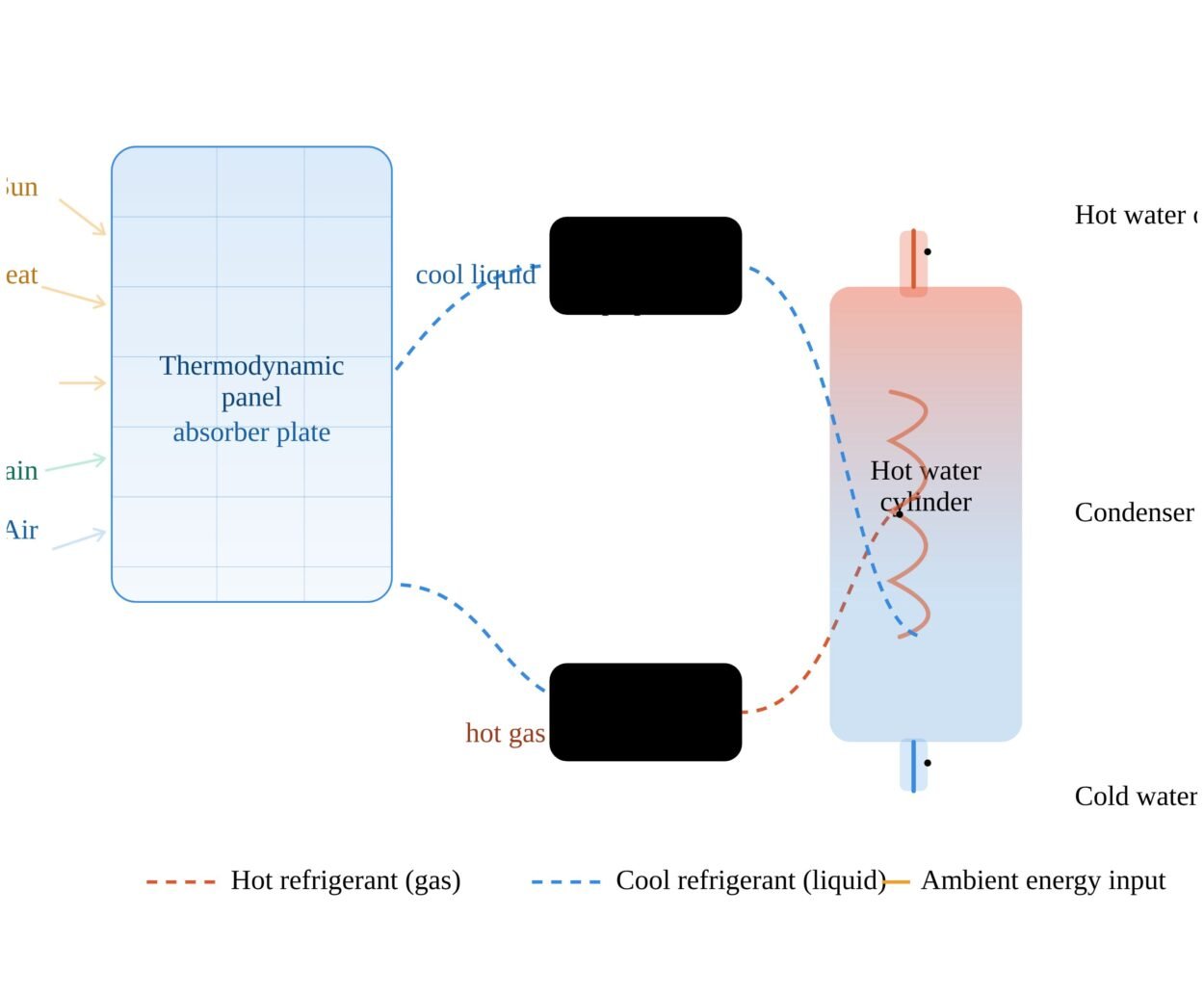
A thermodynamic panel is a type of renewable energy device used primarily to heat water. It looks similar to a solar panel but works very differently — instead of generating electricity from sunlight, it absorbs low-grade heat energy from the surrounding environment to drive a refrigerant-based heating cycle. Crucially, it works 24 hours a day, even at night, in rain, and in cold weather.
How it works — the four-stage cycle
The system is essentially a heat pump with an outdoor absorber panel at its heart. The cycle has four stages:
Must Visit Here: https://makenergy.com/
1. Absorption. A thin aluminum panel (typically mounted on a roof or wall) contains a network of channels filled with refrigerant. The refrigerant has an extremely low boiling point — around −20°C — so it evaporates easily, absorbing ambient energy from sunlight, rainfall, air temperature, and even diffuse radiation. This is why the system works regardless of weather.
2. Compression. The now-gaseous refrigerant flows to a compressor, which pressurises it. Compressing a gas causes its temperature to rise sharply — the refrigerant can reach 80–100°C at this stage. This is where electrical energy is consumed (the only electricity the system uses).
3. Condensation. The hot, pressurised gas passes through a condenser coil inside a hot water cylinder. Here it transfers its heat to the water in the tank, warming it to usable temperatures (typically 50–60°C). As it gives up its heat, the refrigerant cools and returns to a liquid state.
4. Expansion. The liquid refrigerant passes through an expansion valve, which drops its pressure rapidly. This causes the temperature to fall back below ambient levels, and the cycle begins again at the panel.
Key advantages
Because thermodynamic panels extract energy from the environment rather than generating it from scratch, they are highly efficient. For every 1 kWh of electricity consumed by the compressor, they can deliver 3–4 kWh of heat energy to the water — a coefficient of performance (COP) of 3 to 4. This makes them significantly more efficient than a conventional electric immersion heater, which gives a COP of exactly 1.
They are also simpler than full solar thermal systems — no frost protection, no glycol circuits, no overheating risk in summer — and far less weather-dependent than photovoltaic panels used for water heating.
Common uses
Thermodynamic panels are most widely used for domestic hot water production, but they can also be integrated with underfloor heating systems or swimming pool heating. They are particularly popular in countries with mild, wet climates — like the UK, Ireland, and Portugal — where solar irradiance is low but ambient temperatures remain moderate year-round.

Sign up