


5 Critical OPT and H-1B Visa 2026 Changes Every International Student Must Know
If you're an international student on an F-1 visa right now, your newsfeed has probably been flooded with alarming headlines about OPT elimination, H-1B freezes, and sweeping immigration overhauls....

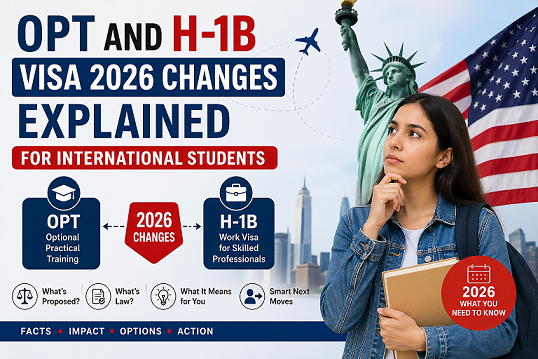
If you’re an international student on an F-1 visa in the United States right now, there’s a very good chance your newsfeed has been flooded with alarming headlines about OPT and H-1B visa 2026 changes. Proposed bills, state-level freezes, regulatory rewrites — it can feel like the ground is shifting beneath you.
Table Of Content
- Table of Contents
- 1. What Are the OPT and H-1B Visa 2026 Proposals?
- 2. The End H-1B Visa Abuse Act: What It Actually Says
- 3. Why Legal Experts Are Not Panicking — Yet
- 4. What Has Already Changed in 2026
- 5. State-Level Freezes: Texas and Florida
- 6. Your Best Alternatives If Access Gets Restricted
- 7. The Keep Innovators in America Act: A Real Counter-Move
- 8. Five Actionable Steps to Protect Your Status Right Now
- Conclusion
- Frequently Asked Questions
Here’s the thing: a lot of what’s circulating online is either incomplete or outright misleading.
In this guide, we break down exactly what’s happening, what’s actually in effect, and — most importantly — what you can do to protect your future in the U.S. No panic, just facts.
Table of Contents
- What Are the OPT and H-1B Visa 2026 Proposals?
- The End H-1B Visa Abuse Act: What It Actually Says
- Why Legal Experts Are Not Panicking — Yet
- What Has Already Changed in 2026
- State-Level Freezes: Texas and Florida
- Your Best Alternatives If Access Gets Restricted
- The Keep Innovators in America Act: A Real Counter-Move
- 5 Actionable Steps to Protect Your Status Right Now
- FAQs
1. What Are the OPT and H-1B Visa 2026 Proposals?
The OPT and H-1B visa 2026 conversation stems from a surge of restrictionist legislation introduced in Congress alongside new administrative proposals from DHS and the Department of Labor.
OPT — Optional Practical Training — lets F-1 students work in the U.S. for up to 12 months after graduation, with a 24-month STEM extension that brings the total to 36 months. It has been a vital bridge to the H-1B visa for decades.
The H-1B, on the other hand, is the primary route for international graduates to stay and work long-term in the U.S. With an annual cap of just 65,000 visas (plus 20,000 for U.S. master’s degree holders), demand has always outpaced supply — and 2026 has added a brand-new layer of legislative uncertainty on top of that.
Understanding the difference between proposed changes and enacted rules is absolutely critical right now.
2. The End H-1B Visa Abuse Act: What It Actually Says
On April 22, 2026, Representative Eli Crane (R-AZ) introduced the “End H-1B Visa Abuse Act of 2026” — the most sweeping restrictionist proposal targeting OPT and H-1B visa 2026 pathways in recent memory.
Here’s what the bill proposes, if enacted:
- A 3-year pause on all new H-1B visas, effective immediately
- Slashing the annual H-1B cap from 65,000 to just 25,000 — with all exemptions eliminated
- A mandatory $200,000 salary floor for any H-1B beneficiary
- Complete elimination of the OPT program, which currently supports hundreds of thousands of international graduates
- A ban on H-1B holders adjusting their status to a Green Card
- Prohibition on H-1B workers bringing dependents (spouses, children) to the U.S.
- A bar on third-party staffing agencies employing H-1B workers
This is not a minor tweak to immigration rules. If passed, it would fundamentally dismantle the talent pipeline that U.S. tech, healthcare, and academia have relied on for 30+ years.
3. Why Legal Experts Are Not Panicking — Yet
Let’s be clear: this bill is a legislative proposal, not law.
To become enforceable, it would need to pass the House of Representatives, clear a 60-vote Senate threshold to overcome a filibuster, and receive presidential approval. Immigration attorneys across the country describe the bill as more of a political statement than a realistic legislative outcome in its current form.
Prominent immigration attorney Rajiv Khanna notes that the cumulative effect of these measures would effectively dismantle the skilled worker pipeline the U.S. economy has relied on for three decades — and the legal challenges would be immediate if any version passed.
Specific provisions raise serious constitutional red flags, too. Retroactively stripping Green Card eligibility from people who’ve been legally waiting 10 to 20 years in the employment-based backlog would face immediate due process litigation. The same applies to restrictions on dependent entry.
Bottom line: Worry about what’s already law. Monitor what’s proposed. Don’t make life-altering decisions based on a bill that hasn’t passed.
4. What Has Already Changed in 2026
While the big bill is still theoretical, several real, enacted changes to OPT and H-1B visa 2026 rules are already in effect — and these deserve your immediate attention.
H-1B Weighted Lottery (Effective February 27, 2026)
DHS has replaced the purely random H-1B lottery with a wage-weighted selection system. Applicants reflecting higher wage tiers now have a statistically better chance of selection. For entry-level graduates, this makes H-1B access measurably harder.
Extended Cap-Gap Protection (Effective January 17, 2025)
A finalized DHS rule now extends cap-gap protection — the period between OPT expiration and H-1B start — all the way to April 1 of the relevant fiscal year, compared to the previous October 1 cutoff. This is genuinely good news for students with pending H-1B petitions.
USCIS Premium Processing Fee Hikes (Effective March 1, 2026)
Expedited processing now costs more. The highest tier jumped from $2,805 to $2,965. If you need predictable timelines, premium processing is still worth it — just budget accordingly.
DOL Prevailing Wage Increases (Proposed March 27, 2026)
The Department of Labor’s proposed rule would raise H-1B salary requirements by 21 to 33 percent across wage tiers. Entry-level positions (Wage Level I) face the sharpest jump — from the 17th to the 34th salary percentile. This is still in the comment period, but employers are already adjusting their hiring calculus.
For the latest updates directly from the source, check USCIS’s official H-1B Cap Season page and NAFSA’s regulatory tracking hub.
5. State-Level Freezes: Texas and Florida
Beyond the federal picture, two major states have created their own OPT and H-1B visa 2026 headaches.
Texas: Governor Greg Abbott issued an executive order halting all state agency and public university H-1B sponsorships until May 31, 2027. The Texas Medical Center — the largest medical complex in the world — has flagged this as an existential threat to its ability to fill critical healthcare roles.
Florida: The Florida Board of Governors approved a year-long H-1B pause across all state universities until January 5, 2027. Officials at the University of Florida have warned this will directly impair UF Health operations.
These freezes don’t affect private employers, but they send a chilling signal across the global academic community. If you’re targeting a public university or state-affiliated institution for your career, factor this into your planning. You can track developments through The Rice Thresher’s coverage and the University of California Davis SISS updates.
6. Your Best Alternatives If Access Gets Restricted
Relying solely on the H-1B lottery has never been a complete strategy, and the OPT and H-1B visa 2026 landscape makes diversification even more important. Here are your strongest alternatives:
O-1 Visa (Extraordinary Ability): No cap, no lottery. Ideal for top researchers, founders, and professionals with a strong publication or award record. This is increasingly viable for Ph.D. graduates with peer-reviewed work.
L-1 Visa (Intracompany Transferee): If you’ve worked at a multinational firm abroad for at least a year, you can transfer to a U.S. office. Completely bypasses the lottery.
Cap-Exempt H-1B: Universities, non-profit research organizations, and government entities are exempt from the annual cap. If you’re considering academia or research, this is your clearest path.
EB-2 NIW (National Interest Waiver): Allows self-petitioning for a Green Card — no employer sponsorship required. Students on STEM OPT can apply simultaneously. This is one of the most underutilized options in the international student toolkit.
Treaty Visas (TN, E-3, H-1B1): If you’re Canadian, Mexican, Australian, Chilean, or Singaporean, check your treaty-specific visa options. These often have faster processing and no lottery.
7. The Keep Innovators in America Act: A Real Counter-Move
Not all the news in 2026 is restrictionist. On March 19, 2026, Representatives Sam Liccardo (D-CA), Jay Obernolte (R-CA), and Raja Krishnamoorthi (D-IL) introduced H.R. 8013 — the Keep Innovators in America Act.
This bipartisan bill would permanently codify OPT into U.S. immigration law, shielding it from executive-branch elimination. It would also formally recognize F-1 students’ right to pursue Green Cards while remaining on OPT — a critical fix for the “dual intent” problem that has left students in legal limbo for years.
The bill has backing from over 50 organizations, including FWD.us, the American Immigration Lawyers Association, and the U.S. for Success Coalition. Read more at NAFSA’s Keep Innovators page and Fwd.us.
This is a counterweight worth watching — and supporting.
8. Five Actionable Steps to Protect Your Status Right Now
Given everything happening with OPT and H-1B visa 2026, here’s what you should be doing today — not next month.
1. Align your degree with STEM CIP codes.
The difference between 12 months of standard OPT and 36 months of STEM OPT is enormous. If your coursework qualifies, make sure your transcript and program designation reflect it. Check the DHS STEM Designated Degree Program List for eligible codes.
2. File your OPT application as early as possible.
USCIS processing delays are real. You can apply up to 90 days before your graduation date. Don’t wait. Use premium processing if your timeline is tight — it’s worth the extra cost.
3. Take your I-983 training plan seriously.
If you’re on STEM OPT, ICE site audits have increased. Your employer must provide genuine, structured training tied to your CIP code. Keep documentation updated and ask questions if anything feels vague.
4. Start exploring the EB-2 NIW early.
Talk to an immigration attorney in your first year of OPT about whether you qualify. For Ph.D. researchers and specialized professionals, this can be the most direct path to long-term stability — with no employer dependency.
5. Get your information from verified sources only.
Rely on your university’s Office for International Students and Scholars (OISS), official USCIS bulletins, and licensed immigration attorneys. Social media speculation has caused unnecessary panic. Also explore internationalstudent.com’s 2026 OPT guide for a solid overview.
Conclusion
The OPT and H-1B visa 2026 landscape is genuinely complex — but it’s not hopeless. The End H-1B Visa Abuse Act is alarming in scope, but it faces enormous legal and political hurdles before it becomes law. What’s actually changed in 2026 — the weighted lottery, extended cap-gap, and fee increases — matters, but can be navigated with the right strategy.
Build your plan around what’s real, not what’s rumored. Diversify your visa pathways — and your income streams. Online tutoring, for instance, has emerged as a practical option for international students on OPT, offering flexible, compliant work experience that aligns with STEM and education-adjacent fields while you wait out the H-1B lottery cycle. File early. And keep one eye on the Keep Innovators in America Act — it could change the game for international students in a way that actually works in your favor.
Frequently Asked Questions
Q1: Is OPT eliminated in 2026?
No. As of today, OPT is fully operational. The proposal to eliminate it is part of the End H-1B Visa Abuse Act, which has only been introduced in Congress and has not passed into law. Both standard and STEM OPT continue under existing rules.
Q2: What does the 2026 H-1B weighted lottery mean for recent graduates?
The new system statistically favors beneficiaries at higher wage levels. Entry-level applicants — typically recent international graduates — face a tougher path. This makes it even more important to explore cap-exempt H-1B positions and alternatives like the EB-2 NIW or O-1 visa simultaneously.
Q3: Is it risky for international students to travel outside the U.S. right now?
Leading immigration law firm Fragomen has advised that it’s currently a risky period for international students to leave the country, given the shifting rules and potential re-entry complications. Consult your OISS or an immigration attorney before booking any international travel.
Q4: What is the Keep Innovators in America Act and why does it matter?
H.R. 8013 is a bipartisan bill introduced in March 2026 that would permanently protect OPT by codifying it into federal law. It would also allow F-1 students to pursue Green Cards while on OPT — solving the dual intent problem. If passed, it would be a landmark protection for international graduates.
Q5: Can I apply for an EB-2 NIW while on STEM OPT?
Yes. The EB-2 National Interest Waiver allows self-petitioning — meaning you don’t need employer sponsorship. STEM OPT students who qualify can file simultaneously while maintaining their current work authorization. Talk to an immigration attorney to evaluate your eligibility.
This article is for informational purposes only and does not constitute legal advice. For guidance specific to your immigration status, consult a licensed U.S. immigration attorney or your university’s international student services office.





No Comment! Be the first one.