




From Solid Rubber to Smart Compounds: The British Tyre History
The earliest form of tyres consisted of iron bands encircling wooden wheels. Carriages drawn by horses suffered great discomfort on these tyres. What now takes an hour would have taken a day then,...

The earliest form of tyres consisted of iron bands encircling wooden wheels. Carriages drawn by horses suffered great discomfort on these tyres. What now takes an hour would have taken a day then, and the passenger would have arrived battered. Then came tyres made of solid rubber. They were smoother, but still not flawless.
Top Content
The actual breakthrough occurred in 1888, when Scottish veterinarian John Boyd Dunlop covered the tricycle wheels of his son with rubber and filled them with air. The pneumatic tyre came into existence. That one innovation changed how people travel. Speed and comfort got better.
From Invention to Mass Production
Dunlop’s patent sparked a frenzy of invention throughout Europe and the United Kingdom. In 1895, the Michelin brothers in France saw the potential of fast travel and released their own pneumatic car tyres. Around 1910, most cars had pneumatic tyres. They did, however, have a major flaw. Punctures were common, and fixing them meant removing the whole tyre from the wheel.
Michelin released the radial tyre in 1946. Radial tyres, unlike the earlier bias-ply layout, in which cords crossed the tyre diagonally, had cords positioned 90 degrees to the direction of travel. The outcome changed the world. Radial tyres gave greater grip, better fuel economy, and longer lifespan. Radials had largely supplanted bias-ply tyres on nearly every vehicle in the UK by the 1970s. A driver today would find it hard to identify a car’s handling on bias-ply tyres.
Contemporary tyres feature computer-designed tread patterns, cutting-edge silica compounds, and manufacturing techniques ensuring reliable performance at motorway speeds. It took less than a century for Dunlop’s tricycle tyre to become a high-performance radial.
The Quiet Revolution: Scientific Tread Patterns Start to Emerge
Tread patterns for pneumatic tyres were basic for the first fifty years. It included straight grooves and some zigzags. Things started to change in the 1970s and 1980s when computer modelling enabled engineers to simulate how water would move around the tread. Tyre developers knew where grooves had to be deeper or angled differently.
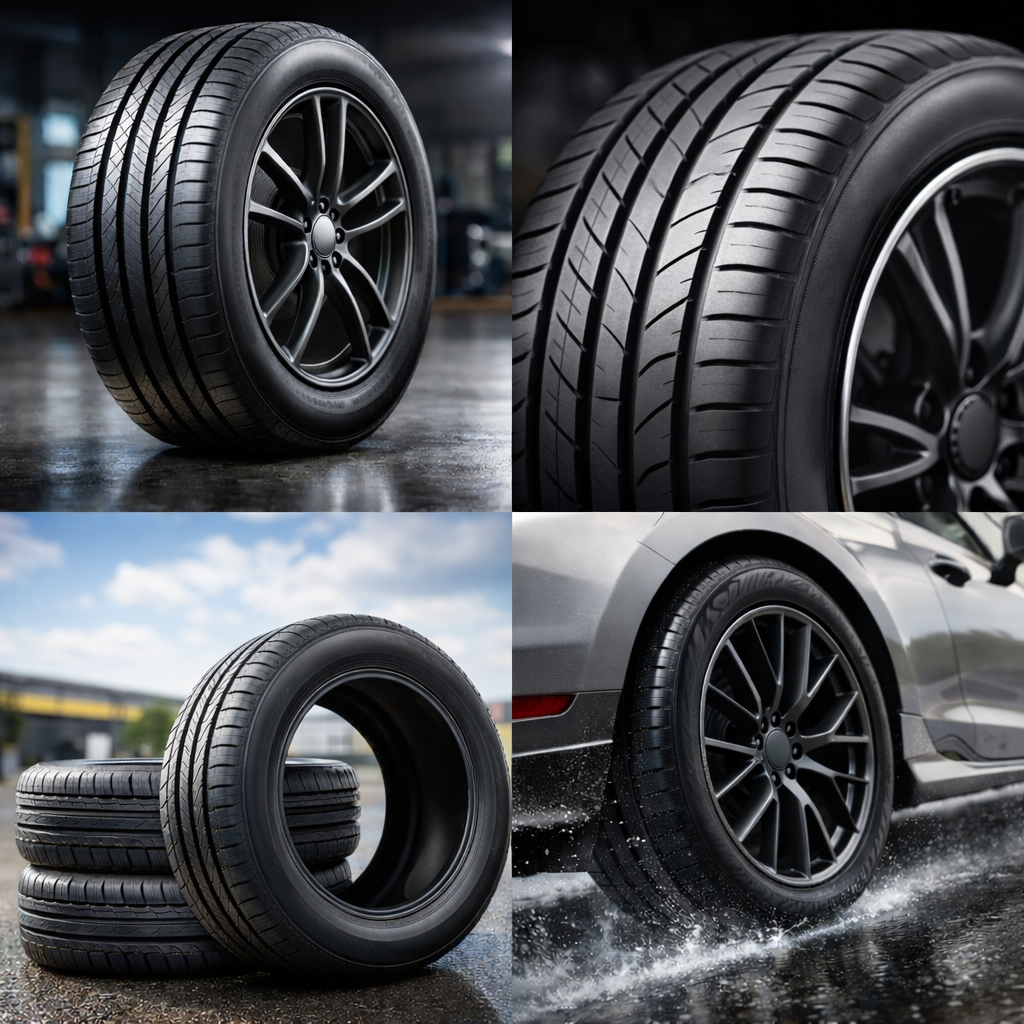
Modern tread designs are beautiful pieces of engineering. The grooves follow a pattern. They are expected to speed water away from the contact patch faster than any other prior design. The blocks between the grooves are designed to keep their shape when the car is turning or stopping. Small sipes are tiny slits in the tread blocks that make more sharp edges. These make the tyres grip better on wet and icy surfaces.
Millions of hours of simulation and testing helped drivers improve the safety and comfort of their rides. Twenty years ago, the tread pattern on a small family hatchback tyre would have been inconceivable.
The Silica Transformation
Tyre rubber was basic for decades. To provide strength and longevity, natural rubber is combined with carbon black. Despite a basic restriction, carbon-black tyres performed fairly well. Wear resistance and grip were the key challenges. A softer substance held more strongly but wore faster. A stronger chemical stayed longer but slipped in the rain.
Including silica as a reinforcing filler altered the equation. At low temperatures, silica keeps tyres flexible; at high temperatures, it resists wear. Since silica molecules attach to water more readily, a silica-rich substance holds wet roads better than a carbon black compound does.
The Run-Flat Invention and Its Trade-Offs
Run-flat technology was developed for military vehicles and subsequently adapted for everyday use. Even if air pressure is lost, a run-flat tyre’s reinforced sidewalls support the car’s weight. A driver can keep going at about 50 miles per hour until they reach a garage or a secure place.
Run-flat tyres have become standard on German-made luxury cars. They make a spare tyre unnecessary, thereby freeing boot space and reducing weight. They do, though, have negatives. The ride is rougher since reinforced sidewalls absorb less road shock. Once punctured, they cannot be fixed. Compared with conventional tyres, they cost much more. A driver thinking about run-flats should realise that the ease of driving after a puncture comes at the expense of comfort and repairability. Cheap tyres in Peterborough can’t help achieve these features.
The Future: Connected Systems and Smart Tyres
Tyre technology is still changing. The future tyres will connect straight to the car. Real-time sensors built into the tyre will assess load, pressure, temperature, and tread depth. The car will alert the driver once the tread is about 3mm. Before the driver detects any change in handling, it will identify a slow puncture. The tyre’s state will help to automatically modify suspension settings.
Certain companies are currently experimenting with self-inflating technologies that automatically maintain optimal pressure. A few others are creating airless tyres never intended to leak. These ideas replace compressed air with a flexible honeycomb structure. They are resistant to blowouts and flats. Reducing rolling resistance and noise to fit those of regular tyres is the challenge with these models, which they promise to fix soon.
Conclusion
From Dunlop’s inflated tricycle tyre to the silica-reinforced, computer-designed radials of today, tyres represent one of the most significant safety advances in automotive history. Tyres now have better grip, last longer, and stop quicker than they ever did. However, the advantages accrue only to individuals who prioritise excellence over cheap brands. Regular pressure checks, tread monitoring, and timely replacement at 3 mm will make every ride safe and comfortable.