



Introduction
For most Pakistani drivers, waiting at petrol pumps is part of their routine life. It seems a simple task, but the process is not always smooth. Sometimes it is the rush, sometimes the service, and sometimes just the unusual nature of what is happening during refueling.
Table Of Content
- Introduction
- 10 Key Problems Drivers Have to Face at Petrol Pumps
- 1. Poor Queues and Long Waiting Lines at Petrol Pumps
- 2. Attitude and Behavior of Staff at Petrol Pumps
- 3. Wrong Fuel Filling or Meter Confusion
- 4. Overcharging and Price Mismatch Issues
- 5. Fuel Quality Concerns and Engine Performance
- 6. Lack of Basic Facilities at Fuel Stops
- 7. Safety Risks at Crowded Stations
- 8. Payment Issues and Limited Digital Systems
- 9. Fuel Shortages and Supply Problems
- 10. Trust Issues Between Drivers and Staff
- Industry-Level Challenges Behind the Scenes
- Importance of Petrol Pump Locations
- Role of Distribution Networks in Service Quality
- Conclusion
In many areas and on highways, drivers feel that even a short fuel stop can turn into a time-consuming and hectic practice. This blog explains the genuine, practical issues drivers face so readers can understand the ground reality.
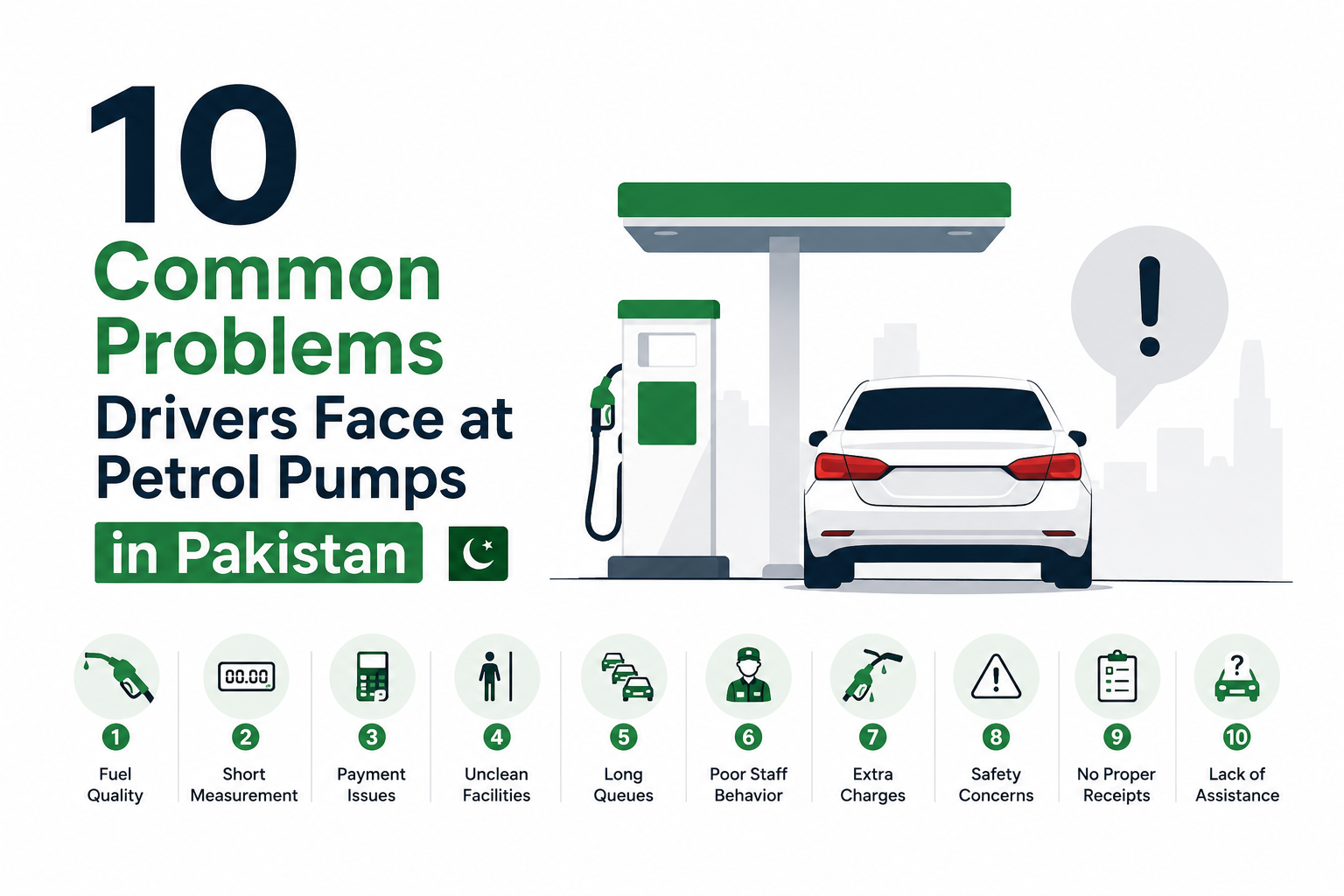
10 Key Problems Drivers Have to Face at Petrol Pumps
1. Poor Queues and Long Waiting Lines at Petrol Pumps
One of the most common frustrations is the long waiting time. During peak hours like morning office time, evening rush, or when fuel prices change, queues at petrol pumps in Pakistan become extremely longer than the normal routine.
The main issue is not just the number of vehicles but also poor management. There is often no proper lane separation for bikes, cars, and heavy vehicles. Everyone mixes into one line, which slows everything down.
In some cities, drivers also face sudden rushes when rumors of a shortage spread. People rush to fill tanks, and the situation becomes worse.
2. Attitude and Behavior of Staff at Petrol Pumps
Another major issue is customer handling. While many workers are polite, others are not trained to deal with pressure situations.
During busy hours, motorcycle riders often feel lower priority compared to cars or commercial vehicles due to the rude attitude of staff towards smaller vehicles.
A simple interaction at a petrol station should be respectful and quick, but poor communication creates unnecessary tension between drivers and staff. This affects trust and overall experience.
3. Wrong Fuel Filling or Meter Confusion
Drivers also worry about mistakes during refueling. In busy environments, even small errors can confuse.
Sometimes drivers feel the meter is not reset properly, or the nozzle is stopped too early. In other cases, fuel type confusion (petrol vs. diesel) creates serious concerns.
Since most drivers cannot open or inspect the tank process closely, they rely completely on staff honesty. This creates a natural sense of doubt even when nothing is wrong.
4. Overcharging and Price Mismatch Issues
Fuel prices are officially set, but not every driver checks them regularly. This creates room for confusion at Petrol Pumps Near Me.
Some drivers feel that prices are not clearly displayed or explained. Even a small mismatch in calculation creates distrust.
In reality, most issues come from a lack of communication, not necessarily wrongdoing. Still, the experience leaves drivers uncertain and careful every time they refuel.
5. Fuel Quality Concerns and Engine Performance
Fuel quality is a sensitive topic. Many drivers in Pakistan believe that not all fuel is the same. When a car shows reduced mileage, engine knocking, or sluggish performance, fuel quality is often blamed first.
These concerns are more common among long-distance drivers who depend on consistency. Even a small change in performance creates suspicion.
While most stations maintain standards, the perception problem still exists and affects customer confidence in petrol pumps.
6. Lack of Basic Facilities at Fuel Stops
A proper petrol pump in Pakistan should offer basic comfort, but many locations still lack proper facilities.
- Drivers often face issues like the following:
- Unclean washrooms
- Non-working air pressure machines
- Poor windshield cleaning setup
- No proper waiting space
For long-route travelers, these small facilities matter a lot. Without them, even a short stop becomes uncomfortable.
7. Safety Risks at Crowded Stations
Safety is another major consideration at busy locations. When your nearest petrol pumps are overcrowded, or vehicles are parked too close together.
Motorcycles often move between cars, creating risky conditions. In extreme cases, fuel spills or careless smoking can increase danger.
Most stations are safe, but the lack of discipline during rush hours increases risk. Proper spacing and monitoring are often missing in smaller towns.
8. Payment Issues and Limited Digital Systems
Cash is still widely used in many areas. This slows down the process during peak hours.
Drivers often face delays in receiving change or confirmation. Some stations do offer digital payments, but it is not consistent everywhere.
A smoother system would help reduce waiting time and improve the overall experience at fuel stops, especially for regular commuters.
9. Fuel Shortages and Supply Problems
At times, drivers suddenly find that fuel is unavailable. This results in confusion, long queues, and frustration.
These shortages are not always local issues. They are often linked to larger supply challenges and distribution planning.
Even a minor disruption in transport or storage can affect availability at multiple fuel stations at once.
10. Trust Issues Between Drivers and Staff
Trust is a vital element in every refueling process. Usually, drivers prefer to double-check readings and watch the meter closely due to a lack of trust in the staff.
It is not always due to a bad experience but more due to fear of minor mistakes or misunderstandings.
As time passes, this ignites mental pressure for both sides. A smoother, clearer system can shrink this gap.
Industry-Level Challenges Behind the Scenes
Behind every refueling stop, there is a large system working continuously. The petroleum industries depend on proper coordination from import to storage and distribution.
Any delay in planning or transportation affects supply at local stations. This shows how connected the system really is.
Efficient Logistics and Supply Chain Management is important to make sure that drivers never face sudden shortages or inconsistent supplies.
Importance of Petrol Pump Locations
Every gas station is different from the others. A petrol pump business located in a major city mostly offers better facilities, well-trained staff, and well-structured systems.
In rural or low-population areas, service quality may not be as consistent. Even well-known petrol pump brands can differ based on management and location.
Over time, drivers begin to trust certain franchises more than others, sometimes by remembering a specific petrol pump name they prefer for trustworthiness.
Role of Distribution Networks in Service Quality
Service quality at stations is not only about staff behavior. It also depends on how fuel reaches them.
A strong Fuel and Lubricant Distributor in Pakistan ensures a consistent supply and better product quality. When distribution is smooth, drivers experience fewer issues and more stable service.
This reduces stress for both station owners and customers.
Conclusion
Routine life at any petrol pump in Pakistan is not always as simple as it looks. Drivers face multiple small but crucial challenges like long queues, trust issues, service gaps, and facility problems.
These challenges may look minor as individuals, but collaboratively they shape how a driver behaves at a petrol pump. Improving clarity, petrol service quality, and basic infrastructure can make refueling faster, safer, and even more convenient for everyone at the petrol station.







No Comment! Be the first one.