


Curcumin’s Absorption Problem Is Real — Here’s How Micellar Technology Actually Solves It
Standard curcumin barely reaches your bloodstream. Here's the science behind micellar curcumin, what the pharmacokinetic data actually shows, and the honest trade-offs formulators need to know.

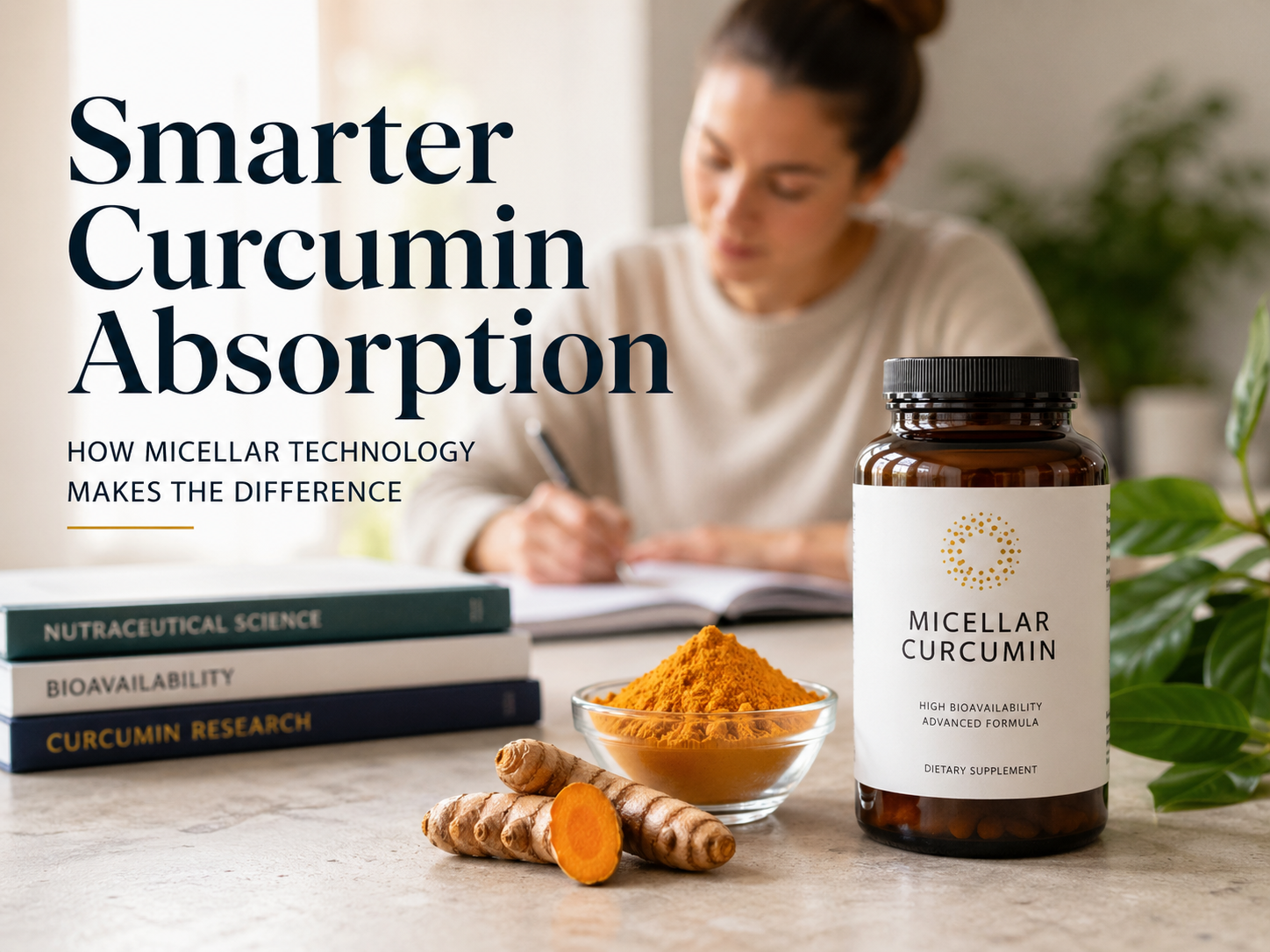
Micellar technology curcumin sits at an interesting crossroads in nutraceutical science: a delivery innovation that is simultaneously well-evidenced and widely misunderstood. Before evaluating whether micellar formulation belongs in a product brief or a supplement stack, it helps to start with why standard curcumin keeps failing — because the problem is more fundamental than most ingredient shortlists acknowledge.
Table Of Content
The Bioavailability Gap Is Not a Marketing Problem
Curcumin, the principal bioactive compound in Curcuma longa, has attracted more than 5,000 published studies over the past three decades. The scientific interest is legitimate. The clinical results, however, have been frustratingly inconsistent — and in many cases, the compound itself is not the issue. The delivery format is.
In a frequently cited pharmacokinetic study, patients received 3.6 grams of standard curcumin extract daily. At that dose — roughly eight capsules — detectable free curcumin in plasma was almost non-existent. The compound cleared the gut, triggered partial metabolism in the intestinal wall, and was largely excreted before it had any meaningful systemic presence. This is not an edge case. It reflects curcumin’s fundamental chemistry: it is lipophilic, poorly water-soluble, and subject to rapid glucuronidation and sulfation that convert it into inactive metabolites.
Piperine — the black pepper alkaloid that became the standard workaround — improves matters by inhibiting glucuronidation enzymes. It offers a meaningful improvement over native curcumin, but it introduces its own constraints: it affects the metabolism of other compounds (relevant for patients on certain medications), and the bioavailability uplift, while real, is modest relative to what micellar formulations achieve.
In our experience working with formulation decisions in the specialty ingredients space, the piperine combination was treated for years as the settled answer. It was not. It was a temporary fix for a structural problem in how curcumin is presented to the gut.
What Micelles Actually Do — and Why the Mechanism Matters
A micelle is not a coating or a capsule in the conventional sense. It is an assembly of lipid molecules — typically polysorbates or similar amphiphilic carriers — that arrange themselves into a nanoscale spherical structure with a hydrophilic exterior and a hydrophobic core. Curcumin, being lipophilic, sits inside that core. The entire structure is water-dispersible.
This changes three things simultaneously. First, curcumin is presented to the intestinal epithelium in a solubilised form, dramatically increasing its contact surface area with absorptive cells. Second, the micellar carrier facilitates direct uptake via endocytosis pathways that bypass some of the metabolic bottlenecks that deactivate free curcumin. Third — and this is the detail that most consumer-facing content glosses over — the nanoscale particle size extends the window during which curcumin remains available in the gastrointestinal tract before clearance.
The pharmacokinetic data from human crossover trials bears this out. In a double-blind randomised crossover study published in Molecular Nutrition & Food Research (Grafeneder et al., 2022), 15 healthy volunteers received either micellar or native curcumin at 105 mg per day for seven days. Micellar curcumin produced a maximum plasma concentration approximately 39 times higher than native curcumin, with an area-under-the-curve roughly 14 times greater. Absorption was also faster: time to peak concentration was under 45 minutes for micellar curcumin versus over four hours for the native form.
The University of Hohenheim study — conducted with the NovaSOL micellar formulation — reported an even larger advantage in some subjects, with bioavailability increases approaching 185-fold compared with unformulated curcumin powder, though it is worth noting that these figures vary considerably by comparator, analytical method, and subject population. The 185x figure refers to AUC for total curcuminoids under specific conditions; other well-designed trials using different micellar systems report more conservative but still substantial improvements. Formulators should treat these numbers as directionally accurate, not as fixed conversion ratios.
Where the Science Gets Complicated
Here is the part that most brand content leaves out — and it matters.
The Grafeneder et al. trial mentioned above found that improved bioavailability did not translate into a measurable reduction in pro-inflammatory cytokines (IL-6 and TNF-α) in an ex vivo model of acute inflammatory response over seven days. The same study did find a statistically significant reduction in PCSK9 concentrations — roughly 10% after seven days — which is potentially relevant for cardiovascular health, though the researchers noted it warrants further investigation before clinical conclusions can be drawn.
What this tells us is that bioavailability improvement is necessary but not sufficient. Getting more curcumin into the bloodstream is a prerequisite for clinical benefit; it does not guarantee it. The endpoint being measured, the dose, and the duration of intervention all determine whether that curcumin in plasma translates into a detectable functional effect. Colorectal inflammation studies in animal models (using micellar curcumin in drinking water, published in Nutrition and Cancer, 2021) showed meaningful suppression of inflammation and reduced tumour formation — but animal models and short-term human trials measure different things.
I genuinely do not know, at this stage in the literature, whether micellar curcumin will outperform standard curcumin on all relevant human clinical endpoints given equivalent duration and appropriate doses. The mechanistic case is sound. The pharmacokinetic advantage is well-established. The functional benefit evidence, at population scale, is still accumulating. Responsible positioning of a micellar curcumin ingredient acknowledges this.
Micellar vs. the Alternatives: A Formulator’s Comparison
Several enhanced-bioavailability curcumin formats compete in the current market. Each has a legitimate evidence base; none is universally superior for every application.
Curcumin phytosomes (such as Meriva, from Indena) use phosphatidylcholine as a lipid carrier. They are well-studied — over 30 clinical trials — and particularly robust for musculoskeletal and gastrointestinal endpoints. The bioavailability advantage over native curcumin is meaningful but considerably lower than micellar formats in head-to-head comparisons.
BCM-95 (Biocurcumax) takes a different approach, combining curcuminoids with turmeric essential oils to leverage a whole-plant synergistic effect. It has shown approximately 7-fold bioavailability improvement over standard curcumin in some trials. Its advantage is a more ‘natural’ formulation story — relevant for brands positioning to clean-label consumers.
Liposomal curcumin uses phospholipid bilayer vesicles. The technology is established in pharmaceutical drug delivery and is making inroads in nutraceuticals, but consistency of liposome size and stability across manufacturing batches remains a practical challenge at commercial scale.
Solid lipid curcumin particles (the basis for Biotest’s patented formula, developed with UCLA neuroscientists) are a distinct sub-category sometimes marketed under the micellar umbrella. A crossover pharmacokinetic study published in Nutrients (2021) placed micellar curcumin ahead of phytosome and piperine formulations on total curcuminoid AUC values, though absolute figures varied substantially by individual.
The honest formulator’s conclusion: micellar delivery currently holds the strongest pharmacokinetic profile in the published literature, but the clinically meaningful advantage over phytosomes for specific endpoints — joint health, gut inflammation — is less clear-cut. The choice between formats should be driven by endpoint target, dose, and the specific manufacturing partner’s quality data, not by headline bioavailability multipliers alone.
What This Means in Practice for Brands and Buyers
For nutraceutical brands evaluating a micellar curcumin ingredient, the most important due diligence questions are not about the bioavailability headline. They are about formulation stability (micelles can be sensitive to temperature and pH during manufacturing), compatibility with other actives in a blend, whether the ingredient can be delivered as a liquid, powder, or encapsulated form, and what dose reduction is realistic given the absorption improvement.
That last point matters commercially. If micellar curcumin genuinely delivers 14–30 times more curcumin to systemic circulation than a native extract, a formulation using 100–200 mg of micellar curcumin may achieve plasma levels that would require 1.5–3 g of standard extract. That is a meaningful per-capsule and per-serving advantage for brands managing ingredient costs, capsule count, and consumer compliance.
For scientifically literate consumers, the takeaway is more straightforward: if you have been taking standard curcumin extract and not noticing anything, the delivery format is a plausible explanation. The compound is not reaching your bloodstream at meaningful concentrations. A micellar or phytosome formulation changes that equation.
Regulatory framing differs by market. In the EU, health claims for curcumin are not approved under EFSA’s Article 13 list, which means brands must be careful about specific disease or health-benefit language regardless of bioavailability format. In the US, FDA requires that curcumin products sold as dietary supplements comply with structure/function claim rules — benefits can be stated, but disease claims cannot. In India, where curcumin carries deep cultural and Ayurvedic significance, FSSAI governs labelling, and the landscape for functional ingredient positioning is evolving.
Companies like Samarth Biorigins LLP, which specialise in high-bioavailability ingredient solutions and apply advanced formulation technologies, are well-positioned to navigate these regulatory and technical requirements — but any ingredient supplier worth working with should be able to provide third-party analytical data, stability reports, and formulation guidance specific to the intended application, not just bioavailability claims.
The Conclusion the Literature Keeps Circling
Micellar curcumin solves a real problem. Standard curcumin’s poor bioavailability is not a myth perpetuated by ingredient suppliers — it is documented in pharmacokinetic literature going back decades. Micellar encapsulation addresses the root causes: poor aqueous solubility, limited intestinal absorption, and rapid pre-systemic metabolism.
What micellar technology does not do is make the clinical case automatically. The science of what curcumin does once it is absorbed — at what dose, over what duration, for which endpoints — remains active research territory. Brands that lead with ‘185x more bioavailable’ and leave it there are telling an incomplete story. The more defensible and ultimately more effective position is to explain what higher bioavailability enables: more curcumin reaching systemic circulation, at lower doses, faster — and then let the downstream evidence on inflammation, cardiovascular markers, and neuroprotection make the case with appropriate hedging. That combination — honest mechanism, real pharmacokinetic data, acknowledged clinical uncertainty — is what separates credible nutraceutical brands from commodity players in an increasingly sophisticated market.
Publisher: The Viral Blogs






No Comment! Be the first one.