



Custom T-Shirts: Complete Guide for Design and Printing Tips (2026 Edition)
Custom T-shirt printing has become one of the most popular ways for businesses, creators, and organisations to build brand visibility in 2026. Custom T-shirts are personalised garments with unique...

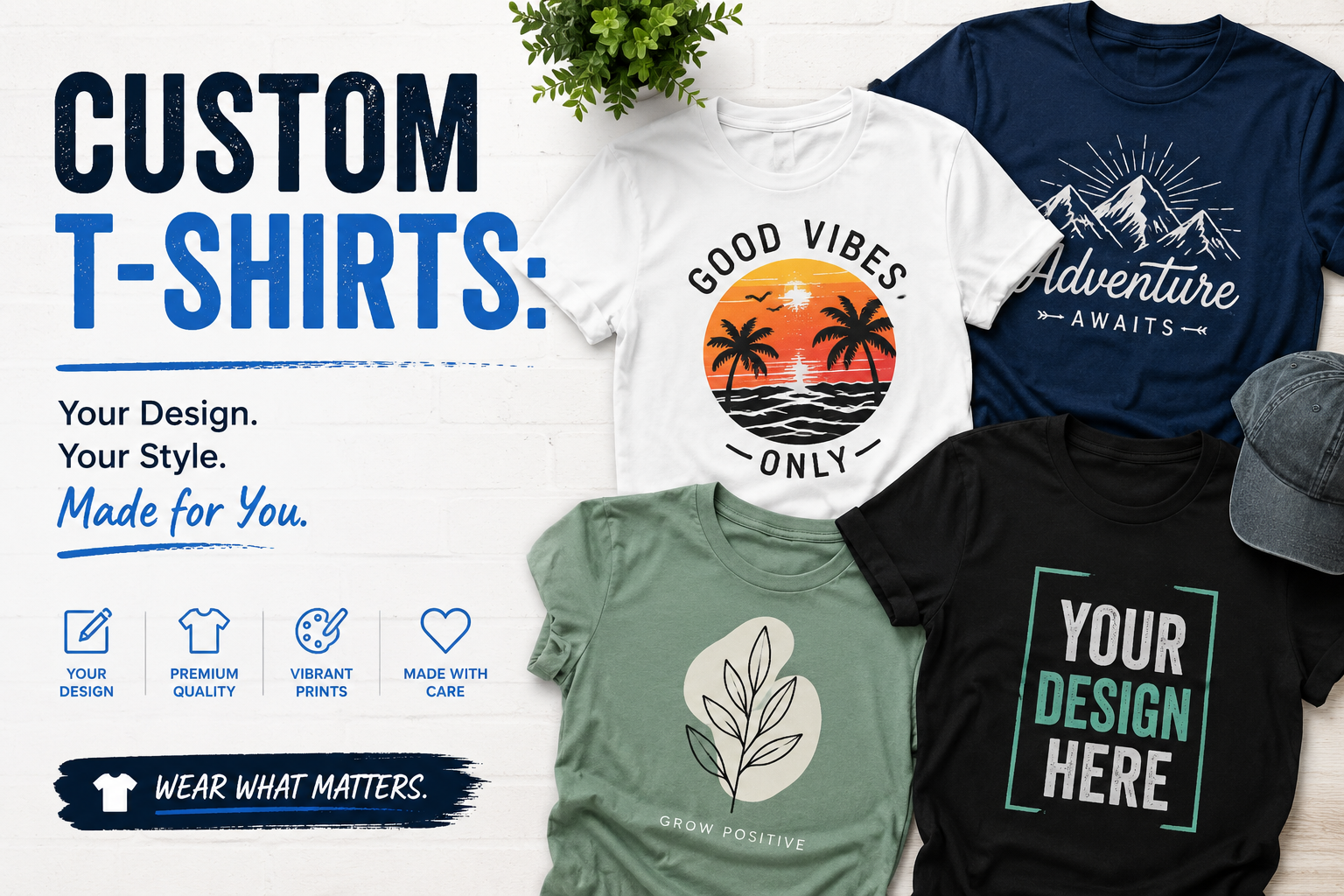
Custom T-shirt printing has become one of the most popular ways for businesses, creators, and organisations to build brand visibility in 2026.
Table Of Content
- Why Custom T-Shirts Matter for Businesses and Creators
- Branding and Marketing Benefits
- Revenue Opportunities
- Use Cases
- How to Design a Custom T-Shirt (Step-by-Step Guide)
- Step 1: Define the Purpose
- Step 2: Choose the Right Fabric
- Step 3: Select the T-Shirt Style
- Step 4: Create the Design
- Design Tips
- Tools to Design
- T-Shirt Printing Methods Explained (Pros & Cons)
- Screen Printing
- Direct-to-Garment (DTG)
- Heat Transfer Printing
- Sublimation Printing
- Embroidery
- Common Mistakes to Avoid When Designing Custom T-Shirts
- Final Checklist Before You Order
Custom T-shirts are personalised garments with unique designs, such as logos, artwork, slogans, or graphics, which can be printed or embroidered onto them. The most common reason businesses or people make printed t-shirts is that:
- They share it with people at events because they are widely used to promote brand image or logo.
- To sell them in merchandise sales to generate revenue.
- Or people wear them personally.
Printed shirts are created using methods like:
- Screen printing: Your imprint designs on the shirt using ink that is pushed through a mesh stencil
- Direct-to-garment (DTG): You use a digital printer to apply ink directly onto the fabric, similar to printing on paper.
- Heat transfer: Your design is printed onto transfer paper and applied to the shirt using heat and pressure.
- Sublimation: Heating the ink into a gas that bonds with polyester fabric.
- Embroidery: You stitch the design to the shirts with thread rather than using ink.
Brands, businesses, content creators, influencers, schools, startups, and entrepreneurs use custom t-shirts as a strategic tool for branding, monetisation, and identity expression.
Why Custom T-Shirts Matter for Businesses and Creators
Others might see custom shirts as just regular clothing, but many use them to market, drive revenue, and build community.
Branding and Marketing Benefits
Everyone who wears a branded shirt with a brand logo promotes the brand wherever they go.
- Walking billboard effect: When a custom shirt features your logo and someone wears it, it promotes your brand as others see people wearing it.
- Brand recall and visibility: the more people wear your custom shirt, the more others tend to remember your brand logo easily.
- Employee uniform cohesion: it makes staff easily identifiable to customers.
- Event marketing: At trade shows, launches, or conferences, custom T-shirts help teams make a lasting impression.
Revenue Opportunities
- Merchandise sales: Businesses or brands can sell custom shirts for customers, turning loyal followers into customers.
- Print-on-demand business model: Platforms like Printful and Printify allow sellers to launch without inventory. But can place orders for custom shirts later on.
- Low startup cost: You do not need to spend much to actually print custom t-shirts, as digital design tools and on-demand printing require minimal cost upfront.
Use Cases
- Corporate events: shirts allow staff to have a professional presence in corporate events.
- Influencer merchandise: creators on YouTube or Instagram sell custom shirts for revenue.
- Sports teams: for the team’s brand promotion during games.
- Family reunions: it creates a sense of belonging and good memories
- Non-profits: for fundraising campaigns, volunteer identification, and awareness drives.
How to Design a Custom T-Shirt (Step-by-Step Guide)
A custom t-shirt is more than just having a logo on it. You need to consider things like:
- The purpose of customising a shirt,
- Fabric type
- Fit
- The file setup determines how professional and durable your final product will look.
Step 1: Define the Purpose
Why are you actually creating a shirt?
- Branding? To promote your brand’s logo, a clean and simple design works best.
- Event? Include data location and theme in the design. It should be readable.
- Fashion? Use a trendy design and be appealing in the fashion sense. The design could be an artwork.
- Fundraising? Use messages that appeal to fundraisers and make them want to give?
Step 2: Choose the Right Fabric
- Cotton (100%)
- Breathability: This is what people can wear everyday and it feels comfortable for them.
- Durability: Usually lasting
- Shrinkage Risk: Moderate if not pre-shrunk
- Printing Compatibility: Excellent for screen printing and DTG
- Cotton/poly blend
- Breathability: Not as comfortable as cotton, but actually comfortable.
- Durability: Very good (wrinkle-resistant)
- Shrinkage Risk: Low
- Printing Compatibility: Good, but colours may appear slightly muted
- Performance fabrics
- Breathability: best for those who want to allow airflow, not necessarily for comfort.
- Durability: High
- Shrinkage Risk: Very low
- Printing Compatibility: Best for sublimation
- Organic options
- Breathability: High
- Durability: Similar to regular cotton
- Shrinkage Risk: Moderate
- Printing Compatibility: Excellent
Step 3: Select the T-Shirt Style
- Crew neck vs V-neck: Crew neck shirts are usually popular, and lots of people love wearing them as opposed to v-necks which are fashionable and more fitting.
- Oversized vs fitted: Oversized is a favourite choice for many, while fitted is just for those who want fitting.
- Long sleeve vs short sleeve: Short-sleeved shirts are popular and cheaper to make than long-sleeved shirts, which are premium-feeling and might feel comfortable for some.
- Unisex vs gender-specific cuts: Unisex makes you spend less on inventory. While gender specific and personalised, better fit and more comfortable.
Step 4: Create the Design
Design Tips:
- Use high-resolution files (300 DPI)
- Vector formats (AI, SVG, EPS)
- Use RGB vs CMYK correctly
- Contrast matters (dark shirts vs light ink)
Tools to Design:
- Canva
- Adobe Illustrator
- Adobe Photoshop
- Figma
T-Shirt Printing Methods Explained (Pros & Cons)
Understanding different custom T-shirt printing methods affects how much you spend, whether the printing is durable and of high quality.
Screen Printing
Best for: Bulk orders
Pros:
- Long-lasting because you do it with high-tension, chemically resistant, and wear-resistant materials.
- Vibrant colors
- Cost-effective when printing in bulk. For one, you can use a single stencil to print on thousands of shirts.
Cons:
- Expensive for small orders because you pay a high price for labour and to set up the mesh stencil.
Direct-to-Garment (DTG)
Best for: Small batches, because it’s just like printing on paper. No set-up required, like creating screens or plates required by traditional methods. Just a heat press machine, which is affordable.
Pros:
- Detailed prints because it prints thousands of small tiny inks on the shirt and supports 1400+ DPI, making it clear, well-inked and high quality.
- No minimum order, with the inkjet technology, you spend less on printing.
Cons:
- Slower for bulk because you have to print one at a time.
- Slightly higher cost per shirt
Heat Transfer Printing
Best for: Small DIY projects because you do not need to invest in much equipment for printing. You use heat press machines, which can be affordable.
Pros:
- Affordable
- Print as fast as you can in bulk, quickly.
Cons:
- Designs can peel over time because the printing is done on the surface rather than being absorbed.
Sublimation Printing
Best for: Polyester fabrics
Pros:
- No cracking
- Full-colour designs
Cons:
- Works only on light polyester
Embroidery
Best for:
- Corporate wear
- Premium branding
Pros:
- Professional and high-end appearance
- Extremely durable
- Ideal for logos
Cons:
- Higher cost per unit
- Limited detail for complex artwork
Common Mistakes to Avoid When Designing Custom T-Shirts
- Low-resolution images
- Poor color contrast
- Overcrowded design
- Ignoring print area boundaries
- Not ordering samples
- Choosing the wrong fabric for printing type
Final Checklist Before You Order
- Confirm design resolution
- Confirm shirt sizes
- Confirm print placement
- Ask for a sample
- Confirm turnaround time
For high-quality custom T-shirts and branded apparel, visit Push Promotions.
Phone: 0800 00 78 74
Address: 3 Sunnyview Road, Greenhithe, Auckland 0632, New Zealand



No Comment! Be the first one.