




Functional Testing: Building Confidence in Every Software Release
Software users expect products to work flawlessly. They want logins to succeed, payments to process correctly, forms to submit without errors, and features to behave exactly as promised. Even a small...

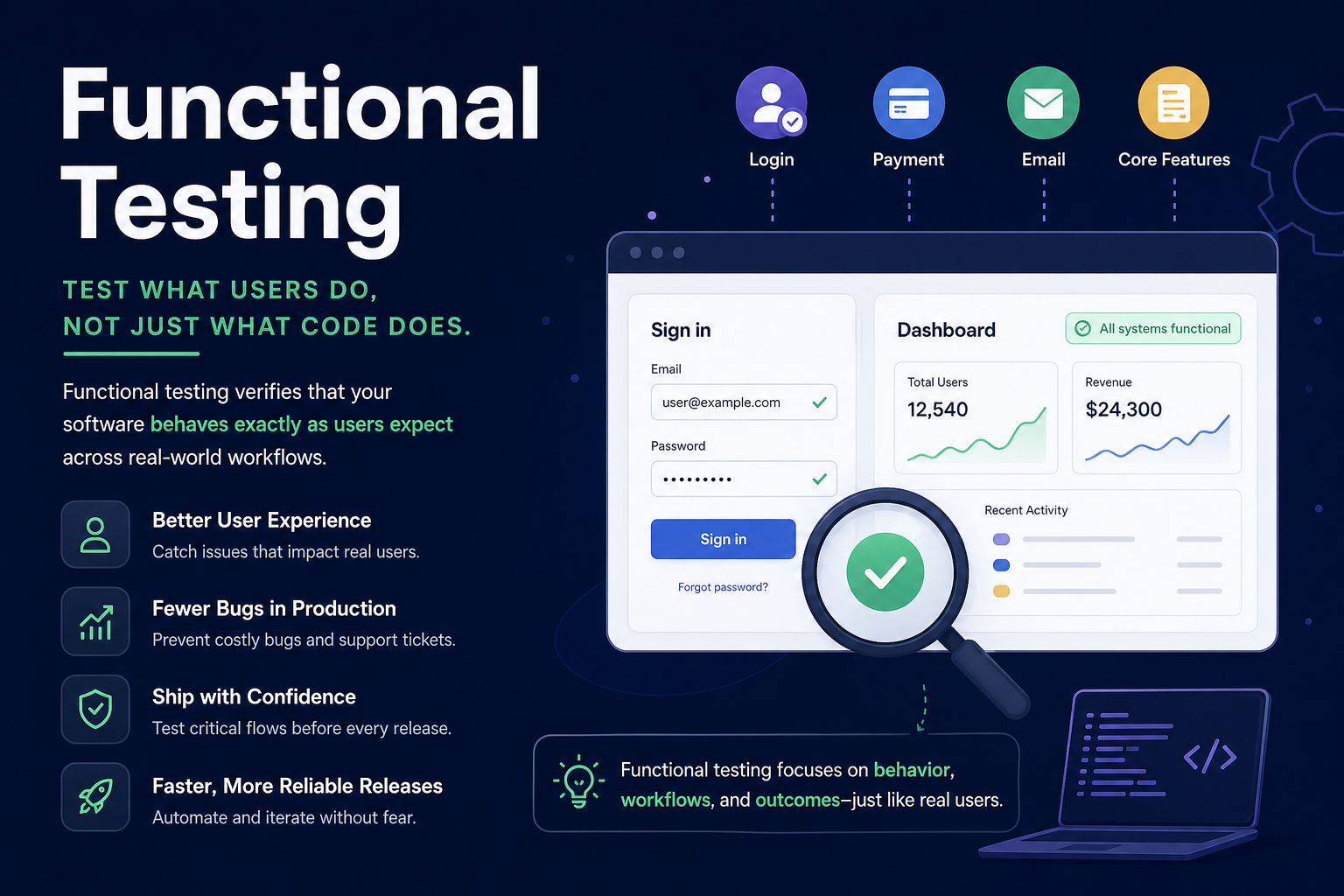
Software users expect products to work flawlessly. They want logins to succeed, payments to process correctly, forms to submit without errors, and features to behave exactly as promised. Even a small failure can damage trust and create costly support issues. That is why functional testing remains one of the most important parts of software quality assurance.
Functional testing is the process of verifying that an application’s features work according to business and technical requirements. It checks whether the software produces the expected output when users perform specific actions. Unlike code-level testing that focuses on internal structure, functional testing evaluates behavior from the user’s perspective.
For example, if a user enters valid credentials, the login page should grant access. If a customer adds items to a cart, the total should update correctly. If a payment is completed, an order confirmation should be generated. These real-world scenarios are the core of functional testing.
The biggest advantage of functional testing is that it validates what matters most to customers: usability and reliability. A beautifully written codebase means little if users cannot complete key tasks. Functional testing helps teams catch broken workflows before they reach production.
There are multiple levels of functional testing used across the development lifecycle. Unit testing checks small components such as individual methods or functions. Integration testing validates how modules and services work together. System testing evaluates the complete application. Acceptance testing confirms that the product meets business goals and user expectations.
Modern applications often include web interfaces, mobile apps, APIs, databases, and third-party integrations. Because of this complexity, functional testing is more important than ever. A failure in one connected component can impact the entire user journey.
Strong functional testing strategies usually include:
- Clear test cases based on requirements
- Realistic user scenarios
- Positive and negative test coverage
- Regression testing after every release
- Automated execution for repetitive flows
- Continuous testing in CI/CD pipelines
Automation has transformed functional testing by helping teams move faster without sacrificing quality. Repetitive checks like login flows, checkout steps, API validations, and form submissions can run automatically on every deployment. This reduces manual effort and catches regressions earlier.
Platforms like Keploy are helping teams modernize functional testing through automated API and workflow validation. By generating tests from real interactions, teams can improve coverage while accelerating releases.
However, automation alone is not enough. Teams still need thoughtful test design, clear requirements, and regular maintenance of test suites. Functional testing works best when it combines human insight with scalable automation.
Common issues uncovered during functional testing include:
- Broken login or signup flows
- Incorrect calculations
- Missing validation messages
- Failed API responses
- Navigation errors
- Permission and access issues
- Checkout or payment failures
These problems directly affect revenue and customer satisfaction, making early detection essential.
As businesses release software faster, functional testing becomes a competitive advantage. It allows teams to ship confidently, reduce incidents, and deliver smoother user experiences.
In the end, software success is not only about innovation—it is about consistency. Users return to products they can trust. Functional testing is the discipline that helps earn and keep that trust with every release.