



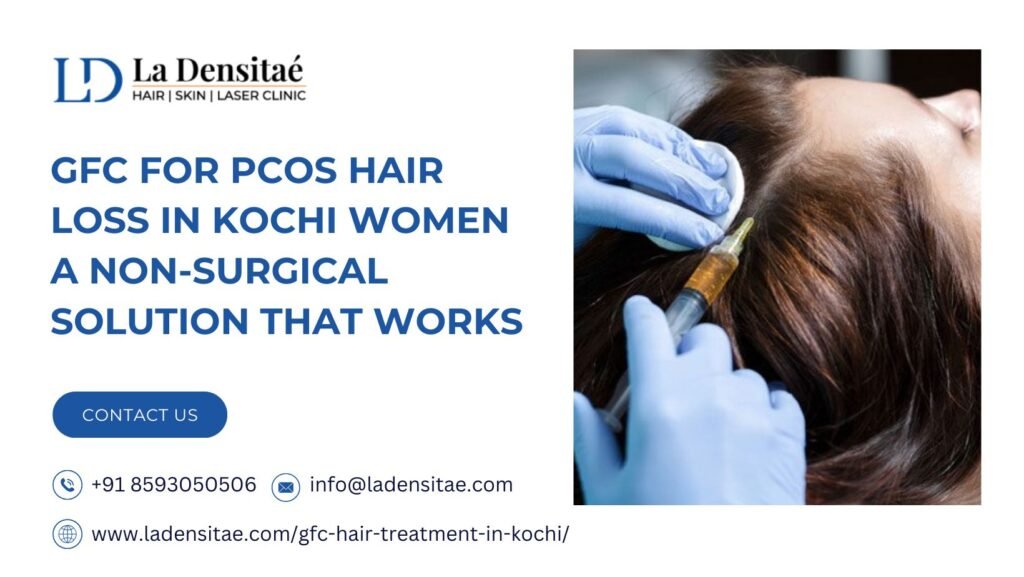
Living with PCOS is already a full-time challenge. The hormonal imbalances, the irregular cycles, the weight fluctuations and then on top of all of that, you start losing your hair. For many women in Kochi, PCOS hair loss is one of the most emotionally difficult parts of the entire condition. It’s visible, it’s progressive, and for a long time, it felt like something you just had to silently accept.
Table Of Content
- Why PCOS Causes Hair Loss in Women
- What Is GFC Hair Treatment and How Does It Help?
- Why GFC Is Particularly Effective for PCOS Patients
- What Results Can Kochi Women with PCOS Realistically Expect?
- Is GFC Available at Hair Clinics in Kochi?
- When Does PCOS Hair Loss Require a Hair Transplant?
- Final Thoughts
That’s changing. And GFC hair treatment is a big part of why.
Why PCOS Causes Hair Loss in Women
Before exploring the solution, it’s worth understanding what’s actually happening inside your body because it directly shapes which treatments work and which ones don’t.
PCOS hair loss is driven by elevated androgens specifically DHT (Dihydrotestosterone), the hormone responsible for follicle miniaturisation. When androgen levels rise above normal due to PCOS, DHT begins attacking hair follicles on the scalp gradually shrinking them, weakening the hair they produce, and eventually causing them to stop producing hair altogether.
The pattern is distinctive. Unlike male baldness which creates defined bald patches, PCOS hair loss in women typically presents as diffuse thinning a widening part line, reduced overall density across the crown, and hair that looks and feels progressively finer over time. It’s the kind of hair loss that others might not immediately notice but that you see every single morning in the mirror.
What makes it particularly frustrating is the ongoing hormonal environment. Even when you address the visible symptoms, if the underlying androgen elevation continues unmanaged, hair loss keeps progressing. This is why the most effective treatments for PCOS-related hair loss always work alongside not instead of proper medical management of PCOS itself.
What Is GFC Hair Treatment and How Does It Help?
GFC hair treatment Growth Factor Concentrate therapy is a non-surgical, minimally invasive procedure that uses concentrated growth factors extracted from your own blood to stimulate hair follicle activity and encourage natural regrowth.
A small amount of your blood is drawn and processed through a specialised closed-system kit. This kit isolates only the pure growth factors removing unnecessary blood components and delivering a highly concentrated, potent solution that is injected directly into the areas of your scalp experiencing thinning or hair loss.
For women dealing with PCOS hair loss, GFC works by delivering powerful biological signals to follicles that have been weakened by DHT improving blood supply to the scalp, reducing inflammation around the follicle, and actively pushing hair back into its growth phase. It doesn’t just nourish follicles from the outside it creates the biological conditions inside the scalp that allow weakened follicles to function properly again.
Why GFC Is Particularly Effective for PCOS Patients
This is the question many Kochi women ask and it deserves a clear, direct answer.
PCOS hair loss is hormonal in nature. The follicles aren’t dead they’re suppressed. And this is precisely where GFC excels. Because GFC hair treatment targets follicle activity at the biological level, it’s particularly well-suited to cases where follicles are miniaturised but still alive and capable of being reactivated.
Unlike conventional treatments like minoxidil which improves surface blood flow but doesn’t address follicle biology directly GFC delivers growth factors that interact with the follicle’s own regenerative mechanisms. The result is more targeted, more meaningful stimulation for the exact type of follicle damage that PCOS creates.
It’s also worth noting that GFC is significantly more advanced than standard PRP therapy. While PRP delivers a mix of blood components to the scalp, GFC hair treatment in Kochi isolates only the pure growth factors removing everything that doesn’t directly serve follicle activation. This makes GFC more concentrated, more consistent, and more effective for hormonal hair loss cases specifically.
What Results Can Kochi Women with PCOS Realistically Expect?
Honest expectation-setting matters and any trustworthy specialist will tell you the same.
GFC works on a biological timeline. Hair follicles have their own growth cycles, and no treatment however advanced can shortcut that biology. What patients consistently experience is meaningful, progressive improvement when sessions are followed consistently.
Most women notice a reduction in daily hair shedding within four to six weeks of their first session which is often the most immediately reassuring sign that treatment is working. By month two, improved hair texture, increased shaft strength, and better overall scalp health become noticeable. Visible improvement in density and thickness typically appears between months three and four. New hair growth in previously thinning areas becomes visible between months four and six for patients who respond well.
A standard GFC protocol involves three to four sessions spaced four weeks apart, followed by maintenance sessions every six to twelve months. For PCOS patients specifically, consistency and maintenance are especially important because the ongoing hormonal environment means follicle support needs to be sustained rather than applied once and forgotten.
Results are also significantly better when GFC is combined with proper hormonal management of PCOS. Bringing androgen levels under better control medically whether through medication, diet, or lifestyle changes prescribed by your gynaecologist or endocrinologist creates a less hostile scalp environment, allowing GFC to work more effectively and the results to last longer.
Is GFC Available at Hair Clinics in Kochi?
Yes and its availability is growing as more clinics invest in advanced non-surgical protocols.
When looking for GFC hair treatment in Kochi, always prioritise clinics where qualified dermatologists or trichologists administer the procedure. PCOS-related hair loss has a hormonal complexity that requires specialist understanding not just general aesthetics expertise.
During your consultation at a reputable clinic, ask specifically about the GFC protocol used for PCOS patients, how many sessions are recommended for your specific stage of hair loss, whether the treatment will be combined with other approaches, and what realistic outcomes to expect for your individual hormonal situation.
The best hair transplant in Kochi clinics will answer every question honestly and thoroughly without rushing you into sessions or overpromising results that aren’t realistic for your situation.
When Does PCOS Hair Loss Require a Hair Transplant?
This is an important question and it deserves a straight answer.
GFC works beautifully for early to moderate PCOS hair loss where follicles are weakened but still alive. But for women whose hair loss has progressed significantly over years of unmanaged PCOS where large areas of the scalp have permanently lost functioning follicles non-surgical treatments alone may not restore adequate density.
In those cases, women hair transplant procedures become the more appropriate long-term solution. Healthy donor follicles from DHT-resistant areas of the scalp are relocated to the thinning zones growing permanently even within the elevated androgen environment created by PCOS, provided that hormone levels are medically managed before and after the procedure.
The right specialist will guide you toward whichever approach genuinely makes sense for your stage not the most expensive option regardless of whether it’s appropriate for you.
Final Thoughts
PCOS hair loss doesn’t have to be something you quietly accept. GFC hair treatment is proving to be one of the most effective non-surgical options for women dealing with hormonal hair loss and Kochi now has clinics offering this treatment at a genuinely high standard.
Combined with proper PCOS management and a consistent treatment protocol, GFC can make a real and meaningful difference to your hair health and your confidence.
The first step is a thorough consultation with a specialist who truly understands the hormonal complexity of your situation and can create a personalised plan that addresses both the root cause and the visible symptoms.






No Comment! Be the first one.