


How AI Is Transforming Digital Marketing in 2026
If you’re looking to see how AI Is transforming digital marketing in 2026, you’re probably looking to find out how it’s changing different aspects of search engines, advertisements,...

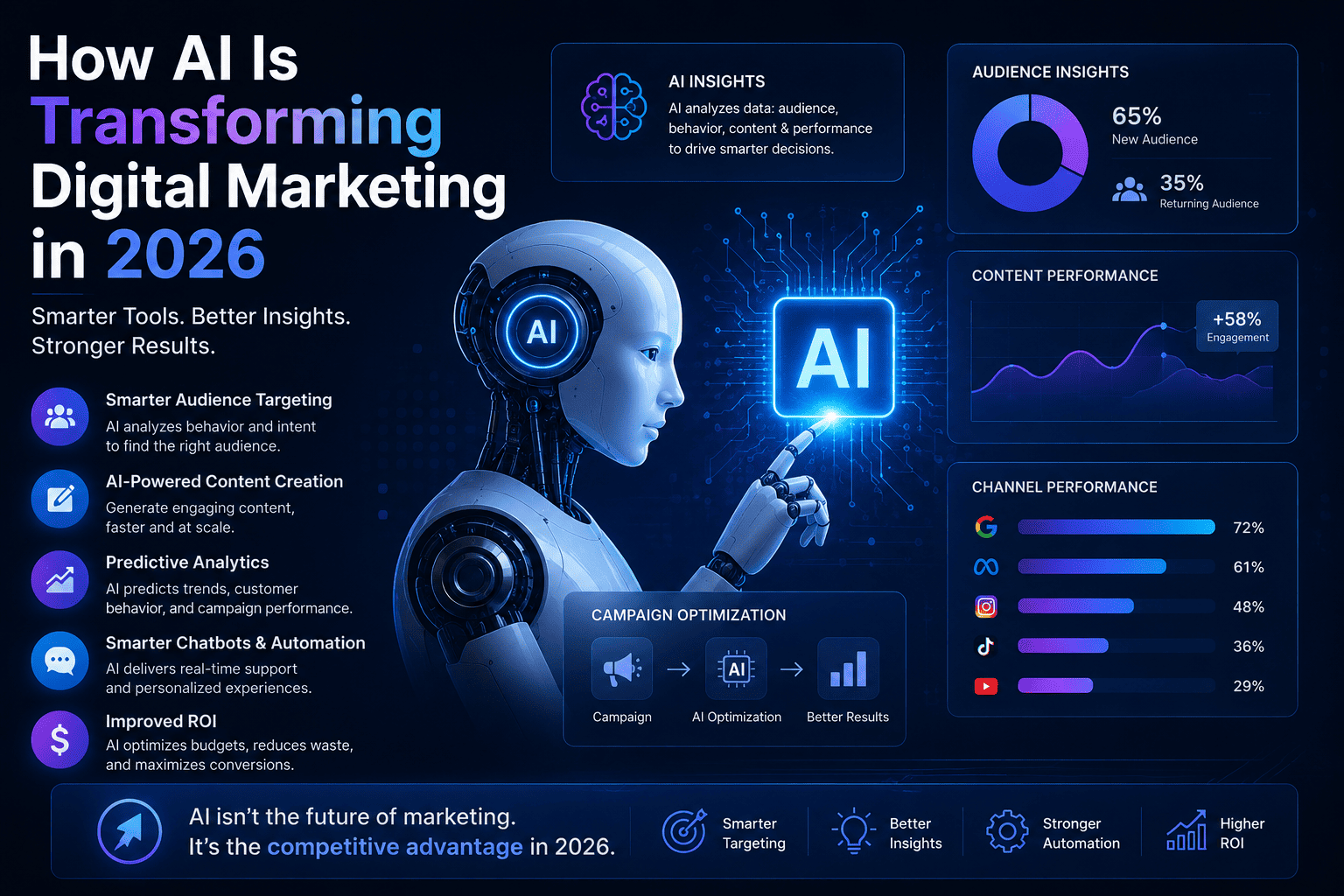
If you’re looking to see how AI Is transforming digital marketing in 2026, you’re probably looking to find out how it’s changing different aspects of search engines, advertisements, communications with customers and more. Today (in 2026), AI has replaced experimental features—it is now the operating system for modern marketing.
Table Of Content
- What Is AI in Digital Marketing?
- Why AI Is Dominating Digital Marketing in 2026
- 1. The End of Third-Party Cookies
- 2. Real-Time Hyper-Personalization
- 3. Cost Reduction Pressure
- 4. AI Search Engines (ChatGPT, Google SGE, Perplexity)
- How AI Is Transforming SEO
- Key transformations in AI SEO
- How AI impacts Google rankings
- AI in Content Marketing
- What AI does well
- What still requires humans
- AI in Google Ads & PPC
- How AI improves Google Ads
- AI in Social Media Marketing
- Top applications
- AI Personalization & Customer Experience
- What hyper-personalization looks like
- Best AI Marketing Tools in 2026 (Comparison Table)
- Benefits of AI in Digital Marketing
- Risks & Challenges of AI Marketing
- AI misinformation
- Over-automation
- Privacy concerns
- Human creativity limitations
- Dependency risk
- Future of AI in Digital Marketing (2027 & Beyond)
- AI Agents
- AI-Generated Ads
- Voice Search Evolution
- Hyper-Personalization at Scale
- AI in Branding
- How Businesses Can Prepare for AI Marketing
- Step 1: Audit your current stack
- Step 2: Train your team on AI literacy
- Step 3: Implement one high-impact AI tool
- Step 4: Optimize for AI search engines
- Step 5: Establish human oversight
- Step 6: Partner with experts when needed
- FAQ Section: How AI Is Transforming Digital Marketing in 2026: The Future of Smarter Marketing Strategies
- What is AI in digital marketing?
- How is AI changing digital marketing?
- What are the best AI marketing tools in 2026?
- Is AI replacing marketers?
- Can AI improve SEO?
- How does AI help Google Ads?
- What is the future of AI marketing?
- Is AI marketing good for small businesses?
- Final Future Predictions
There is a new way of looking at digital marketing; it has been changed forever by an AI-powered SEO solution that can predict when Google will update its algorithm and generative AI solutions that provide hyper-personalized video advertisements in seconds. In this guide we will introduce you to every major change along with AI marketing tools that you can utilize, real-world examples of how people and businesses have successfully leveraged AI and what you should do to prepare your business for the upcoming wave of automated digital marketing.
What Is AI in Digital Marketing?
Artificial intelligence (AI) is used by digital marketers to leverage machine learning, natural language processing (NLP), predictive analytics, and generative models to automate and optimize their efforts. In contrast to previous automation techniques based on rules, AI-based digital marketing has a learning component in addition to being more efficient. As such, AI can adapt and improve its performance as it gains knowledge.
Key applications include:
- AI SEO optimization – Automating keyword research, content structuring, and technical audits.
- AI content creation – Generating blogs, social captions, and video scripts.
- Predictive marketing analytics – Forecasting customer lifetime value and churn.
- AI personalization – Displaying dynamic website content based on behavior.
- Chatbot marketing – Conversational AI that closes sales 24/7.
In 2026, nearly 84% of marketing organizations have integrated AI into their daily workflows, according to Gartner. The question is no longer if you should use AI, but how deeply.
Why AI Is Dominating Digital Marketing in 2026
Three forces explain why AI is dominating digital marketing this year:
1. The End of Third-Party Cookies
With cookies deprecated, traditional targeting collapsed. Machine learning in marketing now builds predictive audiences using first-party data and behavioral signals.
2. Real-Time Hyper-Personalization
Consumers expect brands to know them instantly. AI powered marketing analyzes clickstream, purchase history, and even emotional sentiment from support chats to tailor every touchpoint.
3. Cost Reduction Pressure
Economic uncertainty forces marketers to do more with less. AI marketing automation reduces manual work (email sequencing, bid management, reporting) by up to 70%, freeing teams for strategy.
4. AI Search Engines (ChatGPT, Google SGE, Perplexity)
Search is now conversational. If your content isn’t optimized for AI search engines, you become invisible. AI search optimization is now a core discipline.
Bottom line: In 2026, AI is the difference between generic campaigns and exponential growth.
How AI Is Transforming SEO
AI and SEO have become inseparable. Traditional keyword stuffing and link spam no longer work. Today, AI SEO tools understand user intent, topic clusters, and semantic relationships.
Key transformations in AI SEO:
| Area | Traditional SEO | AI SEO in 2026 |
| Keyword research | Exact-match volume | Intent clusters + question forecasting |
| Content optimization | Keyword density | NLP entity optimization + readability scoring |
| Link building | Manual outreach | AI-predicted authority scores + automated prospecting |
| Technical SEO | Crawl errors | Predictive Core Web Vitals alerts |
How AI impacts Google rankings:
- Google AI Overviews (formerly SGE) now appear for 64% of queries. To be cited, your content must answer “how,” “why,” and “what if” clearly.
- AI for SEO tools like Surfer SEO and Frase use real-time SERP analysis to tell you exactly which entities to include.
- AI website optimization includes automated schema markup generation and internal linking suggestions.
Example: A travel blog used AI SEO optimization to restructure 200 articles into topic clusters. Within 90 days, organic traffic increased 158%, and they were featured in 12 Google AI Overviews.
AI in Content Marketing
Generative AI marketing has evolved from producing mediocre blog posts to creating full-funnel content ecosystems. In 2026, AI content marketing tools handle research, drafting, visuals, and even video.
What AI does well:
- AI copywriting tools (Jasper, Copy.ai, Writesonic) generate ad variations, email sequences, and landing page copy in seconds.
- AI content strategy – Tools like MarketMuse identify content gaps based on competitor analysis and search intent.
- AI storytelling – Models now maintain consistent brand voice across thousands of pages.
- Video generation – Synthesia and HeyGen create presenter-led videos from text prompts.
What still requires humans:
- Strategic narrative
- Original research and interviews
- Emotional resonance and cultural nuance
Pro tip: Use AI for SEO and content creation together. Let AI draft the 80% foundation; you edit the 20% that adds unique expertise.
AI in Google Ads & PPC
AI driven advertising is no longer a beta feature—it’s the default. Google Ads now requires smart bidding for most new campaigns, and Performance Max (PMax) uses deep learning to allocate spend across channels.
How AI improves Google Ads:
| Feature | How AI helps |
| Smart Bidding | Predicts conversion probability at auction-time |
| Audience expansion | Finds lookalikes you didn’t know existed |
| Responsive search ads | Tests thousands of headline/description combos |
| Broad match + Smart Bidding | Interprets misspellings and synonyms dynamically |
| AI advertising tools | Auto-generates assets and A/B tests creatives |
AI for Google Ads also reduces wasted spend. One ecommerce brand reduced CPA by 34% after switching to AI-driven portfolio bid strategies.
Key insight: In 2026, manual bid adjustments are obsolete. You are competing against algorithms, not humans.
AI in Social Media Marketing
AI in social media marketing goes far beyond scheduling posts. Modern platforms (Meta, TikTok, LinkedIn) are AI-native. Their algorithms decide reach, but AI marketing tools help you feed them the right content.
Top applications:
- AI scheduling – Publishes when your specific audience is most active.
- Trend analysis – AI scans billions of posts to recommend viral audio or formats before they peak.
- AI creatives – Generates ad copy, image variations, and video clips from a single URL.
- Social listening – NLP models detect early brand crises or emerging customer needs.
Example: A beauty brand used AI in digital marketing to analyze Reddit and TikTok comments, identifying a demand for “vanilla cinnamon” scents. They launched a product in 6 weeks (vs. 6 months) and sold out in 3 days.
AI Personalization & Customer Experience
AI personalization is the new competitive moat. Generic “Hi [First Name]” emails no longer impress anyone. In 2026, AI customer experience means real-time adaptation.
What hyper-personalization looks like:
- Website changes layout, offers, and CTAs based on past behavior and current intent.
- Email marketing – AI email marketing tools like Seventh Sense send emails when each subscriber is most likely to click.
- Chatbot marketing – AI chatbots (Drift, Intercom) resolve 68% of support queries instantly and escalate only complex issues.
- Predictive marketing analytics – Identifies which users are about to churn and triggers a retention flow automatically.
AI for small businesses has made this accessible. Tools like HubSpot’s AI tools or Mailchimp’s predictive segmentation offer enterprise-level personalization at SMB prices.
Best AI Marketing Tools in 2026 (Comparison Table)
Here are the best AI marketing tools across categories. Prices are approximate for 2026.
| Tool | Category | Key Features | Best For | Pricing (mo) |
| Jasper | AI content creation | Brand voice, SEO mode, API | Content teams | 49–49–499 |
| Surfer SEO | AI SEO optimization | SERP analyzer, content editor | SEO pros | 89–89–239 |
| HubSpot AI | AI marketing platform | Predictive lead scoring, smart content | Full-funnel marketers | 45–45–3,600 |
| Seventh Sense | AI email marketing | Send-time optimization, engagement scoring | Email specialists | $99+ |
| Mutiny | AI personalization | No-code website personalization | B2B SaaS | $149+ |
| Drift AI | chatbot marketing | Conversational AI, meeting booking | Sales-driven teams | $2,500+ |
| HeyGen | AI video generation | Avatar-based video from text | Social media & ads | 29–29–239 |
| Optmyzr | AI for Google Ads | Automated rules, bid suggestions | PPC managers | $299+ |
Tip: Start with one category. For most businesses, AI SEO tools (Surfer, Frase) and AI copywriting tools (Jasper, Copy.ai) offer the fastest ROI.
Benefits of AI in Digital Marketing
The benefits of AI in marketing are measurable and immediate:
- Increased efficiency – Tasks that took 8 hours (competitor analysis, keyword grouping) now take 20 minutes.
- Better ROI – AI reduces wasted ad spend and improves conversion rates through better targeting.
- Faster campaigns – From concept to launch in days, not weeks.
- Improved targeting – Behavioral and predictive segments outperform demographics.
- Reduced costs – One AI tool can replace three junior freelancers.
- 24/7 operation – Chatbots and automated email sequences never sleep.
- Data-driven decisions – No more gut feelings; AI forecasts outcomes with confidence intervals.
AI marketing case study: A financial services firm implemented predictive marketing analytics and reduced customer acquisition cost by 41% in six months while increasing lead quality.
Risks & Challenges of AI Marketing
No technology is a silver bullet. Smart marketers acknowledge the risks and challenges of AI marketing:
AI misinformation
Generative models occasionally “hallucinate” false facts. Always audit AI outputs, especially in regulated industries (health, finance, legal).
Over-automation
Too much AI feels robotic. Customers still crave human empathy during complaints or complex sales.
Privacy concerns
Personalization requires data. If you over-collect or misuse it, you violate GDPR, CCPA, and user trust.
Human creativity limitations
AI remixes existing patterns. True breakthroughs (culture shifts, provocative campaigns) still require human intuition.
Dependency risk
Over-reliance on one AI marketing software can lock you into their ecosystem and data models.
Best practice: Use AI as a co-pilot, not a pilot. Keep a human in the loop for strategy, ethics, and final approval.
Future of AI in Digital Marketing (2027 & Beyond)
Where are we heading? The future of AI in digital marketing includes several breakthroughs already in pilot:
AI Agents
Autonomous agents that plan, execute, and optimize entire campaigns without human supervision. Example: “Launch a Mother’s Day campaign on Meta and Google with a $10k budget.”
AI-Generated Ads
Real-time ad creation based on trending audio and visual styles. Dynamic creative optimization (DCO) 2.0.
Voice Search Evolution
With AI search engines like ChatGPT Voice and Google Gemini Live, voice search will account for over 35% of queries. Content must be conversational and answer-oriented.
Hyper-Personalization at Scale
Websites and emails that change for every single user based on live intent signals, not just historical data.
AI in Branding
Tools that generate entire brand identities (logo, tone, color palette, messaging hierarchy) from a brief.
The future of AI in advertising is not a single tool but an integrated ecosystem where SEO, social, email, and ads share a unified AI brain.
How Businesses Can Prepare for AI Marketing
You don’t need a massive budget. Follow these steps to adapt how AI is transforming digital marketing to your business.
Step 1: Audit your current stack
Identify repetitive tasks (reporting, data entry, basic copywriting). Those are ripe for AI automation tools.
Step 2: Train your team on AI literacy
Every marketer should know prompt engineering, AI output evaluation, and basic data interpretation.
Step 3: Implement one high-impact AI tool
Recommendation path:
- For SEO: Surfer SEO or Frase
- For content: Jasper or Copy.ai
- For ads: Optmyzr or Google’s PMax
- For personalization: Mutiny or HubSpot
Step 4: Optimize for AI search engines
Structure content with clear headings, bullet points, and direct answers. Add FAQ schema. Write conversationally.
Step 5: Establish human oversight
Create an AI governance policy. Who reviews AI content? How do you handle hallucinations? Document it.
Step 6: Partner with experts when needed
Implementing AI-driven marketing strategies can be complex. If you lack in-house expertise, working with a trusted digital marketing company in Kolkata can accelerate your AI adoption, ensuring your campaigns are optimized for both traditional search engines and emerging AI search platforms.
AI for small businesses is especially powerful. You can compete with larger brands by moving faster with AI tools like Canva’s AI suite and Mailchimp’s predictive features.
FAQ Section: How AI Is Transforming Digital Marketing in 2026: The Future of Smarter Marketing Strategies
What is AI in digital marketing?
AI in digital marketing refers to using machine learning, natural language processing, and generative models to automate, optimize, and personalize marketing tasks such as SEO, ad bidding, content creation, and customer segmentation.
How is AI changing digital marketing?
AI is changing digital marketing by shifting it from rules-based automation to predictive and generative systems. It enables real-time personalization, conversational AI search, autonomous ad bidding, and content creation at scale—all areas where how AI is transforming digital marketing is most visible in 2026.
What are the best AI marketing tools in 2026?
The best include Jasper (content), Surfer SEO (AI SEO), HubSpot AI (platform), Seventh Sense (email), Mutiny (personalization), and Optmyzr (Google Ads). Choose based on your primary channel.
Is AI replacing marketers?
No. AI is replacing tasks, not strategists. Marketers who use AI marketing tools will replace those who don’t. Creative direction, empathy, ethics, and brand strategy remain human domains.
Can AI improve SEO?
Absolutely. AI SEO optimization tools analyze search intent, recommend entities, predict ranking difficulty, and automate technical fixes. Sites using AI for SEO consistently outperform those using manual methods.
How does AI help Google Ads?
AI helps Google Ads through smart bidding, automated asset creation, real-time audience expansion, and predictive conversion modeling. AI driven advertising reduces wasted spend and improves ROAS.
What is the future of AI marketing?
The future includes autonomous AI agents, AI-generated video ads, deeper integration with voice and conversational search, and hyper-personalization at the individual level. The future of AI in digital marketing is a fully autonomous marketing department with human oversight.
Is AI marketing good for small businesses?
Yes. AI for small businesses levels the playing field. Tools like Canva AI, Mailchimp’s predictive segments, and chatbot marketing platforms deliver big-business capabilities at low cost. Working with a digital marketing company in Kolkata can help small businesses navigate AI tool selection and implementation efficiently.
Final Future Predictions
By 2028, most digital marketing strategies will assume AI is the primary execution layer. The brands that win will not be those with the biggest budgets, but those with the best human-AI collaboration.
Three predictions to take with you:
- AI will manage 70% of routine marketing decisions (budget allocation, channel selection, basic content).
- Search will become answer-first, not link-first. If your content isn’t structured for AI search engines, you won’t exist.
- Creative humans will be more valuable than ever—precisely because AI handles the mundane.
How AI is transforming digital marketing in 2026 is not a trend. It is the new foundation. Embrace it, learn it, and lead with it. And if you need expert guidance, partnering with a reputable digital marketing company in Kolkata ensures your AI marketing strategy is both cutting-edge and results-driven.


No Comment! Be the first one.