


How Professional PCB Layout Impacts Signal Integrity and Product Reliability
When designing modern electronic devices, the quality of the printed circuit board layout often determines the difference between a product that works flawlessly and one that fails under stress. By...

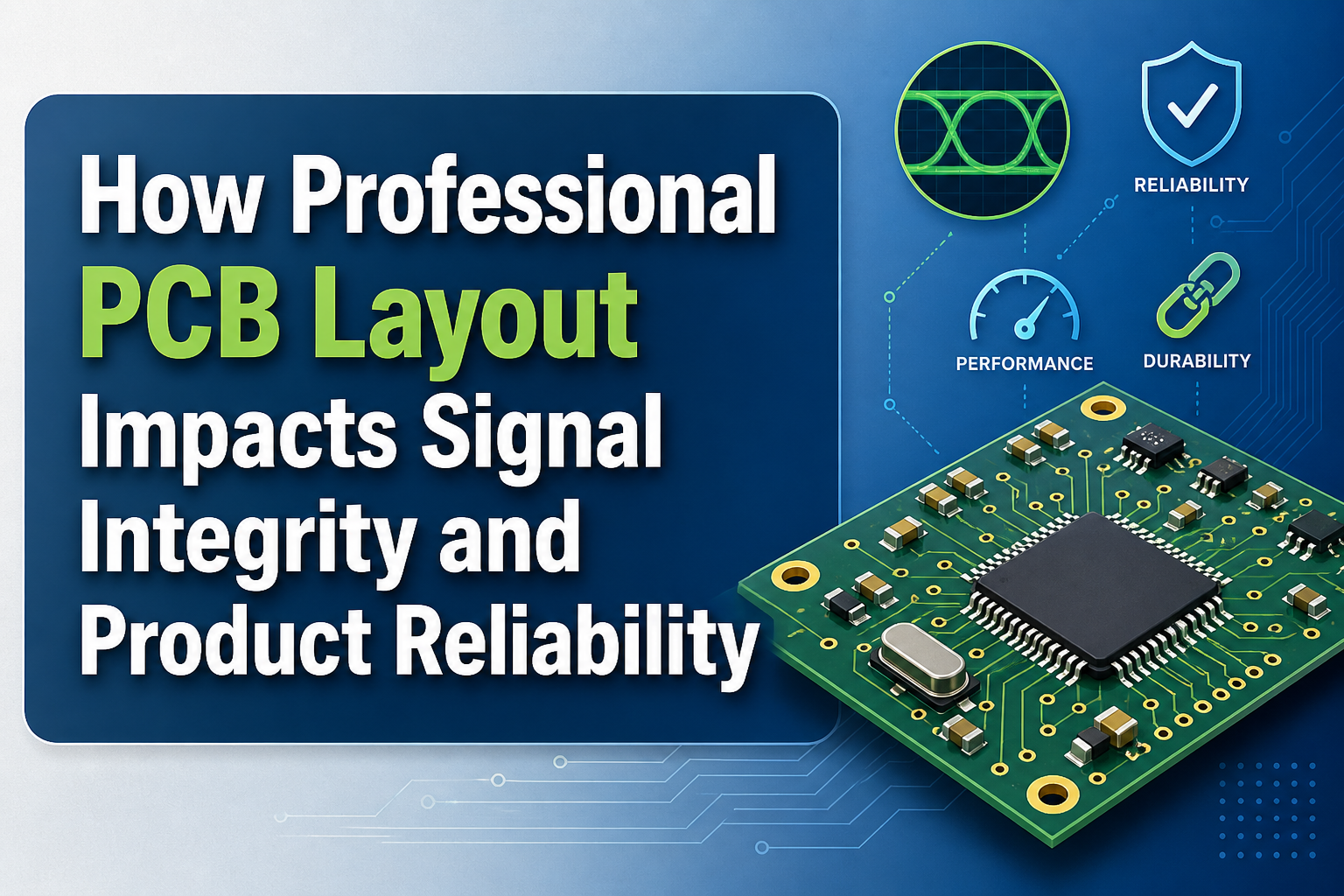
When designing modern electronic devices, the quality of the printed circuit board layout often determines the difference between a product that works flawlessly and one that fails under stress. By engaging PCB layout services, engineers can leverage expertise in trace routing, component placement, and design rule enforcement to create boards that meet stringent performance criteria. A well‑executed layout not only reduces manufacturing defects but also enhances signal integrity and product reliability, which are critical for high‑speed, high‑density applications.
Table Of Content
- The Role of Signal Integrity
- Impedance Control and Trace Geometry
- Managing Differential Pairs and Crosstalk
- Ground and Power Plane Design
- Via Stitching and Ground Loops
- High‑Speed Layout Considerations
- Thermal Management and Reliability
- Design for Manufacturability (DFM)
- Conclusion: From Design to Deployment
The Role of Signal Integrity
Signal integrity (SI) refers to the preservation of signal quality as it travels through a PCB. Poor SI can result in reflections, crosstalk, and attenuation, leading to data corruption or complete system failure. Professional layout practices address these issues by carefully managing trace lengths, maintaining consistent impedance, and ensuring proper termination. By controlling these parameters early in the design phase, engineers can avoid costly redesigns and re‑fabrications that would otherwise compromise reliability.
Impedance Control and Trace Geometry
Maintaining a controlled impedance environment is essential for high‑speed signals, especially those operating at gigabit frequencies. This involves selecting appropriate trace widths, spacings, and dielectric materials to achieve the desired characteristic impedance, typically 50 Ω or 100 Ω for differential pairs. Advanced simulation tools allow designers to predict impedance variations caused by manufacturing tolerances, enabling them to adjust trace dimensions before fabrication. Consistent impedance reduces reflections and preserves signal integrity across the board.
Managing Differential Pairs and Crosstalk
Differential signaling is commonly used in high‑speed interfaces such as PCIe, SATA, and USB 3.0. The key to reliable differential pairs lies in maintaining tight pair spacing, equal trace lengths, and proper shielding from adjacent signals. Crosstalk can be mitigated by inserting guard traces or ground islands between sensitive lines. Professional layout services implement these strategies systematically, ensuring that differential pairs remain isolated and that the overall system operates within its specified error margins.
Ground and Power Plane Design
A robust ground plane provides a low‑impedance return path for signals, while a well‑structured power plane distributes voltage evenly across the board. Gaps or discontinuities in either plane can introduce noise and cause voltage droop, especially under high‑current switching conditions. By designing continuous ground and power planes with strategic via stitching, designers can minimize loop areas, reduce EMI, and improve thermal performance—all of which contribute to greater product reliability.
Via Stitching and Ground Loops
Via stitching connects multiple layers of ground or power planes, creating a dense network that suppresses high‑frequency noise. Properly placed stitching vias reduce the effective impedance between layers, limiting the propagation of unwanted signals. Moreover, stitching helps maintain a uniform ground reference, preventing ground loops that can introduce interference into sensitive signal paths. Experienced layout teams carefully plan via placement to balance the need for shielding with the constraints of manufacturing.
High‑Speed Layout Considerations
High‑speed PCB design demands meticulous attention to trace routing, impedance matching, and component placement. Even small deviations in trace length or spacing can lead to timing skew that exceeds the allowable tolerance of a digital system. By incorporating design rule checks (DRCs) and signal integrity simulations into the workflow, professional services identify potential issues before the board reaches the fab, saving time and reducing the risk of costly rework.
Thermal Management and Reliability
Heat buildup is a common culprit behind component failure. Proper thermal design involves selecting heat‑sinking components, creating thermal vias, and ensuring adequate airflow around power devices. A well‑planned layout allows for efficient heat dissipation, preventing temperature spikes that could degrade performance or shorten component life. By integrating thermal analysis into the design process, engineers can achieve both high performance and long‑term reliability.
Design for Manufacturability (DFM)
Even the most elegant design can fail if it is not manufacturable. DFM practices examine trace width tolerances, drill sizes, and component placement to avoid production defects. Professional layout services collaborate closely with fabrication partners to validate design rules and adjust specifications as needed. This proactive approach reduces yield loss, lowers production costs, and ensures that the final product meets its reliability targets.
Conclusion: From Design to Deployment
By investing in expert PCB layout, designers can achieve superior signal integrity, which directly translates to higher product reliability. From impedance control to thermal management, each element of a professional layout contributes to a robust, high‑performance system. For those looking to transform their designs with industry‑leading tools and expertise, the Allegro PCB platform offers powerful simulation, routing, and verification capabilities that streamline the entire development cycle.







No Comment! Be the first one.