


How to Ensure ADA Compliance in Historic Seattle Commercial Buildings
Historic commercial buildings in Seattle—from the brick-and-timber lofts of Pioneer Square to the ornate terracotta facades of the downtown financial district—are irreplaceable real estate assets....

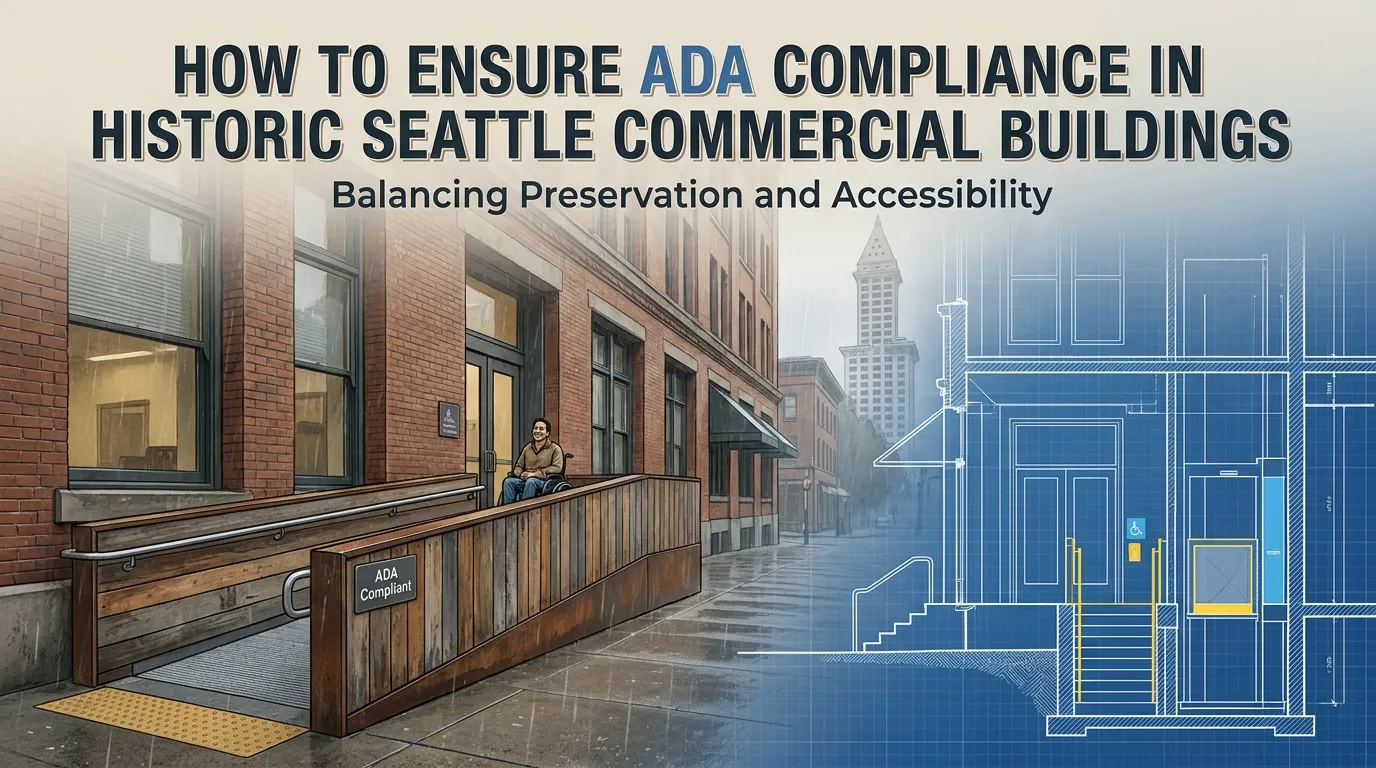
Historic commercial buildings in Seattle—from the brick-and-timber lofts of Pioneer Square to the ornate terracotta facades of the downtown financial district—are irreplaceable real estate assets. They offer unparalleled architectural character that commands premium rents from modern tech tenants, boutique retailers, and high-end hospitality brands. However, owning and operating these heritage assets in 2026 comes with a complex legal and structural burden: navigating the rigorous accessibility requirements of Title III of the Americans with Disabilities Act (ADA).
Table Of Content
- The Rising Threat of Title III Litigation
- The Regulatory Hierarchy: ADAAG vs. Local Seattle Codes
- Navigating Seattle’s Local Preservation Boards
- Common Structural Hurdles in Heritage Assets
- 1. Entrances and Thresholds
- 2. Elevators and Vertical Access
- 3. Restroom Modifications
- The Financial Strategy: Leveraging Federal Tax Credits
- The Critical Role of Specialized Asset Management
For landlords and institutional investors, balancing the preservation of a 100-year-old architectural footprint with modern federal accessibility laws is one of the most challenging aspects of real estate ownership. Understanding how to ensure ADA compliance in historic Seattle commercial buildings is not merely a theoretical exercise; it is a fundamental pillar of risk mitigation, tenant retention, and long-term asset preservation.
The Rising Threat of Title III Litigation
The commercial real estate sector is currently facing a sustained, multi-year wave of Title III ADA litigation. According to legal data tracking ADA lawsuits across the country, businesses in retail, hospitality, and corporate real estate are prime targets. The legal threshold for standing in these cases is notoriously low. This environment has spawned thousands of “drive-by” lawsuits—instances where plaintiffs allege technical or minor violations (such as improper slope grading on a ramp, non-compliant door thresholds, or missing accessible parking signs) without ever entering the building.
These lawsuits result in immediate demand letters for monetary settlements and attorney’s fees. For historic properties in Seattle, this liability risk is magnified. The natural aging of the structure, settling foundations, and outdated original architecture make them easy targets for compliance audits. Proactively modifying these spaces is the only effective legal shield a landlord possesses.
The Regulatory Hierarchy: ADAAG vs. Local Seattle Codes
A dangerous and widespread misconception among property owners is that holding a “historic designation” grants a blanket exemption from the ADA. This is definitively false. While the ADA Accessibility Guidelines (ADAAG) do contain specific provisions for historic properties (specifically under Section 4.1.7), federal law mandates that commercial facilities must remove architectural barriers where such removal is “readily achievable.”
The complexity in Seattle arises when federal mandates intersect with state and local preservation codes. The Washington State Department of Archaeology & Historic Preservation (DAHP) coordinates preservation efforts, but they explicitly do not have the authority to overrule local code officials regarding life safety and accessibility. Therefore, property owners must simultaneously comply with the ADAAG, the Washington State Building Code, and the specific provisions of the Seattle Existing Building Code (SEBC).
If an accessibility upgrade threatens to destroy the historic significance of a building, the ADA allows for “alternative minimum requirements.” However, proving this requires rigorous documentation and consultation with the State Historic Preservation Officer (SHPO), making the compliance process a highly technical administrative task.
Navigating Seattle’s Local Preservation Boards
Achieving compliance becomes even more intricate when a property is located within a designated local historic district. For instance, if you own a commercial asset in the Pioneer Square Preservation District, simply pouring a standard concrete ADA ramp over a historic cobblestone entrance is legally prohibited.
All exterior modifications, signage updates, and structural additions must be extensively reviewed and approved by the Pioneer Square Preservation Board and the Seattle Department of Neighborhoods. The challenge lies in designing accessibility solutions—such as seamlessly integrated platform lifts, regraded interior vestibules, or alternative accessible entrances—that provide equal access without permanently altering the property’s protected historic fabric. Resolving conflicts between the building inspector demanding access and the preservation board protecting the facade requires sophisticated architectural and legal negotiation.
Common Structural Hurdles in Heritage Assets
Retrofitting older buildings involves overcoming specific structural hurdles that modern developments never face. Investors must prioritize their Capital Expenditures (CapEx) around the most critical barrier removals:
1. Entrances and Thresholds
Historic buildings often feature grand, stepped entrances or heavy, narrow brass doors. Ensuring a 32-inch minimum clear width and a threshold no higher than 1/2 inch often requires replacing historic doors entirely or installing automated push-button opening systems that bypass the need for significant structural widening.
2. Elevators and Vertical Access
Many turn-of-the-century multi-story buildings in Seattle lack modern elevators. Installing a full commercial elevator shaft in a historic masonry building can cost millions and compromise the structural integrity. Landlords must often rely on limited-use/limited-application (LULA) elevators or commercial wheelchair lifts strategically placed in secondary lobbies to meet vertical access requirements without destroying the floorplate.
3. Restroom Modifications
Commercial tenants demand modern amenities, but historic plumbing stacks were not designed for ADA-compliant turning radiuses or grab-bar reinforcements. Gutting and expanding central restrooms to meet modern accessibility codes is often the single most expensive interior modification a landlord will execute during a tenant build-out.
The Financial Strategy: Leveraging Federal Tax Credits
Bringing a historic property up to code requires substantial CapEx. Fortunately, Seattle investors have access to powerful financial incentives to significantly offset these retrofitting costs. The most lucrative mechanism is the Federal Historic Preservation Tax Credit program.
Jointly administered by the National Park Service (NPS) and the Internal Revenue Service (IRS), with DAHP coordination at the state level, this program provides a 20% federal income tax credit on “Qualified Rehabilitation Expenditures” (QREs). To qualify, the commercial property must be income-producing, listed on the National Register of Historic Places, and the rehabilitation must be deemed “substantial” (the QREs must equal or exceed the adjusted basis value of the property).
Because ADA compliance upgrades are classified as necessary structural rehabilitations, landlords can effectively subsidize 20% of their accessibility CapEx. By aligning ADA retrofits with broader building renovations, investors dramatically improve the Net Operating Income (NOI) and overall Cap Rate of the asset while utilizing federal funds to minimize out-of-pocket expenses.
The Critical Role of Specialized Asset Management
Balancing strict federal ADA laws, navigating the subjective approvals of Seattle’s historic preservation boards, and successfully executing a 20% federal tax credit application is not a task for passive ownership. The margin for operational error is non-existent. A single unapproved exterior modification can result in massive city fines and the loss of federal tax credits, while ignoring compliance invites immediate Title III litigation.
This complex landscape highlights exactly why partnering with experts in commercial property management in Seattle is a strategic necessity. A highly specialized management firm acts as the landlord’s operational shield. They coordinate the specialized historic architects, interface directly with the Seattle Department of Construction and Inspections (SDCI), manage the intricate CapEx budgets required for ADA compliance, and ensure that the property remains legally protected while commanding top-tier market rents.
Ultimately, heritage buildings in the Pacific Northwest hold incredible financial potential. However, unlocking that potential requires proactively transforming aging infrastructure into safe, accessible, and compliant commercial spaces. By relying on robust data, financial incentives, and historic commercial asset management, investors can safeguard their properties against litigation and secure generational wealth in the heart of Seattle.




No Comment! Be the first one.