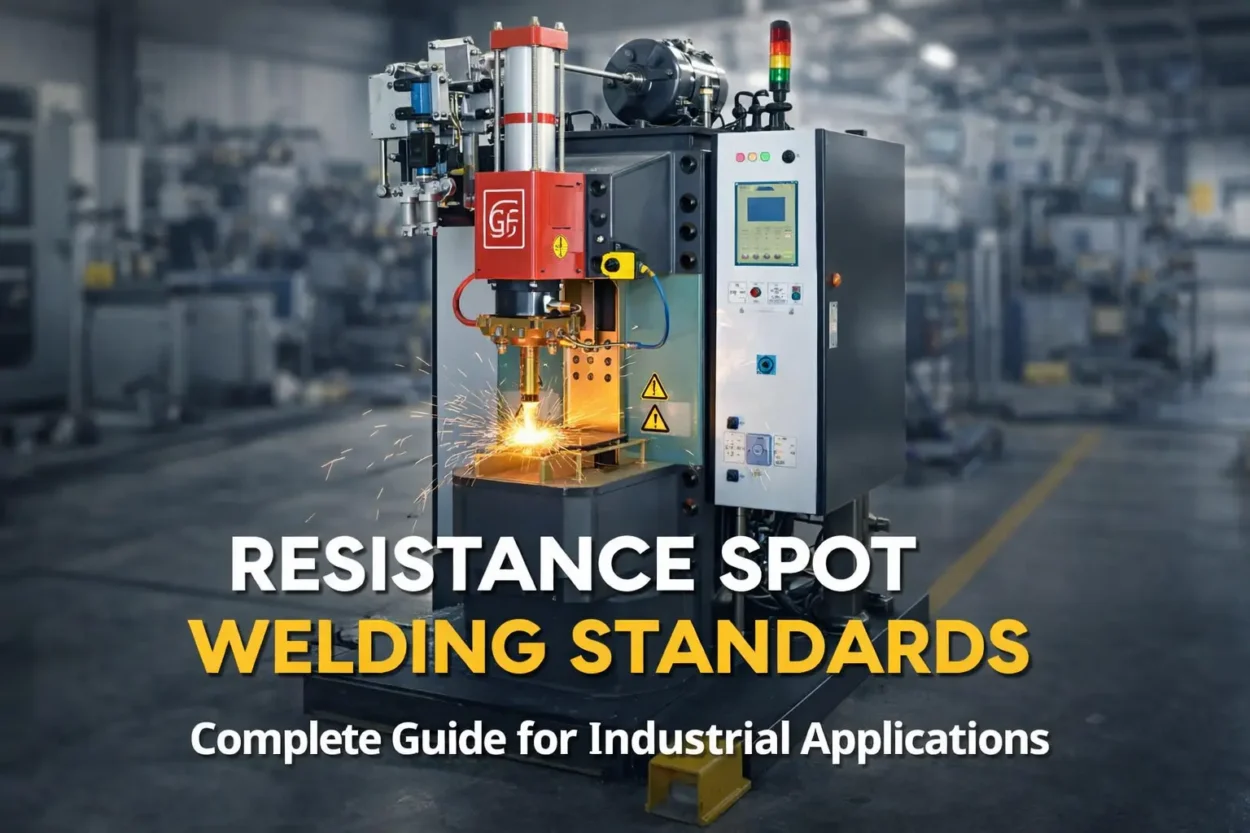
In modern manufacturing, precision, speed, and repeatability define production quality. A resistance welder is one of the most widely used industrial joining systems that delivers exactly that clean, fast, and strong metal-to-metal joints without filler materials or open flames. From automotive body shops to aerospace structures and appliance manufacturing, resistance welding remains a backbone technology for high-volume production lines.
As a global manufacturer of industrial welding and metal-joining systems, Heron Welder specializes in advanced resistance welding solutions, including spot, projection, seam, MFDC, and capacitor discharge systems designed for automated and customized production environments.
What is a Resistance Welder?
A resistance welder is a machine that joins two or more metal parts by applying pressure and high electrical current through electrodes. The heat generated at the contact interface caused by electrical resistance melts the material locally, forming a strong metallurgical bond once pressure is maintained during cooling.
This process is widely known as thermo-electric welding, and it eliminates the need for filler materials, flux, or shielding gases, making it efficient and cost-effective for mass production environments.
Working Principle of Resistance Welding
The core principle of resistance welding is based on Joule heating (I²R effect):
- Electric current passes through the metal joint
- Resistance at the interface generates heat
- Metal reaches plastic or molten state
- Pressure is applied via electrodes
- Fusion occurs at the weld point
Key advantages of this principle include:
- Extremely fast cycle times (milliseconds to seconds)
- Localized heating (minimal deformation)
- High repeatability for automation lines
In industrial environments, welding parameters such as current, force, and time are precisely controlled using advanced controllers and servo systems especially in modern MFDC-based machines.
Main Types of Resistance Welders
Different production requirements demand different resistance welding configurations. Heron integrates multiple technologies to match application needs.
1. Spot Welding Machines
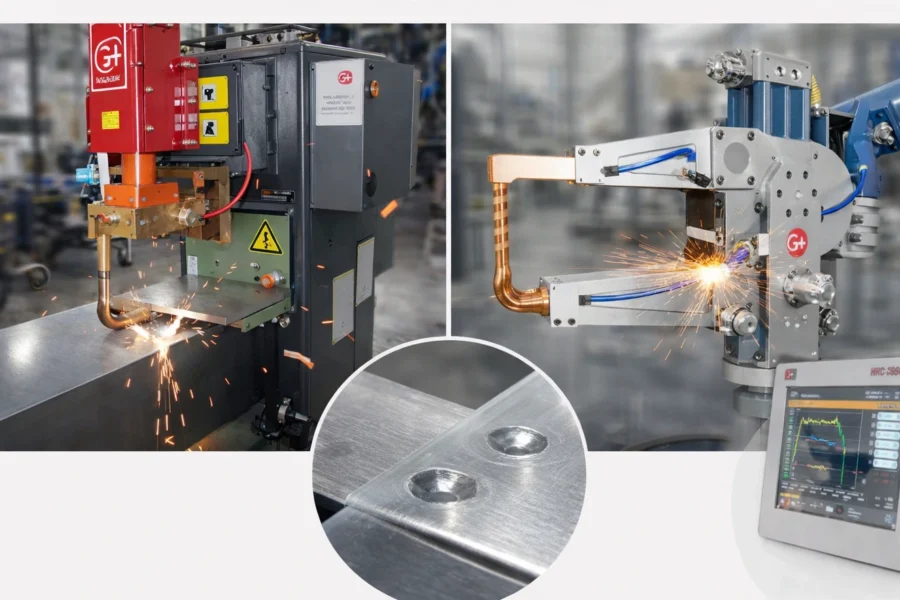
Spot welding is the most common resistance welding method, used for sheet metal joining at specific points.
- Ideal for automotive body panels and appliances
- Fast, localized welds
- High production efficiency
Spot welders are widely used in high-speed production lines where thousands of joints are required daily.
2. Projection Welding Systems
Projection welding uses small raised projections on the workpiece to concentrate current and force at specific points.
- Common for nuts, bolts, studs
- Ideal for automotive components
- Enables multiple welds in a single cycle
This method improves accuracy and reduces electrode wear, making it suitable for mass production environments.
3. Seam Welding Machines
Seam welding uses rotating electrodes to create a continuous weld line.
- Produces leak-proof joints
- Used in fuel tanks, pipes, and containers
- Suitable for long straight or curved seams
It is essentially a continuous form of spot welding, ensuring uniform sealing quality.
4. MFDC Resistance Welders
Medium Frequency Direct Current (MFDC) welders are advanced systems offering superior control.
- Higher energy efficiency
- Better weld consistency
- Reduced electrode wear
- Ideal for robotic automation
MFDC systems are widely adopted in smart factories and automotive production lines.
5. Capacitor Discharge (CD) Welders
These systems store energy in capacitors and release it in a controlled burst.
- Extremely fast welding cycle
- Minimal heat distortion
- Perfect for thin or coated materials
They are often used in precision applications where heat control is critical.
Industrial Applications of Resistance Welders
Resistance welding plays a crucial role in multiple industries:
Automotive Manufacturing
- Car body panels
- Door frames
- Battery trays
- Structural reinforcements
Appliance Industry
- Refrigerators
- Washing machines
- HVAC components
Electrical & Electronics
- Busbars
- Connectors
- Battery terminals
Construction & Heavy Fabrication
- Metal frames
- Structural assemblies
- Sheet metal enclosures
The ability to automate welding makes it especially valuable in high-volume, low-variation production environments.
Resistance Welding vs Other Welding Methods
| Feature | Resistance Welding | Arc Welding | MIG/TIG Welding |
|---|---|---|---|
| Heat Source | Electrical resistance | Electric arc | Arc + filler wire |
| Filler Material | Not required | Often required | Required |
| Speed | Very high | Medium | Medium |
| Automation | Excellent | Limited | Moderate |
| Precision | High | Medium | High |
Resistance welding is preferred when speed, repeatability, and automation compatibility are top priorities.
Best Practices for High-Quality Resistance Welding
To achieve optimal weld performance, engineers should focus on:
1. Electrode Maintenance
Clean and properly shaped electrodes ensure stable current flow and consistent welds.
2. Correct Force Application
Too much or too little pressure can weaken weld strength.
3. Proper Current Settings
Each material requires optimized current levels to avoid weak or burnt joints.
4. Material Surface Preparation
Oil, oxide layers, or coatings must be controlled for better conductivity.
5. Cooling and Duty Cycle Control
Proper thermal management extends machine and electrode life.
Why Industries Prefer Resistance Welders
- High-speed production capability
- Low operating cost per weld
- Strong, consistent joint quality
- Easy integration into robotic systems
- Minimal operator skill requirement
These advantages make resistance welding a core technology for modern manufacturing automation.
Heron Welder: Engineering Advanced Resistance Welding Solutions
At Heron Welder, we design and manufacture a complete range of resistance welding systems including:
- Spot welders
- Projection welders
- Seam welding machines
- MFDC welding systems
- Capacitor discharge welders
- Automated welding production lines
Our focus is not only on machines but on complete welding solutions, including:
- Automation integration
- Custom tooling and fixtures
- Welding process optimization
- Smart control systems
With decades of engineering expertise, Heron supports global manufacturers in achieving higher productivity, stronger weld quality, and lower production cost.
FAQs About Resistance Welder
1. What materials can a resistance welder join?
It can weld steel, stainless steel, aluminum, galvanized sheets, and various conductive metals used in industrial manufacturing.
2. Is resistance welding suitable for automation?
Yes, it is one of the most automation-friendly welding processes, widely used in robotic production lines.
3. Does resistance welding require filler material?
No, it joins metals directly using heat and pressure without fillers or flux.
4. What industries use resistance welders the most?
Automotive, appliance manufacturing, electrical components, and heavy fabrication industries.
5. How long does a resistance weld take?
Most welds are completed in milliseconds to a few seconds depending on material and thickness.
Conclusion
A resistance welder is a critical pillar of modern industrial manufacturing, enabling fast, precise, and cost-efficient metal joining. With its adaptability across spot, projection, seam, and advanced MFDC systems, it remains the preferred solution for high-volume production environments.
Ready to Upgrade Your Welding Process?
Heron Welder provides custom-engineered resistance welding solutions designed for your production needs whether you require standalone machines or fully automated welding lines.
Contact Heron today to request a quote or consultation and discover how advanced resistance welding technology can improve your production efficiency and product quality.

Leave a Comment