




Save The System At Any Cost? A Provocative New Thriller Explores The Ethics Of Sacrifice, Secrecy, And Survival
If saving a nation required deception, coercion, and decisions made without consent, would it still be the right thing to do? And more importantly—who gets to make that call? In Good Country, Bad...

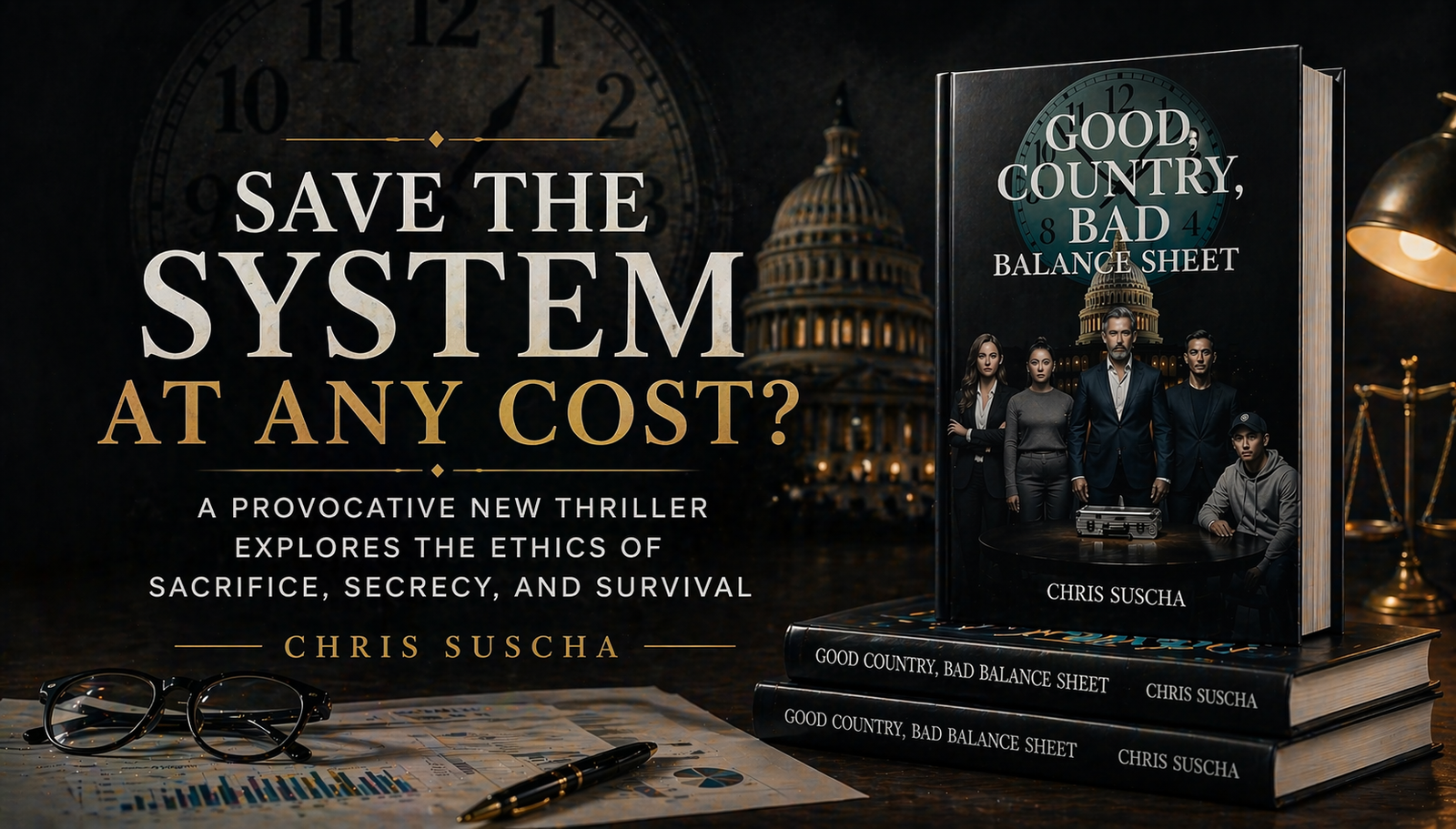
If saving a nation required deception, coercion, and decisions made without consent, would it still be the right thing to do? And more importantly—who gets to make that call?
Top Content
In Good Country, Bad Balance Sheet, author Chris Suscha delivers a gripping financial thriller that goes beyond markets and mechanics to confront one of the most complex dilemmas of modern society: the ethics of saving the system itself.
At a time when institutions are expected to be transparent, accountable, and fair, the book presents a starkly different reality—one where survival may depend on actions that violate those very principles. Blending high-stakes storytelling with deep philosophical tension, the novella asks readers to consider a difficult truth: when the system is on the brink, morality is no longer theoretical—it becomes operational.
At its core, the story poses a haunting question: is it ethical to break the rules in order to preserve the system those rules were designed to protect?
WHEN RIGHT AND NECESSARY ARE NOT THE SAME
Modern societies are built on frameworks of law, process, and ethical norms. These structures are designed to ensure fairness, prevent abuse, and maintain trust. But what happens when adhering to those frameworks leads to collapse rather than stability?
Good Country, Bad Balance Sheet explores this tension with precision. Faced with a rapidly approaching financial catastrophe, a small group of experts must make decisions that cannot wait for approval, debate, or consensus.
In doing so, they cross lines that would be unacceptable under normal circumstances. Yet within the context of the crisis, those same actions become not only defensible—but necessary.
This contradiction lies at the heart of the narrative: the recognition that what is ethically correct in theory may not be viable in practice.
THE MORAL COST OF PREVENTING DISASTER
Preventing a systemic collapse is not a clean or simple task. It requires trade-offs, compromises, and, at times, sacrifices that are not evenly distributed.
In the world of the book, millions of people are affected by decisions they will never fully understand. Policies are implemented without explanation. Outcomes are shaped without participation. The system is stabilized—but at a cost that is largely invisible.
Good Country, Bad Balance Sheet does not shy away from this reality. Instead, it confronts it directly, forcing readers to consider whether the preservation of the whole can justify the manipulation of its parts.
Is it acceptable to protect a nation by overriding the agency of its citizens? Or does doing so undermine the very foundation the system is meant to uphold?
SECRECY AS A TOOL—AND A RISK
Central to the ethical tension of the story is the role of secrecy. The characters operate in an environment where information must be controlled, narratives must be managed, and the truth must often be withheld.
This secrecy is not portrayed as inherently malicious—it is portrayed as functional. Without it, panic could spread, markets could collapse, and the crisis could accelerate beyond control.
Yet secrecy also introduces its own risks. It removes checks and balances. It concentrates power. And it creates a gap between those who act and those who are affected.
The book captures this duality with nuance, presenting secrecy as both a necessary instrument and a potential source of ethical compromise.
WHO BEARS THE RESPONSIBILITY?
Another critical question explored in Good Country, Bad Balance Sheet is the distribution of responsibility. When decisions are made in secrecy, accountability becomes diffuse.
The individuals at the center of the story carry the burden of their actions privately. They cannot explain their choices, defend their reasoning, or seek validation. Their success is invisible, and their failures would be catastrophic.
This isolation underscores the human dimension of the ethical dilemma. These are not abstract decision-makers—they are individuals forced to act in ways that may conflict with their own values, all in the name of a greater good.
It is a portrayal that adds depth and gravity to the narrative, transforming it from a technical story into a profoundly human one.
REAL-WORLD RELEVANCE IN A COMPLEX ERA
The ethical questions raised in the book resonate far beyond its fictional setting. In an increasingly complex and interconnected world, institutions are often required to respond to crises with speed and decisiveness.
Whether in finance, public health, or national security, the tension between transparency and effectiveness is a recurring challenge. Good Country, Bad Balance Sheet captures this dynamic, offering a lens through which to examine how such decisions are made—and what they cost.
By grounding its narrative in realistic scenarios, the book invites readers to reflect on how they would respond in similar circumstances, and what values they would prioritize.
A THRILLER THAT STAYS WITH YOU
While the book delivers the pacing and intensity of a high-stakes thriller, its lasting impact lies in the questions it raises. It does not provide simple answers or clear moral conclusions. Instead, it leaves readers with a sense of unease—and a deeper awareness of the complexities involved in preserving stability.
In doing so, it elevates the genre, transforming a story about financial crisis into a broader exploration of ethics, responsibility, and the limits of control.
ABOUT THE BOOK
Good Country, Bad Balance Sheet is a high-intensity financial thriller that explores the intersection of ethics, systemic risk, and decision-making under extreme pressure. Combining technical authenticity with cinematic storytelling, it offers a compelling perspective on the moral challenges embedded within modern systems.
AVAILABILITY
Good Country, Bad Balance Sheet is available now.
Contact
Author: Chris Suscha
Email: csuscha@gmail.com
Website: https://chrissuscha.com/