


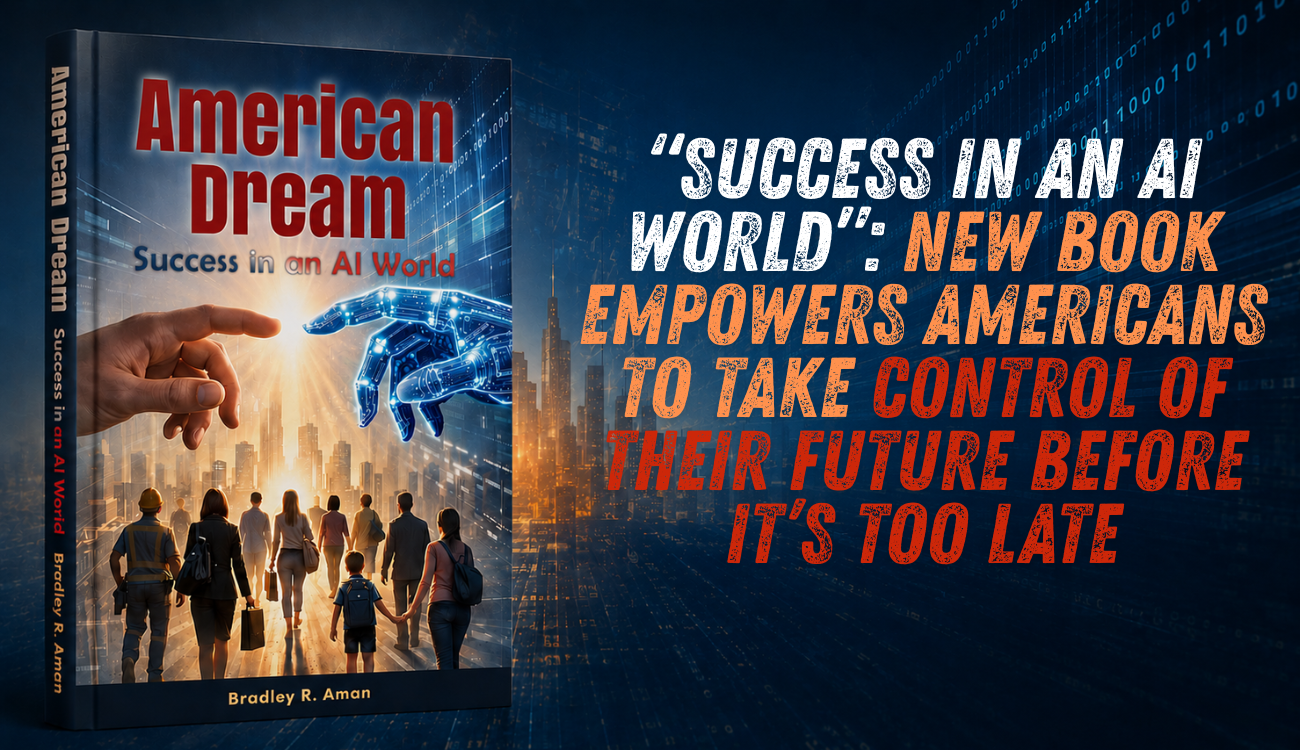
“Success in an AI World”: New Book Empowers Americans to Take Control of Their Future Before It’s Too Late
For many Americans, the future of work still feels like something distant. A conversation for later.A shift that will happen gradually.A change that can be adapted to when the time comes. But what if...

For many Americans, the future of work still feels like something distant.
Table Of Content
A conversation for later.
A shift that will happen gradually.
A change that can be adapted to when the time comes.
But what if that assumption is wrong?
In American Dream AI, author Bradley R. Aman presents a different reality—one where the transformation of work is not approaching, but already underway. And more importantly, one where the window to respond early may be narrower than most people think.
Because in moments of rapid change, timing matters.
And those who move first rarely face the same obstacles as those who wait.
The Gap Is Already Forming
The impact of artificial intelligence is often discussed in future terms.
Jobs will change.
Industries will evolve.
Skills will become obsolete.
But beneath that language, something quieter is already happening.
A gap is forming.
Not between industries, but between individuals—those who are actively engaging with new tools, new ways of thinking, and new opportunities, and those who are continuing to operate as if the environment has not changed.
At first, the difference is subtle.
Over time, it becomes structural.
American Dream AI focuses on this divide—not as a distant concern, but as a present reality that is shaping outcomes in real time.
Why Waiting Feels Safe—But Isn’t
There is a natural instinct to wait during periods of uncertainty.
To observe. To gather information. To avoid making the wrong move.
On the surface, this feels like caution.
But in a fast-moving environment, waiting has a cost.
Opportunities shift. Expectations evolve. The baseline of what is considered “current” moves forward. And those who delay engagement often find themselves reacting to change rather than benefiting from it.
The book addresses this mindset directly.
It does not criticize hesitation—it explains it.
But it also makes something clear: the longer individuals remain in observation mode, the more difficult it becomes to close the gap that forms.
Because by the time change feels undeniable, it is often already established.
Control in an Uncontrollable Environment
One of the central ideas explored in American Dream AI is the concept of control.
Not control over external systems—technology, markets, or global trends—but control over response.
While individuals cannot stop the advancement of AI, they can decide how they engage with it.
They can choose to learn or ignore.
To experiment or avoid.
To build or remain dependent on existing structures.
This shift—from external control to internal responsibility—is where the book places its emphasis.
Because even in unpredictable environments, response remains a constant.
And over time, that response shapes outcomes.
A Different Kind of Preparation
Preparation, in the traditional sense, often meant mastering a specific path.
Earning a degree. Building experience in a defined role. Advancing within a structured system.
AI is changing that model.
Preparation is no longer about locking into a single trajectory.
It is about developing the ability to adjust.
This includes:
- Becoming familiar with emerging tools
- Building skills that extend beyond one function
- Learning how to think in terms of value, not just tasks
- Staying engaged with change rather than avoiding it
The book emphasizes that preparation today is less about certainty and more about flexibility.
And those who develop that flexibility early are better positioned to navigate what comes next.
Opportunity Is Expanding—But So Is Competition
Aman presents a balanced view of the current moment.
On one side, opportunity is increasing.
AI is making it easier to access information, build systems, and create value. Individuals can operate with more independence and efficiency than ever before.
On the other side, competition is increasing as well.
Because when tools become widely available, the number of people using them grows rapidly. The advantage no longer comes from access alone.
It comes from how effectively that access is used.
This creates a new dynamic: opportunity is not limited, but it is not evenly realized.
It favors those who engage with it early and consistently.
A Call to Move—Not to Panic
While the book introduces urgency, it does not promote fear.
It does not suggest drastic, immediate change or unrealistic transformation.
Instead, it focuses on movement.
Small, consistent steps.
Learning over time.
Building confidence through action.
The idea is simple: individuals do not need to have everything figured out to begin.
They need to begin in order to figure things out.
This distinction is central to the book’s message.
Because the greatest risk in a changing environment is not making the wrong move.
It is making no move at all.
A Moment That Will Define the Next Decade
Periods of transition often feel unclear while they are happening.
It is only in hindsight that their significance becomes obvious.
American Dream AI suggests that this moment—this intersection of artificial intelligence, economic change, and shifting expectations—will define the next decade of opportunity.
Not just for industries.
But for individuals.
And the difference between those who benefit from that shift and those who struggle within it may come down to a single factor:
When they chose to engage.
About the Author
Bradley R. Aman is an author focused on personal growth, economic opportunity, and the evolving role of technology in shaping modern careers. His work explores how individuals can navigate uncertainty, build resilience, and create long-term success in rapidly changing environments.
Media Contact
Author Name: Bradley R Aman
Amazon: AMERICAN DREAM: Success in an Al World
Website: www.youramericadream.com
https://www.youtube.com/@YourAmericanDreamer/shorts
https://www.facebook.com/profile.php?id=61583530424497#
https://www.instagram.com/_youramericandream_



No Comment! Be the first one.