



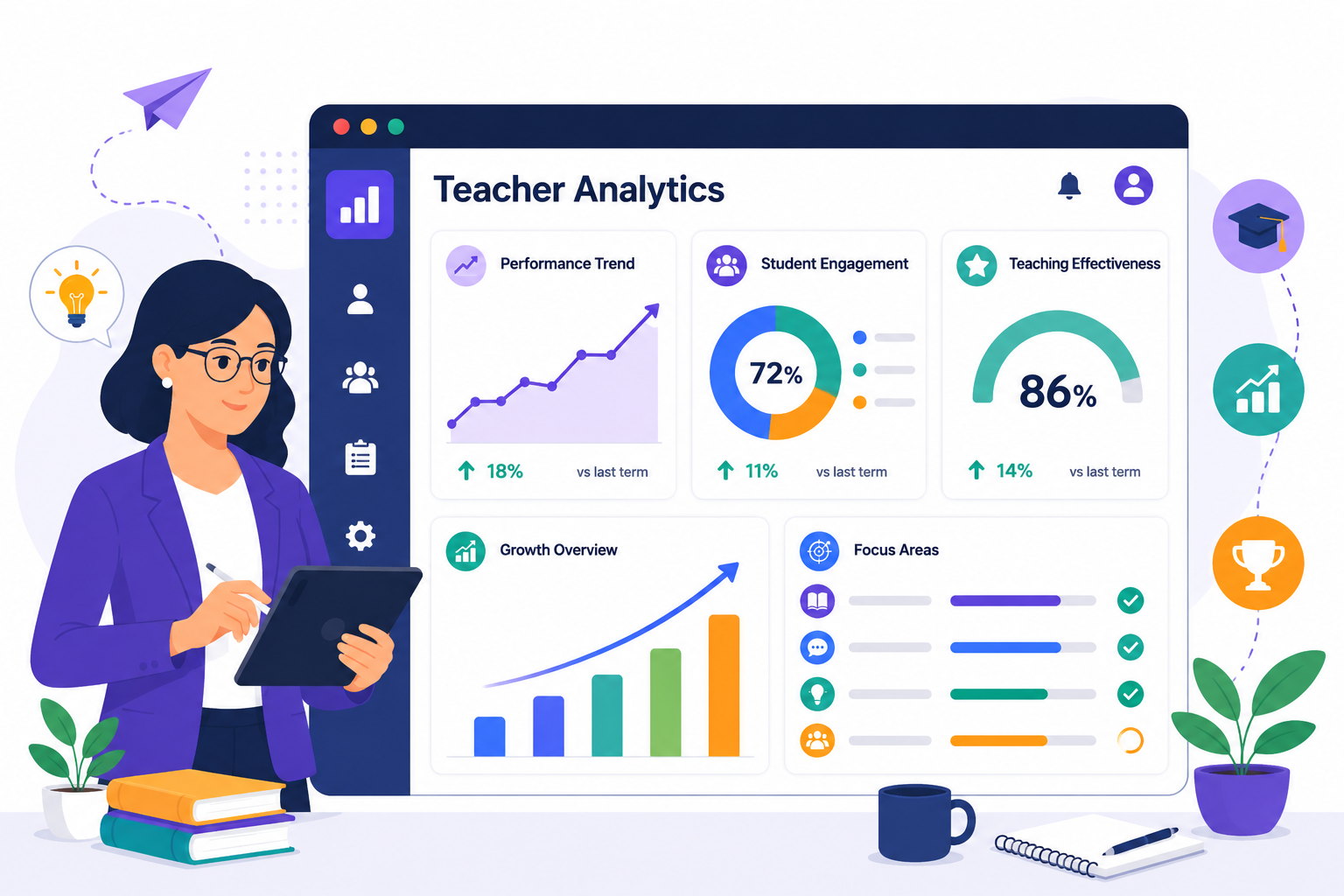
Teacher analytics is becoming one of the most valuable tools available to school leaders seeking to improve teaching quality and student outcomes. The conversation around educational improvement often focuses on curriculum changes, new learning methods, or classroom technology. While all of these play an important role, one factor consistently remains at the center of student success: teaching quality.
Table Of Content
As schools face growing expectations from parents, regulators, and academic boards, administrators are under increasing pressure to ensure that teaching standards remain high across every classroom. The challenge is that traditional evaluation methods alone are no longer enough to provide a complete picture of instructional effectiveness.
This is where data-driven school management is making a noticeable impact.
The Shift Toward Smarter School Operations
During a typical school day, thousands of academic activities generate valuable information. Attendance records, lesson completion updates, assignment submissions, assessment performance, and classroom engagement all contribute to a larger educational picture.
For many years, much of this information remained scattered across multiple systems or was simply never analyzed in a meaningful way.
Today, modern school management platforms are helping institutions bring this data together and convert it into actionable insights. Solutions such as Practido allow schools to centralize academic operations while providing administrators with better visibility into teaching and learning processes.
The result is a more informed approach to educational leadership.
Why Traditional Teacher Evaluations Have Limitations
Classroom observations and annual performance reviews have long been the foundation of teacher evaluation. While these methods remain valuable, they often capture only a small portion of a teacher’s overall contribution.
A single observation may reflect one lesson on one particular day. It may not accurately represent instructional consistency, curriculum progress, student engagement trends, or long-term academic impact.
This limitation has led many educational institutions to explore more comprehensive evaluation methods.
Teacher analytics provides an additional layer of understanding by incorporating objective performance indicators alongside professional observations and feedback.
How Teacher Analytics Supports Better Decision-Making
Teacher analytics is not about replacing human judgment. Instead, it helps school leaders make decisions with greater confidence and context.
By analyzing academic performance metrics, administrators can identify:
- Trends in lesson completion and curriculum delivery
- Student engagement patterns
- Assessment management efficiency
- Attendance consistency
- Areas requiring additional academic support
- Opportunities for professional development
These insights allow schools to respond proactively rather than reactively.
Instead of waiting for problems to become visible, leadership teams can identify challenges earlier and implement solutions more effectively.
Supporting Teachers Through Meaningful Insights
One of the most common misconceptions about educational analytics is that it exists primarily for monitoring purposes.
In reality, the most successful implementations focus on support and improvement.
When teachers receive data-backed feedback, they gain a clearer understanding of classroom performance and student learning patterns. This information can help educators refine instructional strategies, improve planning, and collaborate more effectively with colleagues.
Likewise, administrators can design professional development programs that address actual classroom needs rather than relying on assumptions.
This creates a culture centered on growth rather than compliance.
Building Consistency Across the Institution
Consistency is one of the biggest challenges facing growing schools.
Whether an institution manages multiple grade levels, departments, or campuses, maintaining uniform academic standards requires reliable systems and processes.
Educational analytics helps establish consistency by creating common performance indicators and evaluation frameworks. School leaders can compare outcomes more accurately, identify institution-wide trends, and ensure that improvement initiatives are aligned with organizational goals.
This level of visibility becomes increasingly valuable as schools expand and educational expectations continue to rise.
The Future of School Leadership
The future of school management will be shaped by institutions that successfully combine professional expertise with meaningful data.
The goal is not to collect more information than ever before. The goal is to use information intelligently.
Schools that embrace data-driven decision-making are often better positioned to improve teaching quality, strengthen accountability, optimize resource allocation, and support student achievement.
As educational technology continues to evolve, teacher analytics will likely become a standard component of effective school leadership strategies.
For educators and administrators interested in learning more about this growing trend, the following article provides valuable insights into how school management systems are using teacher analytics to improve instructional quality:
👉 https://practido.com/blog/teacher-analytics-school-management/
In an increasingly competitive educational landscape, the schools that thrive will be those that use data not as a monitoring tool, but as a catalyst for continuous improvement.
👉 Check out more from Practido here: https://practido.com
👉 Boost student learning with Practido — download the app on Google Play and the App Store.



No Comment! Be the first one.