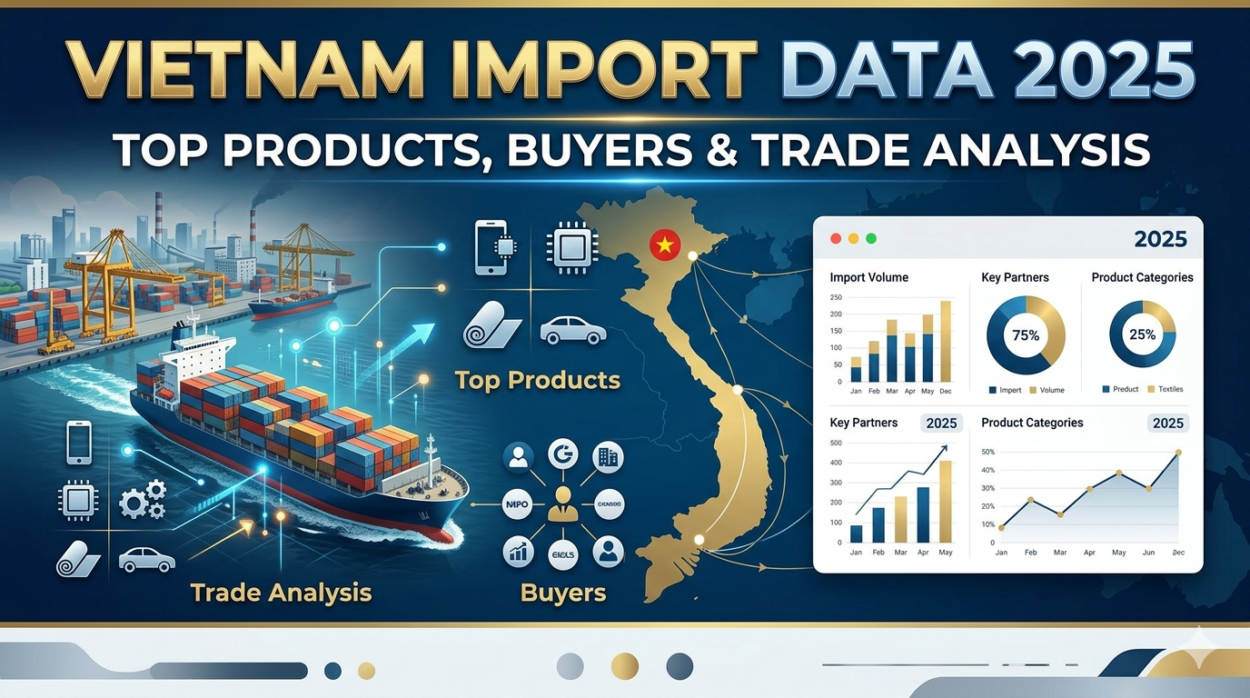
In today’s rapidly evolving global economy, Vietnam has emerged as one of Asia’s most dynamic trade hubs. With a strong manufacturing base, strategic geographic location, and increasing integration into global supply chains, the country continues to expand its international trade footprint. A critical component of this growth is its robust import sector. Understanding vietnam imports is essential for businesses aiming to enter or expand within this high-potential market.
According to the latest vietnam import data and vietnam customs data, Vietnam’s total imports reached approximately $379 billion in 2024, reflecting a 7.2% year-on-year increase. This steady growth highlights the country’s dependence on foreign goods to fuel its industrial expansion and meet consumer demand. Furthermore, early 2025 figures indicate continued momentum, with imports totaling $175.56 billion in just the first five months—a significant 17.4% increase compared to the same period last year.
Overview of Vietnam Imports Growth
Vietnam’s import-driven economy is largely fueled by its role as a global manufacturing hub. The majority of vietnam imports consist of production materials, accounting for nearly 94% of total import value. These include machinery, electronics, raw materials, and intermediate goods essential for export-oriented industries.
Over the past decade, Vietnam has demonstrated consistent import growth:
- 2014: $147.83 billion
- 2018: $236.86 billion
- 2021: $330.75 billion
- 2024: $379 billion
This upward trajectory reflects the country’s industrialization and increasing foreign direct investment (FDI). The rise in imports also correlates with Vietnam’s growing exports, as imported materials are often used in manufacturing finished goods for global markets.
Top 10 Vietnam Imports by HS Code
A closer look at vietnam imports reveals a diverse range of product categories. However, certain sectors dominate due to their importance in industrial production and economic development.
1. Electrical Machinery & Equipment (HS Code 85)
Valued at $116.54 billion, this category leads all imports. It includes semiconductors, integrated circuits, and electronic components vital for Vietnam’s electronics manufacturing sector.
2. Machinery & Nuclear Reactors (HS Code 84)
At $29.10 billion, machinery imports support infrastructure, manufacturing, and energy sectors.
3. Plastics & Articles (HS Code 39)
Worth $16.48 billion, plastics are widely used in packaging and industrial applications.
4. Mineral Fuels & Oils (HS Code 27)
Imports totaling $16.03 billion highlight Vietnam’s reliance on external energy sources.
5. Iron & Steel (HS Code 72)
With $12.21 billion in imports, these materials are essential for construction and infrastructure.
6. Vehicles (HS Code 87)
Valued at $7.22 billion, reflecting growing transportation demand.
7. Medical & Optical Instruments (HS Code 90)
Imports of $7.12 billion support healthcare advancements.
8. Knitted Fabrics (HS Code 60)
At $6.68 billion, these imports fuel Vietnam’s textile exports.
9. Cereals (HS Code 10)
Worth $4.79 billion, ensuring food security.
10. Cotton (HS Code 52)
Valued at $4.75 billion, essential for garment manufacturing.
These categories clearly show that vietnam imports are heavily concentrated in industrial and production-related goods.
Vietnam Imports by Country: Key Trade Partners
Understanding vietnam imports by country is crucial for identifying global trade relationships and sourcing opportunities. Vietnam maintains strong import ties with several major economies:
1. China – $144.3 Billion (37.9%)
China remains Vietnam’s largest supplier, providing raw materials, machinery, and electronics.
2. South Korea – $79.7 Billion (20.9%)
A major source of high-tech components and industrial equipment.
3. Japan – $35.8 Billion (9.4%)
Known for automotive and machinery exports.
4. Taiwan – $32 Billion (8.4%)
A key partner for electronics and semiconductors.
5. United States – $14.3 Billion (3.8%)
Supplies agricultural products, machinery, and technology.
6. Thailand – $11.6 Billion (3.1%)
Exports food products and industrial goods.
7. Malaysia – $7.3 Billion (1.9%)
Provides chemicals and electronics.
8. Indonesia – $5.8 Billion (1.5%)
Focuses on energy and raw materials.
9. India – $5.7 Billion (1.5%)
Supplies pharmaceuticals and textiles.
10. Australia – $4.5 Billion (1.2%)
Exports minerals and agricultural goods.
The data on vietnam imports by country highlights Vietnam’s heavy reliance on Asian markets while also diversifying toward Western economies.
Top Importers and Vietnam Importers List
A significant portion of imports is handled by multinational corporations operating in Vietnam. The Vietnam importers list is dominated by electronics and semiconductor companies, reflecting the country’s manufacturing focus.
Top importers include:
- Intel Vietnam
- Samsung Thai Nguyen
- Samsung HCMC
- Hanyang Vina
- Compal Vietnam
- Wistron Vietnam
These companies primarily import integrated circuits, micro-assemblies, and electronic components from China, South Korea, and Taiwan.
The Vietnam importers list is a valuable resource for businesses seeking partnerships, as it provides insights into major buyers and their sourcing patterns.
Vietnam Import Trends Analysis (2024–25)
Recent Vietnam trade data reveals several key trends shaping the import landscape:
1. Surge in Electronics Imports
Driven by global tech giants expanding production in Vietnam, electronics imports continue to rise significantly.
2. Growth in Industrial Machinery
Infrastructure development and manufacturing expansion are boosting machinery imports.
3. Increased Intermediate Goods Imports
Vietnam’s role as an assembly hub has led to higher demand for semi-finished goods.
4. Diversification of Supply Chains
Vietnam is gradually reducing its dependence on China by sourcing from ASEAN countries, India, and Europe.
5. Rising Renewable Energy Imports
Green energy initiatives are increasing demand for solar panels and related equipment.
These trends indicate a shift toward high-tech and sustainable development, reinforcing the importance of vietnam imports in economic growth.
Sectoral Insights for 2025
Looking ahead, several sectors are expected to drive future vietnam imports:
- Technology & Electronics: Continued expansion of semiconductor and electronics manufacturing
- Automotive & EVs: Rising demand for electric vehicles and components
- Energy: Increased imports of renewable energy equipment
- Agriculture: Higher imports due to climate-related challenges
These sectors present lucrative opportunities for global exporters and investors.
Impact of Trade Policies and Tariffs
Trade policies also play a crucial role in shaping vietnam imports. In 2025, new U.S. tariff measures impacted several Vietnamese exports, indirectly influencing import patterns. Increased tariffs on steel, aluminum, and electronics have prompted Vietnam to diversify trade relationships and strengthen domestic production capabilities.
Such developments highlight the importance of monitoring Vietnam trade data to stay informed about regulatory changes and market dynamics.
Why Vietnam Import Data Matters for Businesses
Access to accurate vietnam import data and vietnam customs data is essential for:
- Identifying high-demand products
- Analyzing competitor strategies
- Finding reliable buyers and suppliers
- Understanding pricing and market trends
Additionally, leveraging a verified Vietnam importers list enables businesses to connect with key players and establish strategic partnerships.
Key Highlights of Vietnam Imports (2024–25)
- Total imports reached $379 billion in 2024
- Strong growth of 7.2% year-on-year
- Electronics and machinery dominate import categories
- China, South Korea, and Japan lead as top suppliers
- Increasing diversification of trade partners
- Rising demand for high-tech and renewable energy products
These highlights reinforce Vietnam’s position as a major global importer and manufacturing hub.
Conclusion
Vietnam’s import sector continues to expand rapidly, driven by industrial growth, foreign investment, and evolving consumer demand. The latest insights into vietnam imports, vietnam imports by country, and overall Vietnam trade data reveal a dynamic and opportunity-rich market.
As the country strengthens its global trade position, businesses that leverage accurate vietnam import data, utilize a reliable Vietnam importers list, and analyze vietnam customs data will be better positioned to succeed in this competitive landscape.
Whether you are an exporter, investor, or market analyst, understanding Vietnam’s import ecosystem is key to unlocking new growth opportunities in one of Asia’s fastest-growing economies.




Leave a Comment