




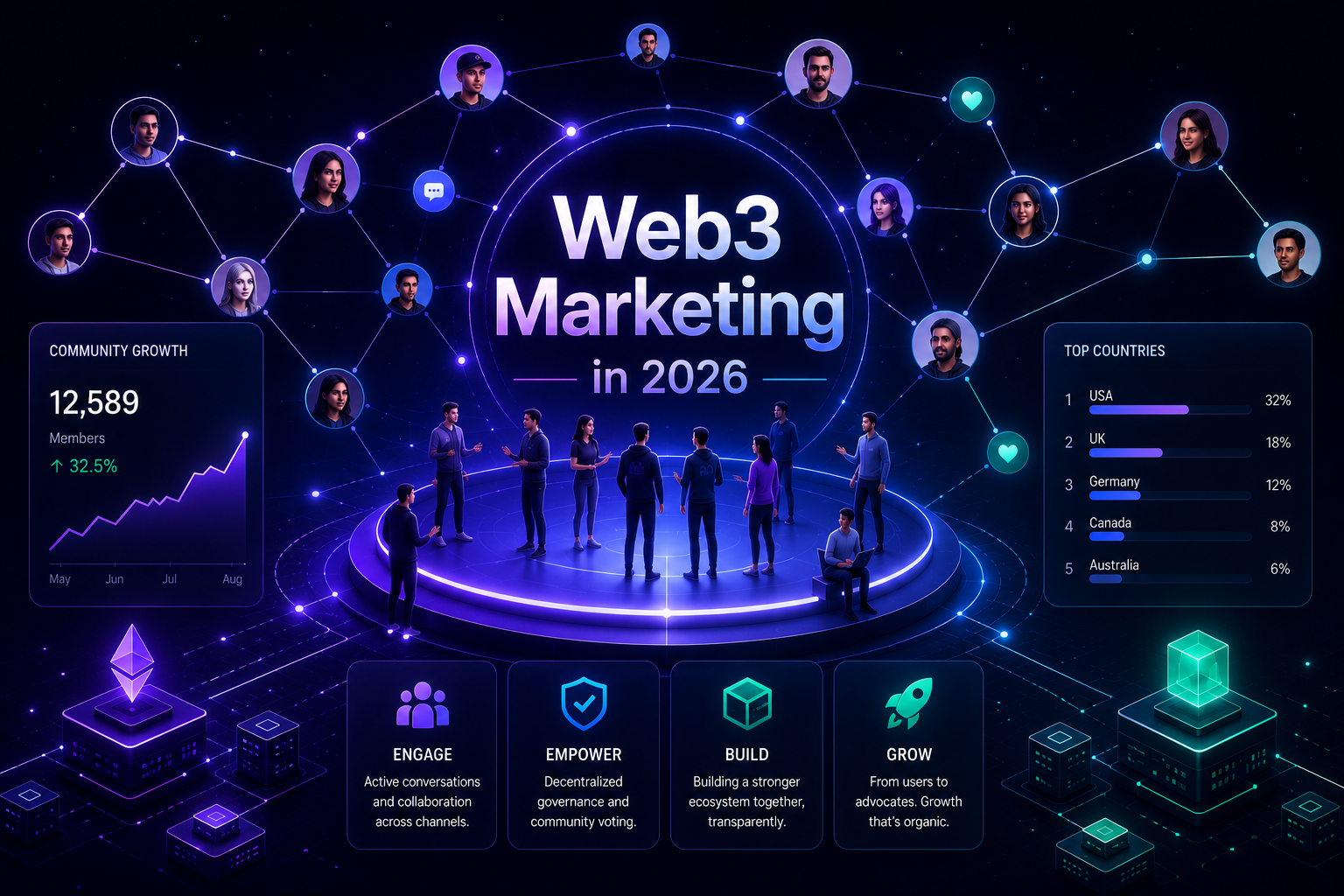
Web3 marketing has matured.
Table Of Content
- The Shift from Hype to Sustainable Growth
- Strategy 1: Community-First Growth
- What works in 2026
- Strategy 2: Content That Educates, Not Just Promotes
- High-performing content includes
- Strategy 3: Smarter KOL Marketing
- What’s changed
- Strategy 4: Seamless User Onboarding
- What works
- Strategy 5: Gamification and Incentive Design
- Strategy 6: Data-Driven Marketing
- Key metrics to track
- Strategy 7: Integrated Ecosystems
- Strategy 8: Transparency and Trust
- Common Mistakes That Still Hold Projects Back
- Over-reliance on hype
- Ignoring community
- Poor onboarding
- Lack of consistency
- No clear strategy
- What Successful Web3 Projects Are Doing Differently
- The Future of Web3 Marketing
- Conclusion
A few years ago, it was easy to get attention. Airdrops, influencer threads, and hype cycles could bring in thousands of users overnight. But most of that growth didn’t last.
Users came for rewards and left just as quickly.
In 2026, that approach doesn’t work anymore.
The market is more competitive. Users are more informed. And attention spans are shorter than ever. Projects that rely purely on hype struggle to survive, while those focused on real value and community continue to grow.
This shift has changed how Web3 marketing works.
It’s no longer about going viral. It’s about building systems that attract the right users, keep them engaged, and turn them into long-term participants.
Let’s break down the strategies that are actually working in 2026.
The Shift from Hype to Sustainable Growth
The biggest change in Web3 marketing is the shift from short-term campaigns to long-term ecosystems.
Earlier, success looked like:
- Trending on social media
- Rapid follower growth
- Large airdrop participation
Now, success looks like:
- Active communities
- Consistent user engagement
- Real product usage
- High retention rates
The focus has moved from “How many users joined?” to “How many users stayed?”
This single shift defines modern Web3 marketing.
Strategy 1: Community-First Growth
In Web3, your community is your strongest asset.
Platforms like Discord and Telegram are no longer optional they are central to your growth strategy.
What works in 2026:
- Structured onboarding for new members
- Daily engagement through conversations and events
- Active community management
- Clear roles and incentives for contributors
Communities are not just support channels. They are growth engines.
Projects that invest in community early see better retention and organic expansion.
Strategy 2: Content That Educates, Not Just Promotes
Users today are more skeptical of marketing.
They don’t want to be sold to they want to understand.
This is why content has shifted from promotional to educational.
Platforms like Twitter are still powerful, but the type of content that works has changed.
High-performing content includes:
- Explainer threads
- Deep dives into product features
- Use-case driven storytelling
- Transparent updates and insights
The goal is simple: make complex ideas easy to understand.
When users understand your product, they are more likely to trust and use it.
Strategy 3: Smarter KOL Marketing
KOL marketing is still effective but only when done right.
In 2026, it’s not about big influencers. It’s about the right influencers.
What’s changed:
- Micro-KOLs with niche audiences perform better
- Authentic content outperforms scripted promotions
- Long-term partnerships replace one-off campaigns
The focus is now on relevance and credibility.
A smaller creator with a highly engaged audience can drive more conversions than a large account with low interaction.
Strategy 4: Seamless User Onboarding
One of the biggest barriers in Web3 is complexity.
Wallets, transactions, gas fees these can confuse new users.
If onboarding is difficult, users leave.
What works:
- Step-by-step guides
- Simple tutorials
- Clear user journeys
- Dedicated support channels
Projects that simplify onboarding see higher conversion and retention rates.
Good marketing brings users in. Great onboarding keeps them.
Strategy 5: Gamification and Incentive Design
Incentives are still important but they need to be designed differently.
The old model:
- Short-term rewards
- Airdrop farming
- One-time participation
The new model:
- Long-term engagement rewards
- Activity-based progression systems
- Contributor recognition
- Exclusive access for active members
Gamification works when it encourages meaningful participation, not just quick actions.
Strategy 6: Data-Driven Marketing
Guesswork doesn’t work anymore.
Successful Web3 marketing in 2026 is data-driven.
Key metrics to track:
- Active users (daily/weekly)
- Retention rates
- Engagement levels
- Conversion rates
These metrics provide real insights into what’s working.
Instead of chasing trends, projects focus on improving performance based on data.
Strategy 7: Integrated Ecosystems
Web3 marketing is no longer about isolated campaigns.
It’s about connected systems.
For example:
- Content on Twitter drives awareness
- Users join Discord for engagement
- Community drives product usage
- Product usage drives retention
Each part supports the other.
This creates a loop where growth becomes sustainable.
Strategy 8: Transparency and Trust
Trust has become one of the most important factors in Web3.
Users want:
- Clear communication
- Honest updates
- Transparency about progress and challenges
Projects that communicate openly build stronger relationships with their audience.
Trust leads to loyalty. Loyalty leads to growth.
Common Mistakes That Still Hold Projects Back
Even in 2026, many projects repeat the same mistakes.
Over-reliance on hype
Short-term spikes don’t create long-term value.
Ignoring community
Without engagement, users leave.
Poor onboarding
Confused users don’t convert.
Lack of consistency
Marketing needs continuous effort.
No clear strategy
Random campaigns rarely work.
Avoiding these mistakes is just as important as applying the right strategies.
What Successful Web3 Projects Are Doing Differently
The projects that are growing today have a few things in common:
- They prioritize users over metrics
- They build strong communities early
- They focus on education and clarity
- They invest in long-term engagement
- They continuously optimize based on data
They don’t chase trends. They build systems.
The Future of Web3 Marketing
Looking ahead, Web3 marketing will continue to evolve.
We can expect:
- More community ownership and participation
- Better onboarding experiences
- Increased use of AI for personalization and insights
- Stronger focus on retention over acquisition
The gap between hype-driven projects and value-driven projects will continue to grow.
Conclusion
Web3 marketing in 2026 is no longer about getting attention.
It’s about keeping it and turning it into real usage.
The strategies that work today are built around:
- Community
- Education
- Trust
- Engagement
- Data
Projects that focus on these areas will build sustainable growth.
Those that rely on hype will struggle to keep users.
Because in the end, growth isn’t about how many people show up.
It’s about how many choose to stay.






No Comment! Be the first one.