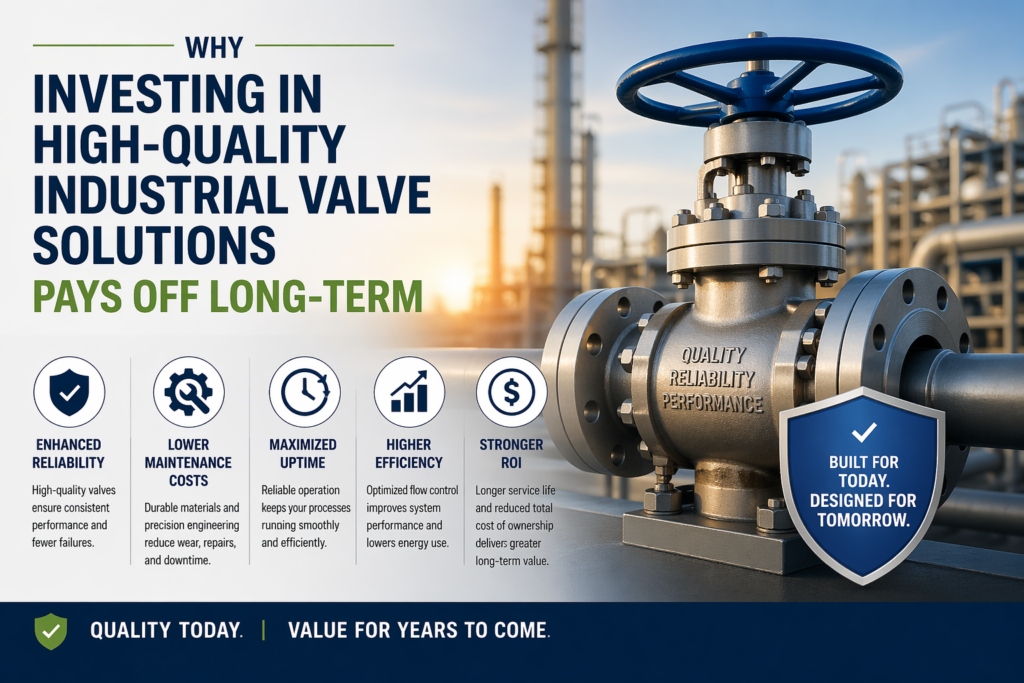
In industries with high stakes, such as oil and gas, water treatment, and power generation, every single piece of equipment is important; however, the industrial valve is one of the key components that deserves attention over and above others. The industrial valve is also one of the most neglected elements of the vast system of which it is a part, yet it performs the critical functions of flow control, pressure control and safety for entire industrial systems by themselves. For companies doing business in the UAE, where they will be exposed to extreme heat and other challenging environmental conditions, high-quality industrial valves are a strategic investment in addition to being a technical investment.
This article will focus on why you should select industrial valves based on their quality, rather than their price tag, in order to save money long-term, maximise operational efficiency and improve the safety of their operations.
How Much Low-Quality Valves Cost
At first glance, selecting a lower price point valve may seem to be an economically sound method of reducing costs. However, the long-term results can be significantly more detrimental to the company than the short-term savings realised through purchasing a lower-cost valve. Low-quality valves are subject to the following:
- Frequent failure
- Premature leakage and pressure fluctuations
- Higher maintenance and longer downtimes
Unplanned downtime in the oil and gas industry can cost between $5 million and $10 million per day. The failure of one valve may cause a snowball effect in the entire system.
Enhanced Durability in UAE’s Harsh Conditions
Because of the unique industrial landscape of the UAE—primarily due to extreme heat, sand, valuable moisture, and corrosion—standard valves frequently do not hold up well against these conditions, resulting in rapid wear and tear.
High-capacity industrial valves, by contrast, are manufactured with high-performance materials, i.e., alloys of stainless steel and special corrosion-resistant coatings. These materials ensure the following:
- Longer duration of service
- Resistance to environmental degradation
- The need for replacement is significantly diminished
For those industries that are located in either desert or offshore environments, durability is a must.
Improved Efficiency and Performance
The backbone of all industrial operations is efficiency; therefore, when valves are well designed, they provide accurate control over flow (measured in both volume & pressure), optimising system capacity for operating at their highest (efficient) performance level(s).
To achieve optimal performance at as few energy costs as possible, it is imperative that modern valves be designed to:
- Make accurate adjustments of flow
- Make minimal pressure loss
- Provide smooth operation regardless of load variations
According to the International Energy Agency, improved equipment efficiency can reduce energy costs up to 15%. Thus, energy cost savings directly translate into cost savings and improved economic productivity.
Safety: Keeping Employees and Property Safe
In businesses that handle high-pressure, hazardous materials or complex processes, safety is an extreme priority. If a valve fails to operate, a disaster such as a leak, explosion, or environmental disaster is possible.
Industrial valves with high quality are designed with safety features that include the following:
- Reliable sealing systems
- Pressure relief capabilities
- Compliance with global industry standard (API, ISO)
These features allow the systems to have stability through extreme operating conditions, resulting in the protection of both personnel and the facility.
Reduced Maintenance and Operating Costs
One of the key benefits to investing in quality valves is that over time there will be fewer maintenance costs associated with them. Although cheaper valves may require many repairs or replacements, quality valves:
- Require less maintenance over time
- Less cost associated with repair expenses
- Minimal disruption of operations
This results in TCO (total cost of ownership) being lower, allowing organisations to focus on growing the company by increasing operational efficiency.
Integration Into Smart Technology
With the UAE committed to Industry 4.0, the use of automation and smart systems will become common practice in many industrial operations. Today’s industrial valves are now equipped with the following:
- IoT-enabled sensors
- Real-time data monitoring
- Predictive maintenance capabilities
All of these technologies give engineers the opportunity to detect problems before they happen, allowing for uninterrupted operation.
Final Thoughts:
When it comes to industrial operations, compromising on a critical part like a valve could have disastrous and expensive implications. By purchasing high-end industrial valves from reputable manufacturers, you’re not just looking at performance today but also considering how reliable, safe, and efficient they will be in the future.
When considering factors such as reducing downtime or maintenance costs, improving system performance, and improving safety, the advantages can be easily recognised. For companies located in the UAE where there are higher than average operational requirements, investing in quality industrial valves is a necessity.
Leave a Comment