



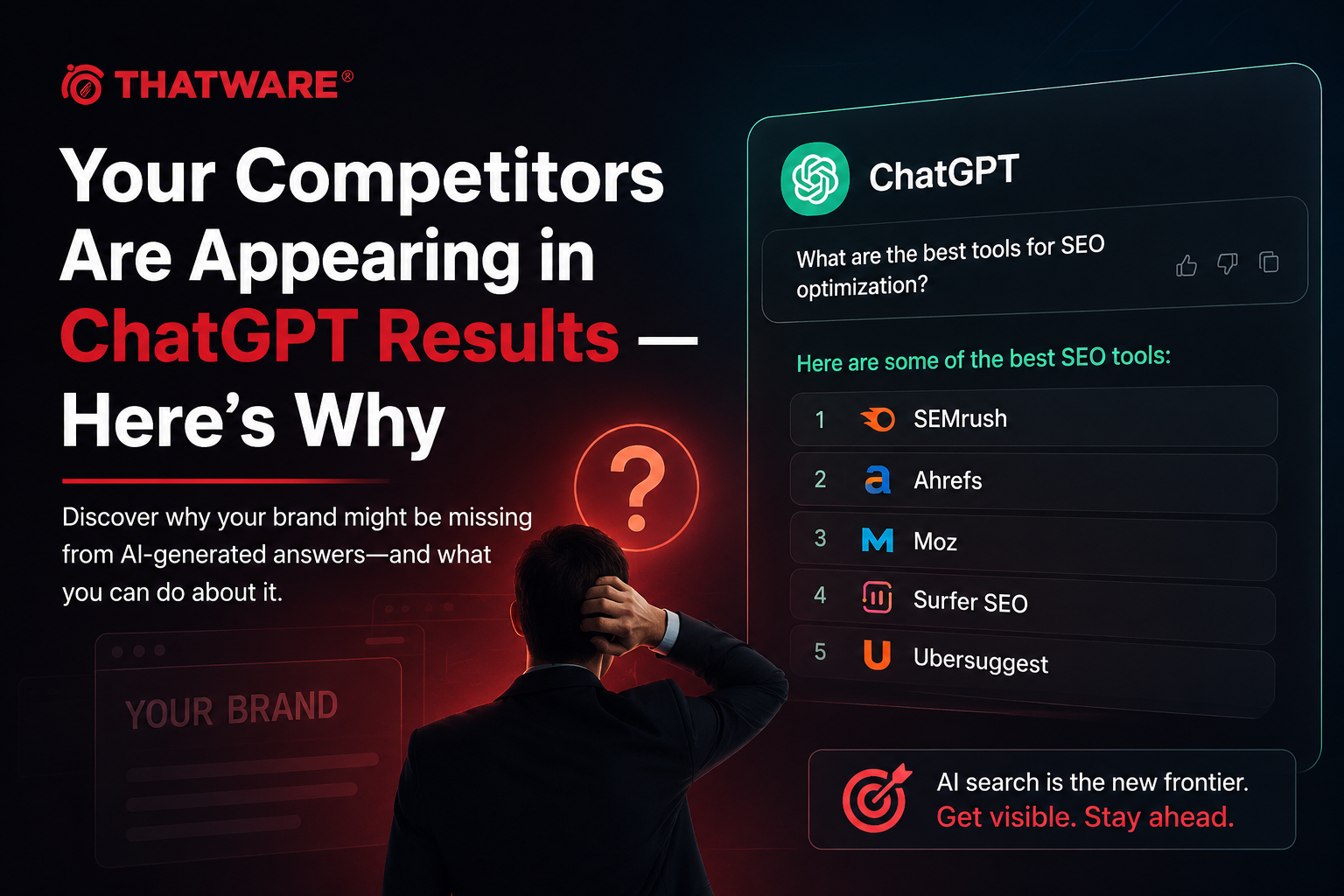
Search behavior is changing faster than most businesses expected.
Table Of Content
- Why AI Search Is Different From Traditional Search
- The Real Problem Most Brands Don’t Notice
- How Competitors Gain Visibility Inside ChatGPT
- Strong Brand Documentation
- They Have Better Third-Party Mentions
- Their Content Solves Specific Problems
- AI Visibility Gaps Usually Appear in Three Ways
- Complete Absence
- Incorrect Brand Positioning
- Low Confidence Mentions
- What Modern AI Search Optimization Actually Involves
- The Importance of Citation Footprints
- The Future of Search Is Already Changing
- Why This Matters More Than Ever
- Final Thoughts
A few years ago, people searched on Google, opened multiple tabs, compared websites, and made decisions after reading blog posts or reviews. Today, many users skip that entire process. They ask ChatGPT, Gemini, or Perplexity a direct question and trust the answer they receive.
That shift creates a serious challenge for brands that still focus only on traditional SEO.
If your competitors are showing up in AI-generated answers while your brand is missing, it is not random. There is a reason behind it. More importantly, there is a way to fix it.
At ThatWare, we have seen many businesses struggle with this exact issue. Their websites rank on Google for certain terms, yet AI systems barely recognize them. Some are mentioned incorrectly. Others are confused with competitors. Many are invisible altogether.
This is where modern search visibility is heading, and businesses that ignore it may lose attention, authority, and conversions over time.
Why AI Search Is Different From Traditional Search
Traditional search engines rely heavily on indexing pages and ranking them through signals like backlinks, keywords, technical optimization, and user behavior.
AI search works differently.
Language models build an understanding of brands, services, products, and industries by analyzing patterns across massive amounts of information. They do not simply “rank” pages. They interpret entities and relationships.
That means AI systems need to clearly understand:
- Who your brand is
- What your business does
- Which industry you belong to
- What problems you solve
- Why people trust you
- How others describe your company online
If these signals are weak, inconsistent, or missing, the AI struggles to confidently mention your business in responses.
Your competitors may not necessarily have better products or services. They may simply have stronger digital entity signals.
The Real Problem Most Brands Don’t Notice
Most companies assume that having a website is enough.
It is not.
There is another version of your business that exists across the AI ecosystem. That version is built from mentions, citations, reviews, expert discussions, articles, comparisons, and structured data spread across the internet.
If those signals are incomplete, outdated, or inconsistent, AI systems develop a weak understanding of your brand.
This is why some businesses disappear from AI-generated recommendations even when they are highly relevant to the query.
The issue is not always visibility on Google. The issue is machine understanding.
That is where llm visibility optimization becomes essential for modern businesses trying to stay competitive in AI-driven discovery systems.
How Competitors Gain Visibility Inside ChatGPT
Businesses that frequently appear in AI responses usually share several characteristics.
Strong Brand Documentation
AI models trust brands that are consistently described across multiple credible sources.
If your company information changes from one platform to another, confusion happens. One site may describe your company as a software firm, another as a marketing agency, and another as a consulting business.
That inconsistency weakens your entity clarity.
Competitors who maintain structured and unified brand descriptions across the web create stronger recognition signals for AI systems.
They Have Better Third-Party Mentions
AI systems heavily rely on trusted external references.
These may include:
- Industry publications
- Review websites
- Case studies
- News mentions
- Expert blogs
- Podcasts
- Interviews
- Comparison articles
If your competitors are consistently mentioned in these environments, language models develop higher confidence in their authority.
Your own website alone is not enough to establish credibility in AI search.
Their Content Solves Specific Problems
Generic content rarely performs well in AI-generated search environments.
AI systems prefer pages that deeply answer specific questions with expertise and clarity.
Many brands still create surface-level articles focused only on keywords. Meanwhile, competitors publish highly detailed, experience-based content that directly addresses real user intent.
That difference matters.
The more helpful and specific the content is, the easier it becomes for AI systems to understand when and why your brand should be recommended.
AI Visibility Gaps Usually Appear in Three Ways
Businesses often experience one of these visibility problems without realizing it.
Complete Absence
This is the most obvious issue.
Someone asks ChatGPT about a product category or service niche, and your brand never appears despite being relevant.
This usually happens because your entity footprint is too weak or too limited across authoritative sources.
Incorrect Brand Positioning
Sometimes the AI mentions your company but describes it inaccurately.
It may misunderstand your services, mention outdated offerings, or confuse you with another company entirely.
This often results from inconsistent content and poor entity association online.
Low Confidence Mentions
In some cases, the AI mentions your brand briefly while competitors receive stronger and more detailed recommendations.
This happens when the AI has limited confidence in the quality or authority of your digital footprint.
What Modern AI Search Optimization Actually Involves
Many businesses think this process is just another SEO trend.
It is much deeper than that.
AI search optimization service focuses on helping language models clearly understand your business through structured authority signals.
That includes:
- Improving entity clarity
- Strengthening structured data
- Building authoritative citations
- Publishing expert-level content
- Expanding trusted brand mentions
- Creating topic-specific authority
- Maintaining consistent brand language across platforms
This process requires strategy, patience, and long-term consistency.
Quick fixes rarely work in AI visibility building.
The Importance of Citation Footprints
One of the most overlooked aspects of AI visibility is citation quality.
Language models trust brands that repeatedly appear in authoritative contexts.
For example, if your business is discussed across respected industry websites, professional reviews, and comparison articles, AI systems gain stronger confidence in your relevance.
This creates a compounding effect over time.
Every trusted mention improves your entity understanding.
Every authoritative article strengthens your positioning.
Every expert citation increases AI confidence.
That is why brands investing early in AI visibility are building long-term advantages that competitors may struggle to catch later.
The Future of Search Is Already Changing
Many businesses still believe AI-generated search is experimental.
It is not.
User behavior is already shifting toward conversational search experiences. People increasingly expect direct answers instead of browsing through multiple search results.
That is why understanding the future of SEO in AI search era has become critical for brands that want sustainable digital growth.
The businesses that adapt early will likely dominate visibility across future AI-powered search ecosystems.
The businesses that wait too long may find themselves competing for attention in a much harder environment later.
Why This Matters More Than Ever
AI-generated search responses influence trust quickly.
If users repeatedly see your competitors recommended while your business remains absent, perception changes over time.
People naturally assume the visible brands are the authoritative ones.
That creates a silent competitive disadvantage.
Visibility inside AI systems is no longer just a technical discussion. It directly impacts brand authority, trust, lead generation, and customer acquisition.
Final Thoughts
The shift toward AI-driven search is not coming in the future. It is already happening.
ChatGPT, Gemini, and Perplexity are influencing how users discover products, services, and businesses every day. Brands that fail to build strong AI visibility signals risk becoming invisible during these conversations.
The good news is that this problem can be solved.
With the right entity strategy, authoritative content, citation footprint, and structured optimization, businesses can improve how language models understand and recommend their brand.
The window of opportunity is still open, but it will not stay open forever.
Companies that invest in AI visibility today are preparing for the next generation of search before it becomes overcrowded.





No Comment! Be the first one.