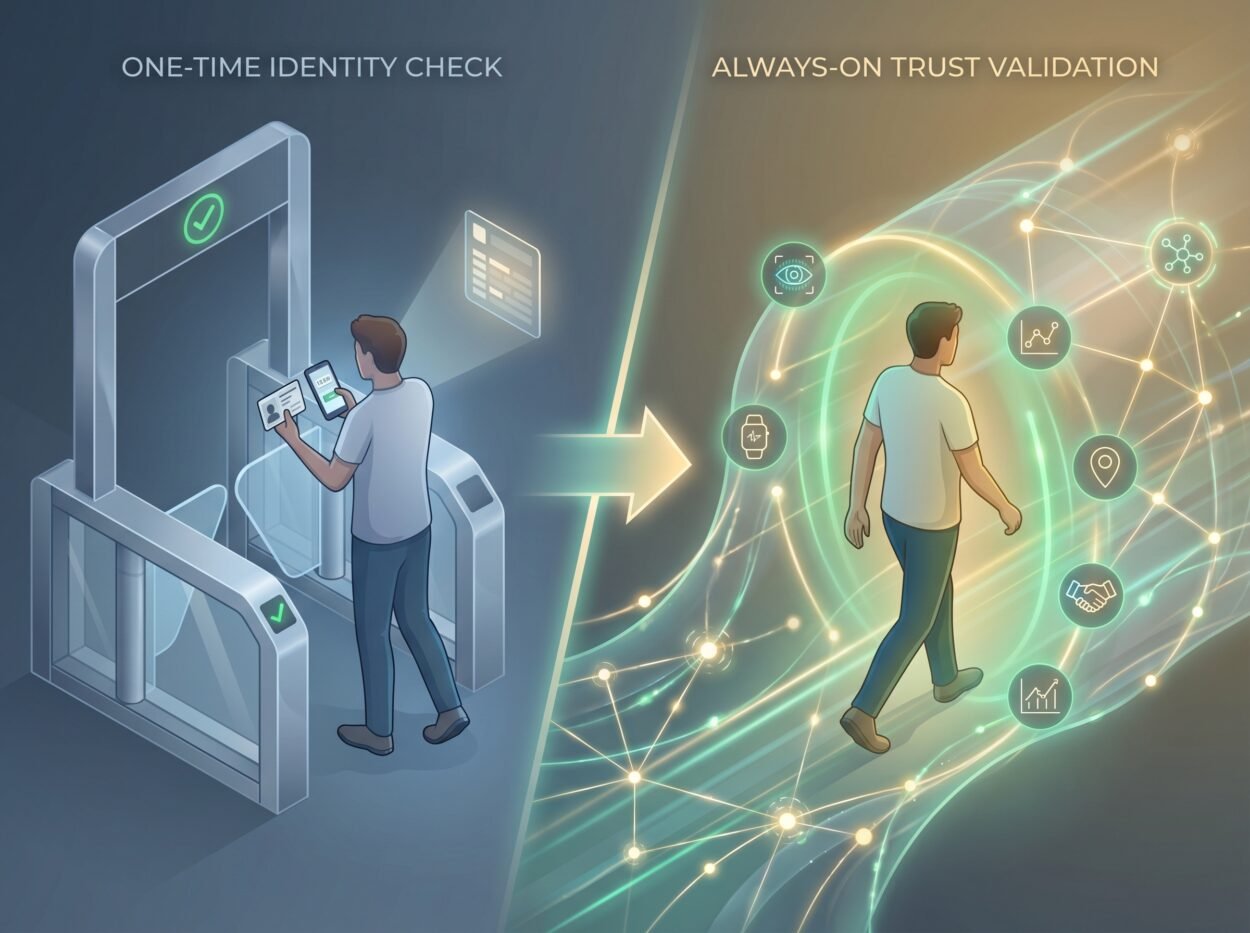
For years, digital identity systems have relied on a simple idea: verify once, then trust.
A user logs in, completes identity verification, and gains access. From that point onward, the system assumes everything is secure.
But in today’s threat landscape, that assumption no longer holds.
Cyber risks evolve in real time. User behavior changes. Devices, locations, and access patterns shift constantly. A one-time identity check is no longer enough to guarantee security.
This is why the industry is moving toward a new model: always-on trust validation.
🔍 The Limits of One-Time Identity Verification
Traditional digital identity verification systems were built for convenience and scale. They work well at the entry point but fall short after that.
Key challenges include:
- Trust is granted permanently after a single check
- No continuous monitoring of user behavior
- Increased vulnerability to session hijacking and fraud
- Limited ability to detect anomalies after login
In essence, once access is granted, systems often stop verifying.
That’s a risk modern organizations can’t afford.
🔐 What Is Always-On Trust Validation?
Always-on trust validation shifts identity from a single checkpoint to a continuous process.
Instead of asking “Who are you?” just once, systems continuously evaluate:
- User behavior patterns
- Device and network context
- Location changes
- Access requests and activity
This creates a dynamic model where trust is constantly reassessed not assumed.
⚙️ How Modern Identity Systems Are Evolving
To support continuous trust, organizations are adopting smarter, layered technologies:
1. Behavioral Monitoring
Tracking how users interact with systems to detect anomalies in real time.
2. Context-Aware Authentication
Adjusting security requirements based on device, location, and risk level.
3. Digital Credentials and Verification
Using digital credentials and verifiable credentials for secure, reusable identity validation.
4. Decentralized Identity Models
Giving users control over identity while enabling secure verification across platforms.
5. Automation in Compliance
Leveraging digital identity compliance automation software to ensure real-time regulatory alignment.
⛓️ The Role of Blockchain and Trust Infrastructure
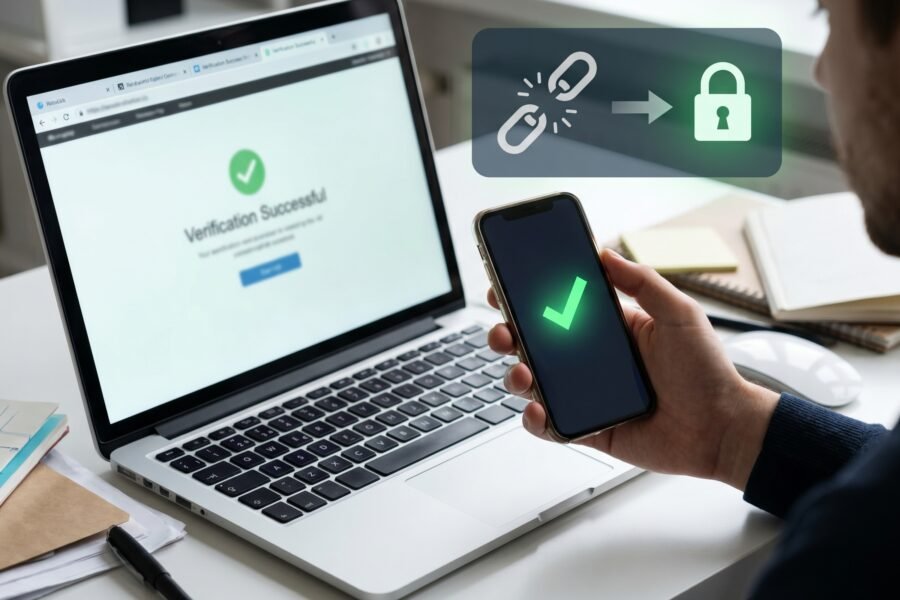
Technologies like blockchain identity solutions add an extra layer of reliability by ensuring that identity data and credentials are tamper-proof.
With blockchain credentials:
- Verification becomes instant and secure
- Data integrity is guaranteed
- Trust is distributed rather than centralized
This strengthens the foundation of continuous trust systems.
🚀 Benefits of Continuous Trust Validation
Moving to always-on trust brings significant advantages:
For Organizations:
- Reduced fraud and unauthorized access
- Stronger security posture
- Real-time threat detection
- Improved compliance readiness
For Users:
- Seamless and secure experiences
- Fewer interruptions during normal activity
- Better protection of personal data
It’s not just more secure, it’s also more user-friendly.
🌍 Why This Shift Matters Now
As digital ecosystems expand especially across finance, government, and enterprise platforms identity systems must evolve to handle:
- Increasing cyber threats
- Remote and distributed access
- Cross-platform interactions
- Strict regulatory requirements
Static identity models simply can’t keep up.
Always-on trust validation ensures that identity systems remain adaptive, responsive, and secure.
🧠 Final Thoughts
The shift from one-time identity checks to continuous trust validation marks a fundamental change in how we approach digital security.
Identity is no longer a moment, it’s a journey.
By combining digital identity platforms, credential verification systems, and real-time monitoring, organizations can build environments where trust is not assumed but continuously earned.
And in a world where threats never stop evolving, neither should trust.
Looking to upgrade your identity systems with continuous trust validation?
We help organizations build:
- Advanced digital identity platforms
- Verifiable credential systems
- Blockchain-based identity solutions
- Identity compliance automation frameworks
👉 Connect with us to create secure, scalable, and future-ready identity ecosystems.


Leave a Comment