




Growing Up Poor in a World of Possibility: Class, Confidence, and College Life in the 1970s
One of the most quietly powerful threads running through Because He Loved Me is not just the story of a young woman coming of age, but the story of what it feels like to grow up poor and step into a...

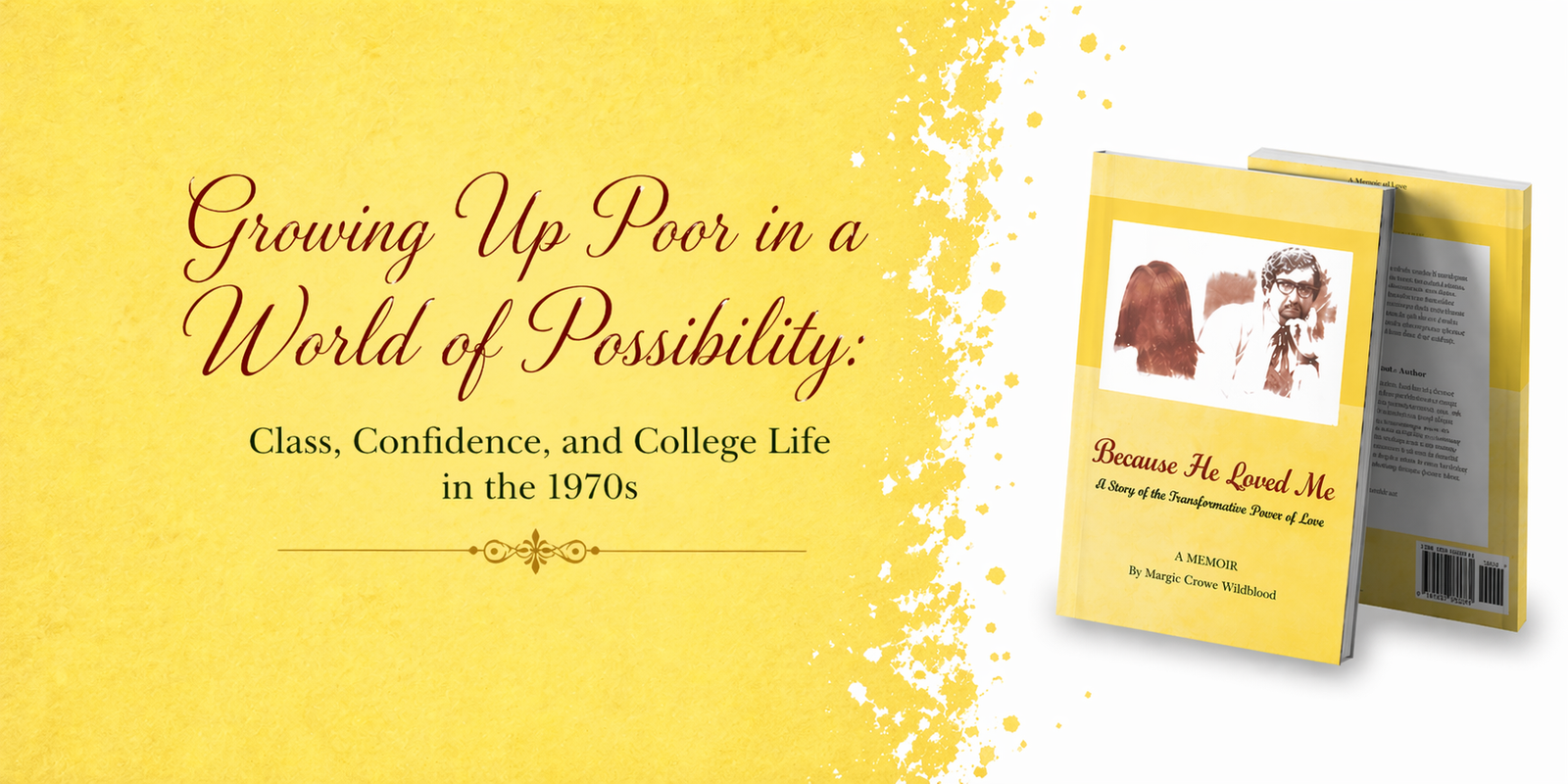
One of the most quietly powerful threads running through Because He Loved Me is not just the story of a young woman coming of age, but the story of what it feels like to grow up poor and step into a world that seems to belong to someone else.
Margie Crowe Wildblood does not frame her background with bitterness or resentment. Instead, she presents it with clarity—sometimes even with affection. But underneath that honesty is a deeper reality: growing up with limited means shaped not only her circumstances, but her sense of identity.
And that sense of identity does not disappear when she arrives at college.
In many coming-of-age stories, college is portrayed as a place of freedom and reinvention. For Margie, it is something more complicated. It is an opportunity, yes—but also a confrontation. It forces her to examine the beliefs she has carried with her for years, beliefs about where she belongs and what she is allowed to become.
Those beliefs did not come out of nowhere.
They were formed early, in a household where money was scarce and survival required discipline. Margie grew up in a large family, where every dollar mattered and every decision had consequences. Her parents worked hard, doing what they could to provide stability, but there was little room for indulgence or risk.
Within that environment, a particular message took root: know your place.
It was not always spoken harshly. In fact, it often came from a place of protection. Her mother, especially, seemed to believe that stepping too far beyond their social and economic boundaries could lead to disappointment or even humiliation. Better to stay within what was known. Better to avoid situations where one might feel out of place.
For a young Margie, this message became internalized.
By the time she reaches high school, and later college, she is already measuring herself against an invisible standard. She assumes others have advantages she does not—more money, more confidence, more right to be where they are. Even when no one explicitly tells her she doesn’t belong, she feels it.
That feeling follows her into Radford College.
From the outside, she blends in. She attends classes, participates in campus life, forms friendships. But internally, there is a constant awareness of difference. She notices what others wear, how they carry themselves, how easily they seem to navigate situations that feel uncertain to her.
It is not envy, exactly. It is something quieter and more persistent—a sense that she is always slightly out of step.
What makes this portrayal so compelling is how subtle it is. Margie does not experience overt exclusion or dramatic conflict based on class. Instead, the struggle is internal. It plays out in small moments: hesitations before speaking, second-guessing her choices, wondering if she is somehow less capable or deserving than those around her.
These moments accumulate.
They shape how she sees herself, often more powerfully than any external judgment could. Even her achievements feel tentative, as though they might be taken away if she is discovered to be an outsider.
And yet, college also begins to challenge these assumptions.
Through her classes, she is exposed to new ideas—about psychology, literature, human development. These subjects do more than expand her academic knowledge; they give her new ways of thinking about herself. She begins to see that identity is not fixed, that the beliefs she holds about herself are not necessarily permanent truths.
Her relationships also play a role in this shift.
Her roommates, for example, come from different backgrounds and bring with them a level of ease that Margie finds both surprising and comforting. They do not treat her as someone who is lesser. They include her, talk with her, share experiences with her. Through these interactions, she begins to see that the boundaries she has internalized are not always recognized by others.
Still, the most significant change happens internally.
Through ongoing conversations with a trusted mentor, Margie starts to examine the origins of her self-doubt. She reflects on her upbringing, on her mother’s warnings, on the ways she has limited herself without fully realizing it. These reflections are not immediate breakthroughs. They are gradual, unfolding over time.
She begins to ask questions she has never asked before.
Why does she assume others are more deserving? Why does she feel the need to stay within certain boundaries? What would happen if she allowed herself to fully participate, to fully belong?
These questions do not come with easy answers, but they create a shift in perspective.
For the first time, Margie considers that her background, while shaping her, does not define her entirely. That being “poor” is not the same as being less capable. That the qualities she has developed—resilience, thoughtfulness, sensitivity—are not disadvantages, but strengths.
This realization is not dramatic. It does not arrive all at once. But it begins to loosen the grip of the beliefs that have held her back.
Another important aspect of this journey is how Margie’s writing intersects with her sense of class and identity. Through her poetry and reflections, she gives voice to experiences that are often left unspoken. She writes about insecurity, about longing, about the desire to be seen. In doing so, she transforms those private feelings into something tangible.
Writing becomes a way of claiming space.
It allows her to assert, even if only on the page at first, that her experiences matter. That her perspective is valid. That her voice deserves to be heard, regardless of where she comes from.
By the time the reader reaches the later parts of this section of her life, there is a noticeable shift. Margie is not suddenly free of self-doubt, but she is no longer entirely defined by it. She begins to move through her world with a little more confidence, a little more willingness to trust herself.
She starts to belong—not because her circumstances have changed, but because her understanding of herself has.
Because He Loved Me offers a nuanced portrayal of class that goes beyond economics. It shows how deeply these early messages can shape identity, and how difficult—but also how possible—it is to question and move beyond them.
For anyone who has ever felt like an outsider in a room they worked hard to enter, Margie’s story resonates.
It reminds us that sometimes the hardest barriers to overcome are not the ones imposed by others, but the ones we carry within ourselves.