




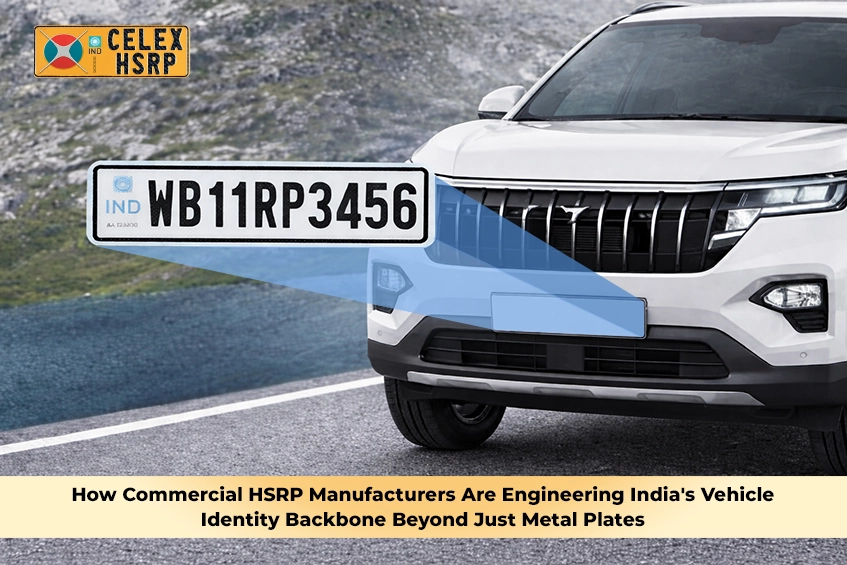
How Commercial HSRP Manufacturers Are Engineering India’s Vehicle Identity Backbone Beyond Just Metal Plates
Introduction Here’s a question most people never think of asking. What actually happens between a vehicle rolling off an assembly line and that same vehicle carrying a verified, traceable...

Introduction
Here’s a question most people never think of asking. What actually happens between a vehicle rolling off an assembly line and that same vehicle carrying a verified, traceable identity on a public road?
Top Content
- Introduction
- The Shift from Identification to Infrastructure: Redefining the Role of HSRP Manufacturers
- Regulatory Architecture: The Framework Driving Commercial HSRP Manufacturing in India
- Engineering Precision: The Advanced Manufacturing Processes Behind HSRPs
- Security by Design: Building Tamper-Proof and Anti-Counterfeit Registration Plates
- Digital Convergence: Linking Physical Plates to National Data Systems
- OEM Integration: Embedding HSRPs into the Automotive Supply Chain
- Scaling Nationwide Operations: Meeting India’s Massive Vehicle Demand
- Automation and Intelligence: Transforming Manufacturing with Technology
- Enabling Smart Mobility: HSRPs in Intelligent Transport Systems
- Beyond Plates: Building India’s Vehicle Identity Backbone
- Conclusion
- Partner with India’s Best Commercial HSRP Manufacturer for Precision Compliance at Scale
- Frequently Asked Questions (FAQs)
The answer involves a lot more than a metal plate with embossed letters. It involves precision manufacturing, regulatory compliance, digital database integration, anti-counterfeiting engineering, and nationwide logistics, all working together as a single coordinated system.
India has over 300 million registered vehicles and adds roughly 20 million more every year. Managing the identity of that entire fleet is a governance challenge of staggering complexity. Traditional registration plates failed this challenge completely. They were unregulated, easily duplicated, and completely untrackable.
Commercial HSRP manufacture in India stepped in to fix this. But the role these manufacturers play today goes far beyond producing physical plates.
This guide reveals the full story of how commercial HSRP manufacture in India has evolved into something genuinely foundational to the country’s transport infrastructure. Read on. The details will surprise you.
The Shift from Identification to Infrastructure: Redefining the Role of HSRP Manufacturers
Not long ago, a vehicle registration plate was exactly what it looked like. A piece of metal with painted or embossed characters showing a registration number. That was its entire function. Display a number. Nothing more.
This simplicity was also its fatal weakness. A plate that only displays a number, with no security features, no traceability, and no connection to any verification system, is trivially easy to duplicate, swap, or fabricate. And that’s exactly what criminals did, at scale, for years across India’s road network.
The consequences weren’t abstract. Stolen vehicles changed identities overnight by carrying cloned plates. Hit-and-run perpetrators escaped because enforcement cameras captured plate numbers that led nowhere. Toll evasion became systematic because vehicles could carry duplicate plates of vehicles registered in other states. The entire vehicle identification framework was undermined by the fundamental insecurity of the plates at its centre.
The introduction of high-security registration plate production under government mandate transformed what a registration plate is required to be. A compliant plate today is a multi-layered security instrument, a data access point, an anti-fraud mechanism, and a component of national transport governance infrastructure. It also happens to display a registration number, but that’s the least of what it does.
Commercial HSRP manufacture in India evolved to meet this transformation. Manufacturers who built the capability to produce compliant plates at scale didn’t just enter a new product market. They became infrastructure providers for a system on which the entire country’s vehicle governance depends. Companies like Celex Technologies Pvt. Ltd. represent this evolved category of manufacturer, combining production capability, digital integration, compliance expertise, and operational scale into a unified infrastructure role that goes far beyond supplying physical plates.
Regulatory Architecture: The Framework Driving Commercial HSRP Manufacturing in India
Every serious infrastructure system operates within a regulatory framework that defines its standards, enforces its quality, and maintains its integrity over time. Commercial HSRP manufacture in India is no exception.
The CMVR Rule 50 compliance system forms the legal foundation of India’s vehicle registration plate standards. Rule 50 of the Central Motor Vehicles Rules specifies mandatory requirements covering every significant aspect of plate production and installation. Material specifications mandate the use of aluminium substrates to meet defined thickness and alloy standards.
Reflective sheeting requirements specify minimum retroreflectivity coefficients that finished plates must achieve under standardised measurement conditions. Security feature mandates require the integration of chromium holograms, laser-etched vehicle identification codes, and non-reusable snap-lock installation hardware. Character dimension standards specify exact heights, widths, spacing, and profile depths for embossed alphanumeric characters across all vehicle categories.
The regulatory framework also governs who can produce compliant plates. Only manufacturers receiving government approval through a defined certification process can legally produce high-security registration plate production units for use in India. This approval requires demonstrating compliant production facilities, certified quality management systems, and the ability to integrate with government vehicle registration databases.
Compliance monitoring is ongoing rather than a one-time certification event. Approved manufacturers submit periodic audits that verify continued adherence to production standards, material specifications, and quality management requirements. Manufacturers failing to meet audit requirements for risk suspension or revocation of their approval status would halt production entirely.
The best HSRP manufacturer operations understand that regulatory compliance isn’t just a legal obligation. It’s the foundation of trust that makes the entire vehicle identity system reliable. Celex Technologies Pvt. Ltd. aligns every aspect of its production processes and quality systems with these regulatory requirements, ensuring every plate produced contributes to a transparent and enforceable vehicle registration system across India.
Engineering Precision: The Advanced Manufacturing Processes Behind HSRPs
The manufacturing process behind a compliant HSRP is considerably more sophisticated than most people imagine. Each plate passes through a sequence of precisely controlled production stages where any deviation can compromise the finished plate’s security, durability, or compliance status.
The process begins with aluminium blanking. High-grade aluminium alloy sheets, selected for appropriate thickness, tensile strength, and surface quality, are cut to standardised plate dimensions using precision cutting equipment. The tolerances here are tight because dimensional accuracy at the blanking stage affects character spacing and border dimensions throughout all subsequent processing.
Embossed aluminium registration plates take shape at the embossing station. Servo-controlled embossing presses use precision dies to raise alphanumeric characters to the exact profile heights and geometries specified by CMVR Rule 50 compliance system standards. The embossing process requires carefully controlled press force and die alignment to produce consistent character profiles across millions of production cycles without die wear causing dimensional drift.
Retroreflective licence plate material lamination follows embossing. Specialised reflective sheeting is applied to the plate surface using controlled heat and pressure processes calibrated to the specific adhesive system and sheeting material in use. Uniform lamination without adhesion failures, bubbles, or misalignment is critical for both regulatory compliance and the long-term field performance of the finished plate.
Hologram application uses hot-stamping equipment operating at precisely calibrated temperature and pressure parameters. The chromium hologram foil bonds to the reflective sheeting surface under these conditions, creating a permanent bond that cannot be broken without visibly damaging the plate.
Laser-etched vehicle identification codes are applied using high-powered laser engraving systems that physically remove material from the plate surface to create permanent identification markings. The engraving parameters are calibrated for consistent depth and contrast across all plate variants.
Celex Technologies Pvt. Ltd. operates automated manufacturing lines incorporating all these processes, using precision machinery and rigorous process controls to maintain production consistency and regulatory compliance across large-scale output volumes.
Security by Design: Building Tamper-Proof and Anti-Counterfeit Registration Plates
Security features in modern HSRPs aren’t decorative additions. Each feature addresses a specific fraud vector that criminals previously exploited using traditional plates. Together, these features create a layered anti-counterfeit plate manufacturing architecture that makes fraudulent plate production and use practically impossible under real-world conditions.
The chromium hologram is the most visually prominent security feature. This element uses diffraction-based optics to create colour-shifting visual patterns that change appearance depending on viewing angle. Standard printing, photocopying, or photographic reproduction cannot replicate diffraction-based optical effects. Any attempt to copy the hologram produces a flat, non-diffractive image that immediately identifies the plate as fraudulent to any officer familiar with authentic plate characteristics. The hologram is applied through hot stamping, which bonds it to the plate surface at a level that prevents removal without destroying the hologram entirely.
Laser-etched vehicle identification codes provide the permanent digital security layer. The laser physically removes material from the plate surface to create an identification code that cannot be altered without leaving obvious physical damage. No adhesive, paint, or chemical treatment can restore an altered laser engraving to its original appearance. Any modification attempt is permanently visible during inspection.
The tamper-proof number plate technology extends to the installation hardware. Non-reusable snap-lock bolts allow plates to be affixed to vehicles but cannot be removed without destroying the locking mechanism. The damaged hardware from any removal attempt is permanently visible, immediately signalling tampering during any subsequent inspection. This feature eliminates plate-swapping between vehicles as a practical criminal option.
Retroreflective licence plate material with the embedded “IND” national identification inscription adds another authentication layer. This inscription is integrated into the sheeting material during its production, making it impossible to add counterfeit reflective films after the fact.
Celex Technologies Pvt. Ltd. maintains controlled production environments and specialised equipment specifically configured to apply each of these security features consistently across every plate produced, ensuring the secure vehicle registration ecosystem remains reliable under adversarial real-world conditions.
Digital Convergence: Linking Physical Plates to National Data Systems
This is the development that transformed commercial HSRP manufacture in India from a compliance manufacturing activity into a genuine infrastructure function. The connection between physical plates and national digital databases changes what a plate fundamentally is and what it can do.
VAHAN database-linked plates represent the practical realisation of this transformation. VAHAN is India’s national vehicle registration database, maintained by the Ministry of Road Transport and Highways and containing comprehensive records for every registered vehicle in the country. Each HSRP’s laser-etched vehicle identification code serves as the digital key linking the physical plate to the corresponding VAHAN record.
This linkage is established during the manufacturing process itself. The manufacturer’s production management system generates each plate’s unique identification code in coordination with the VAHAN system. The code is simultaneously engraved on the plate and recorded against the vehicle’s database entry, creating a permanent, verified connection that is established before the plate leaves the production facility.
The vehicle identity management system built around this digital linkage transforms routine enforcement interactions. An officer scanning an HSRP’s identification code instantly retrieves complete vehicle information, including ownership details, registration validity, insurance status, emission compliance, and any active enforcement flags such as theft reports. This retrieval takes seconds and requires no radio communication or manual database consultation.
Automated enforcement systems leverage this connectivity even more powerfully. Automated number plate recognition (ANPR) cameras capture plate images from moving vehicles, extract identification codes, and query VAHAN automatically within milliseconds. Vehicles with expired registration, invalid insurance, or active theft flags are identified and flagged for attention without requiring human judgment at the point of capture.
The data accuracy of this system depends directly on manufacturers maintaining precise plate-to-vehicle mapping throughout their production and distribution processes. Celex Technologies Pvt. Ltd. integrates digital systems with manufacturing operations to ensure accurate data synchronisation from plate production through installation, supporting governance, enforcement, and transport monitoring applications that rely on this data infrastructure.
OEM Integration: Embedding HSRPs into the Automotive Supply Chain
The most operationally impactful innovation in commercial HSRP manufacture in India wasn’t a manufacturing technology breakthrough. It was a supply chain integration strategy that moved compliance from a post-purchase consumer responsibility to a pre-delivery automotive process.
The previous compliance model created a persistent gap between vehicle registration and HSRP installation. Buyers received their vehicles, navigated the HSRP application process independently, and installed compliant plates at some point after purchase. Many delayed this process significantly. Some have never completed it. The result was a large population of newly registered vehicles operating on non-compliant plates despite the HSRP mandate being legally in effect.
HSRP OEM integration closes this gap by embedding plate production and installation directly into the vehicle delivery workflow. The integrated process works like this. A customer finalises a vehicle purchase at an authorised dealership. The dealership submits registration details to the transport authority as part of the purchase process. The transport authority generates the registration number and transmits it to the approved manufacturer’s production system. The manufacturer produces plates carrying the correct details, all required security features, and linked identification codes. Completed plates are dispatched to the dealership before the scheduled vehicle delivery date. Installation happens at the dealership before the customer receives the vehicle.
This workflow requires tight data integration between the transport authority’s registration system, the manufacturer’s production management platform, the logistics operation, and the dealership delivery scheduling system. Real-time data exchange ensures that every party operates from accurate, synchronised information to prevent mismatches between plate production and vehicle delivery timing.
The compliance impact is immediate and measurable. Every vehicle delivered under this integrated model carries a correctly installed, fully registered HSRP from its first moment on public roads. VAHAN database-linked plates are connected from day one. The vehicle identity is complete and verifiable immediately.
Celex Technologies Pvt. Ltd. maintains extensive HSRP OEM integration partnerships spanning hundreds of automotive manufacturers and dealership networks, aligning production schedules with automotive manufacturing cycles and ensuring seamless plate availability across India’s dealership network.
Scaling Nationwide Operations: Meeting India’s Massive Vehicle Demand
Let’s put the operational challenge into concrete terms, because abstract scale discussions don’t convey what’s actually required here.
India registers approximately 20 million new vehicles annually. That’s roughly 40 million new plates every year from new vehicle registrations alone, since each vehicle requires a front plate and a rear plate. Add the ongoing retrofit demand from existing vehicles transitioning to HSRP compliance, and daily production requirements across the industry run into hundreds of thousands of plates.
Sustaining this volume while maintaining the quality and compliance standards that high security registration plate production requires demands industrial-scale manufacturing infrastructure. Multiple production lines are running continuously. Raw material supply chains with buffer inventory sized for uninterrupted operations. Quality management systems process the full production volume without creating bottlenecks. Distribution networks reaching dealerships and installation centres across all of India’s geographic diversity.
HSRP manufacturing automation is essential for maintaining quality consistency at these volumes. Manual inspection and process control cannot scale to meet production rates measured in millions of units monthly. Automated optical inspection systems check every plate for character embossing dimensions, reflective sheeting adhesion quality, hologram positioning and bond integrity, and laser code clarity. These systems process plates faster than human inspectors and apply consistent evaluation criteria across 24-hour production runs.
Distribution logistics present their own scale challenges. Plates manufactured at central production facilities must reach dealerships and installation centres serving vehicle owners in metropolitan centres, mid-sized cities, and remote rural districts across a country of subcontinental scale. Regional distribution hubs, carrier partnerships, and real-time delivery tracking systems are all required to maintain this reach with the timing precision that OEM delivery commitments demand.
Among the best HSRP manufacturer operations in India, Celex Technologies Pvt. Ltd. stands out for building scalable manufacturing and distribution systems capable of handling high volumes while maintaining regulatory compliance and delivery reliability across the country.
Automation and Intelligence: Transforming Manufacturing with Technology
Traditional manufacturing measures success by output volume and defect rates. Intelligent manufacturing measures success by those same metrics plus data accuracy, process traceability, compliance automation, and system integration. HSRP manufacturing automation has moved commercial HSRP manufacture in India firmly into the intelligent manufacturing category.
Software-driven production management platforms form the intelligence layer of modern HSRP manufacturing operations. These systems manage order intake from OEM partners and transport authorities, schedule production batches across available equipment capacity, generate unique identification codes for each plate in coordination with VAHAN, track every plate through each production stage in real time, manage quality inspection records and rejection disposition, and handle dispatch scheduling and delivery confirmation workflows.
The compliance automation capabilities of these platforms directly reduce error rates that previously required manual correction processes. Document validation systems verify incoming vehicle registration data before production begins. Any discrepancies in registration details, vehicle category codes, or owner identification information are flagged for resolution before plates are produced, preventing compliance errors from becoming physical products requiring disposal and reproduced units.
Real-time production monitoring dashboards give operations managers visibility into current production rates, equipment status, quality rejection trends, and batch completion estimates across all active production lines simultaneously. Automated alerts notify maintenance teams when process parameters drift outside acceptable ranges, enabling proactive intervention before quality issues develop at scale.
Automated number plate recognition (ANPR) compatibility requirements feed back into the manufacturing process control. The character font specifications, reflectivity standards, and dimensional tolerances that ANPR systems require for reliable plate reads are built into the process control parameters that automated manufacturing systems enforce during production. Consistent output quality is achieved through process discipline rather than inspection-based sorting.
Celex Technologies Pvt. Ltd. leverages technology across its manufacturing operations to improve efficiency, reduce errors, and enhance traceability, building the kind of intelligent production infrastructure that the secure vehicle registration ecosystem requires at a national scale.
Enabling Smart Mobility: HSRPs in Intelligent Transport Systems
Smart transport infrastructure in India is expanding rapidly. Electronic toll collection operates across thousands of highway kilometres. ANPR cameras are being deployed at toll plazas, traffic enforcement points, and urban intersections in growing numbers. Smart city initiatives in dozens of major cities incorporate vehicle tracking and traffic management systems that depend on accurate, real-time plate reads. Every one of these applications depends on the quality and standardisation of the plates at the centre of the system.
Automated number plate recognition (ANPR) technology exemplifies this dependency. ANPR systems capture plate images from vehicles at highway speeds under varying lighting and weather conditions. Image processing algorithms extract alphanumeric characters from these images and query vehicle databases within milliseconds. The accuracy of character extraction depends on plate reflectivity, character font clarity, dimensional consistency, and surface condition. A plate that meets all regulatory specifications produces reliable ANPR reads across all standard deployment conditions. A substandard plate degrades read accuracy in ways that reduce system effectiveness across every application using that data.
Retroreflective license plate material specifications in the CMVR Rule 50 compliance system are calibrated to ANPR operational requirements. The minimum retroreflectivity coefficients mandated by regulation correspond to the illumination levels that ANPR camera infrared LED arrays produce at standard deployment distances. Plates meeting these specifications produce sufficient image contrast for reliable character recognition. Plates falling below specification increase error rates and reduce the overall effectiveness of enforcement and monitoring systems.
Character font standardisation also serves ANPR accuracy. The approved character font for HSRPs minimises visual ambiguity between similar characters like 0 and O, or 1 and I, under real-world imaging conditions. This standardisation improves recognition accuracy across diverse imaging environments, from clear midday conditions to challenging nighttime or rain scenarios.
Beyond ANPR, smart transport infrastructure applications in India, including electronic toll collection, congestion monitoring, parking management, and border crossing systems, all rely on the same plate quality foundation. Celex Technologies Pvt. Ltd. produces plates engineered to support all these intelligent transport applications, positioning the best HSRP manufacturer’s operations as essential enablers of India’s expanding smart mobility ecosystem.
Beyond Plates: Building India’s Vehicle Identity Backbone
Step back from the individual technical details and appreciate the complete picture of what commercial HSRP manufacturing in India has built.
India now has a vehicle identity system where every registered vehicle carries a plate that is precision-engineered, security-layered, database-linked, installation-verified, and enforcement-readable. Every plate is traceable from raw material through manufacture, distribution, installation, and field operation. Every plate connects the physical vehicle to a comprehensive digital record accessible in real time by enforcement agencies, transport authorities, and automated systems across the country.
This infrastructure didn’t exist twenty years ago. It was built through the combined effort of regulatory mandate, manufacturing investment, digital integration, and operational scale that commercial HSRP manufacturing in India represents today.
The vehicle identity management system that HSRPs enable serves multiple governance objectives simultaneously. It supports traffic law enforcement through ANPR compatibility. It enables stolen vehicle detection through a database linkage. It supports emission and insurance compliance monitoring through real-time record access. It provides transport department data for policy planning and fleet analysis. It enables smart city traffic management through standardised, machine-readable plate formats.
The manufacturers who built this infrastructure are no longer simply producing physical products. They are operating and maintaining critical national infrastructure that the entire vehicle governance system depends on for its reliability and effectiveness.
Celex Technologies Pvt. Ltd. exemplifies this evolved infrastructure role. By integrating manufacturing excellence, compliance automation, digital system connectivity, OEM partnership management, and nationwide distribution capability into a unified operational ecosystem, Celex demonstrates how the best HSRP manufacturer operations have positioned themselves as foundational contributors to India’s secure vehicle registration ecosystem and its ongoing smart mobility evolution.
Conclusion
Commercial HSRP manufacture in India has undergone a complete transformation. What began as a regulatory compliance response to fraudulent and unregulated plate manufacturing has evolved into one of the country’s most important transport infrastructure sectors.
Today’s HSRP manufacturers combine precision high-security registration plate production, anti-counterfeit plate manufacturing systems, VAHAN database-linked plate integration, HSRP OEM integration with automotive supply chains, and HSRP manufacturing automation platforms into unified operational ecosystems that serve governance, enforcement, and smart mobility objectives simultaneously.
The physical plate is just the visible output. Behind it sits a sophisticated manufacturing, digital, and logistics infrastructure that keeps India’s vehicle identity system reliable, traceable, and tamper-proof across a fleet of hundreds of millions of vehicles.
Celex Technologies Pvt. Ltd. leads this ecosystem, combining industrial-scale manufacturing with deep digital integration and extensive OEM partnerships to deliver the secure vehicle registration ecosystem that modern India’s transport infrastructure demands.
Partner with India’s Best Commercial HSRP Manufacturer for Precision Compliance at Scale
Choose Celex Technologies Pvt. Ltd. for Intelligent Commercial HSRP Manufacturing Solutions
India’s vehicle identity infrastructure demands manufacturing partners who deliver more than compliant plates. It demands partners who bring digital integration capability, OEM supply chain alignment, nationwide distribution reach, and HSRP manufacturing automation that maintains quality across millions of units monthly. Celex Technologies Pvt. Ltd. offers all of these and more.
As one of the best commercial HSRP manufacturers in India, Celex combines advanced high security registration plate production with seamless VAHAN database-linked plate integration and proven HSRP OEM integration expertise. Whether you’re an automotive OEM, dealership network, or transport authority, Celex has the capability, certifications, and infrastructure to meet your compliance needs at any scale. Connect with Celex Technologies Pvt. Ltd. today and build your vehicle compliance program on a foundation that genuinely works.
Frequently Asked Questions (FAQs)
1. What distinguishes commercial HSRP manufacture in India from basic number plate production?
Commercial HSRP manufacture in India involves far more than stamping aluminium and painting characters. It requires government-approved production facilities, certified quality management systems, compliance with the CMVR Rule 50 compliance system, integration with VAHAN database-linked plates systems, and the operational capability to produce and distribute plates at the scale India’s vehicle fleet demands. The best HSRP manufacturer operations also integrate HSRP OEM integration with automotive supply chains and deploy HSRP manufacturing automation for quality consistency, and maintain a nationwide distribution infrastructure that basic number plate producers cannot approach.
2. How do laser-etched vehicle identification codes contribute to India’s vehicle identity management system?
Laser-etched vehicle identification codes permanently link each physical plate to its corresponding vehicle record in national databases. The laser physically removes material from the plate surface to create a permanent marking that cannot be altered without leaving obvious damage. This code enables real-time vehicle verification by enforcement officers and automated number plate recognition (ANPR) systems, converting the plate from a static display into a dynamic data access point. Any discrepancy between a plate’s identification code and its vehicle’s database record immediately signals a fraud attempt during verification.
3. Why is retroreflective licence plate material critical for modern enforcement systems?
Retroreflective licence plate material redirects incident light back toward its source with high efficiency, producing exceptional plate visibility under all lighting and weather conditions. This performance is critical for automated number plate recognition (ANPR) systems, which use infrared illumination to capture plate images from vehicles in motion. The minimum retroreflectivity standards mandated by the CMVR Rule 50 compliance system are calibrated to ANPR operational requirements, ensuring that compliant plates produce reliable, high-contrast images for automated character recognition across all standard deployment environments.
4. How does HSRP OEM integration improve vehicle compliance rates?
HSRP OEM integration embeds plate production and installation directly into the vehicle delivery process, eliminating the compliance gap created when individual buyers are responsible for obtaining HSRPs after purchase. Under the integrated model, plates are produced, linked to the correct VAHAN record, and installed at the dealership before the customer receives the vehicle. Every delivered vehicle carries a compliant, correctly registered HSRP from its first moment on public roads, producing significantly higher compliance rates than post-purchase consumer-managed installation models.
5. How does HSRP manufacturing automation improve production quality and compliance accuracy?
HSRP manufacturing automation replaces manual inspection and process control with automated optical inspection systems, software-driven process monitoring, and compliance validation platforms that operate continuously across full production volumes. Automated systems check every plate for character embossing dimensions, reflective sheeting quality, hologram integrity, and laser code accuracy at production rates that human inspection cannot match. Compliance automation platforms validate incoming vehicle registration data before production begins, preventing data errors from becoming physical plates. The combined effect is higher quality consistency, lower defect rates, and more accurate VAHAN database-linked plates data throughout the production process.