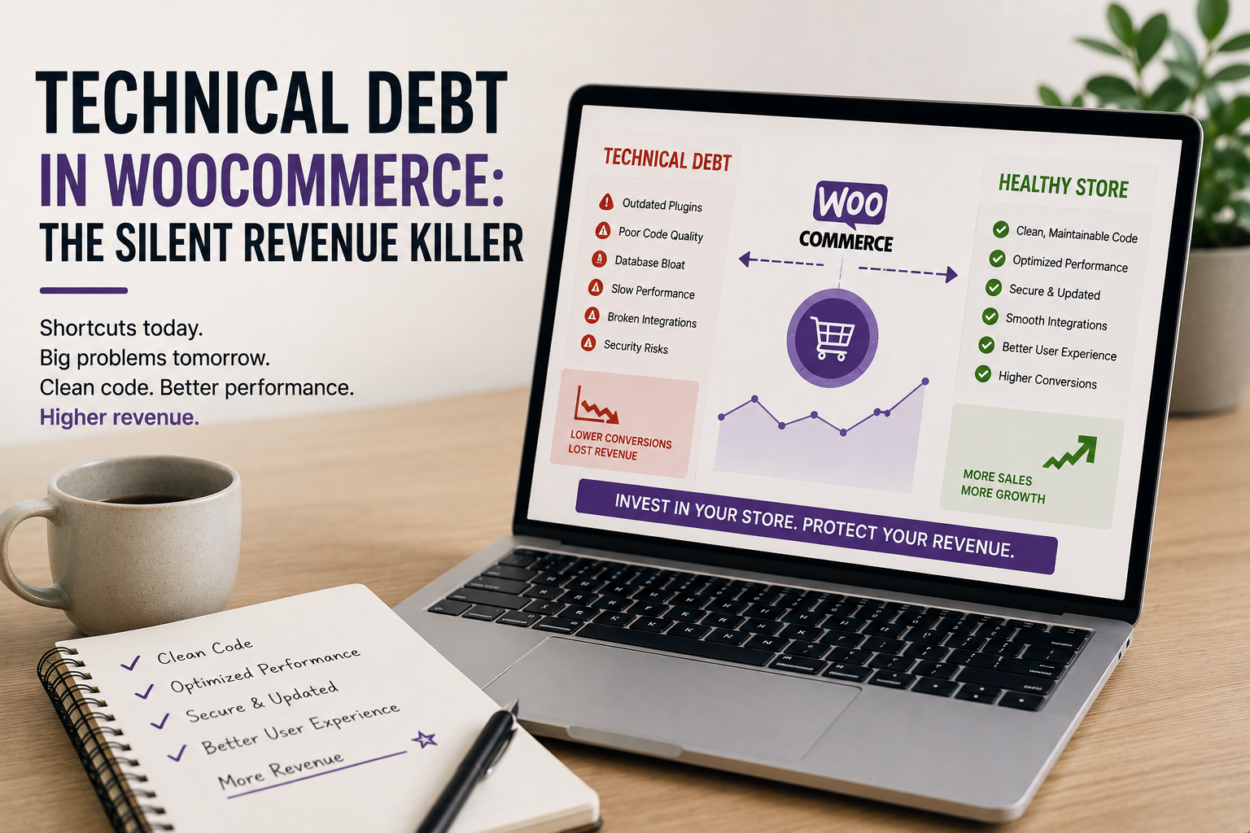
Technical debt doesn’t shout. It grows on the sly, in the background, in every shortcut, in every patch that’s used instead of fixing the problem, in every plugin you install to fix a problem that should have been engineered. When most store owners realize it, it has already cost them quite a bit!
What Technical Debt Actually Means for a WooCommerce Store
Technical debt, a term borrowed from software engineering, refers to the debt incurred by opting for a quick or easy solution rather than a proper and sustainable one now. It has interest as with financial debt. The longer it remains unaddressed, the more it costs, not in one dramatic blow, but in a progressive steady cost to performance, reliability and progress.
Technical debt can manifest itself in various ways in a WooCommerce context. It’s a custom code snippet that was added 2 years ago by a developer who doesn’t work with the store anymore and with no documentation and no one knowing what it does or if removing it would break anything. It is the theme that has not been updated in 18 months because the previous update was causing problems with the homepage layout and no one was able to get to it to fix it properly. It’s the checkout flow that has a working experience across desktop, but fails to work correctly from time to time on mobile devices, it’s been identified in support tickets and not fixed ever. It’s the database that slowly grinds every query you issue and keeps bloating over the years with all the transient data, duplicate entries and post revisions.
None of these things would make for dramatic reading on their own. When combined, they create an invisible ceiling on what the store can achieve, in performance, in conversion and in the ability to scale. That ceiling is what professional Woocommerce development services are designed to break through and it’s much more beneficial for the store owner to experience than they may think.
How Technical Debt Accumulates Without Anyone Noticing
Technical debt tends to come in dribs and drabs. It builds up by dozens of little ones, each reasonable on its own, but harmful when put together. A plugin is added to address an immediate need at a time of high trading volume (no need to assess other options or long-term fit). A developer makes a quick change in a plugin file, not creating a proper child theme override, knowing that the plugin will be updated and that change will be overwritten, but his/her site has to function even if the file is updated. A feature is added on top of an existing feature instead of thinking about re-architecting the underlying architecture, as that takes time and the launch schedule does not afford it.
The decisions are not taken lightly, but rather are taken in the context of running a business. But they’re not looked at after the initial pressure subsides. The temporary solution turns into a permanent one. The workaround becomes integral to the use. The rushed plugin turns into something no one wants to approach because there are a lot of things that rely on it that they no longer know how to do without. This accumulation becomes an easily overlooked, costly store over the course of months and years.
What is the most harmful part of this process is that the store remains open all the while. Sales are still on the way in. Orders still process. It’s hidden, until it’s not, until some WordPress update tears up an important integration, or the volume of activity reveals a performance problem which only a smaller number of visitors previously masked, or a security vulnerability in an abandoned plugin becomes a real threat.
Technical debt is not the fire, it’s the dry wood. It all appears to be straightforward until it’s not, at which point, of course, it’s already ruined.
The Revenue Cost That Never Appears on a Report
One of the reasons for why technical debt remains a problem in so many WooCommerce stores is that its cost is nearly impossible to track in a typical business report. No line item exists relating to any revenue lost due to slow page loads because of a poorly optimised database. No report exists indicating that the conversions are dropped due to browser / device specific checkout error that fires on an intermittent basis. No dashboard shows the developer hours dedicated to fixing issues caused by conflicts between old plugins and not to the creation of new functionality.
The costs are real and great, but they don’t present themselves in a way that will elicit action. A healthy codebase and a healthy plugin stack will load faster, convert better, break less often, and need a lot less reactive maintenance than will a store in years of unpaid debt. The two stores differ in performance by more than a glaring margin. Research after research has found that a single-second page speed boost can boost conversions by several points. In most stores with substantial sales, that’s not a rounding error.
The hidden developer cost is also important. Adding new features or making changes in a clean and well-documented codebase is easy. Every change can have unforeseen side effects and take longer to complete with a cluster of undocumented modifications and years-long workarounds. Teams with big, old codebases invest too much time in firefighting the old code, and not enough in creating the new code.
Identifying Technical Debt Before It Becomes a Crisis
Most of the time, store owners learn about their technical debt when things go wrong, or when a developer shows them a horrendous estimate for a change that should have been easy, or when a performance audit shows there are issues that have been present for a while. To beat that day, you need a proactive audit approach that most businesses don’t do naturally, but should do.
There are multiple aspects of a meaningful technical debt audit for a WooCommerce store. The individual codebase should be checked for any customisations, deprecated functions, direct changes to the plugin and anything that would be replaced during a normal update cycle. The plugin stack should be evaluated for orphaned or inactive plugins, compatibility with the versions and duplication. Important things to check in the database include patterns in the queries degrading performance, missing indexes and bloat. The theme should be checked to see that it is maintained correctly, and is safe to update.
There is no way to conduct this type of audit from the WordPress admin panel. It demands technical knowledge and expertise in reading code, interacting with a database, and comprehending how WooCommerce operates behind the scenes. The best way to obtain a true picture of debt and the cost of debt in the business is to hire a professional who can provide an objective technical assessment.
Paying Down Debt Without Stopping the Business
When facing a substantial technical debt, one of the most frequent issues store owners have is that they are worried about the disruption caused to address it. The store is active and open for business. People are ordering products. What would it take to do decent work without exacerbating the instability that the debt is already causing?
The key is prioritisation and staging. Not every technical debt is equal, nor does it have the same risk or cost. First comes the debt that is a real security threat or is likely to lead to real failures: undocumented code in critical paths, plugins with known vulnerabilities that haven’t been updated, database problems that impact the reliability of order processing. After the highest risk items are sorted out, the remaining debt can be incrementally addressed, through a staging environment, with changes implemented gradually, thus reducing the impact on the live site.
It’s not a project that you once did, it’s a discipline. A well managed technical debt management strategy treats technical debt like the financial debt of a healthy business: it’s regularly reviewed, there is a plan in place to pay it off and you generally don’t go into debt unless you’ve got a really good reason. Those stores that embrace this discipline – with an appropriate woocommerce development services team – do so consistently better than those that don’t – whether it’s in terms of speed, stability, conversion or the ability to grow without the past always working against them.
Build Clean, Stay Clean
The ideal time to deal with technical debt is before it becomes so costly that it is taking customers and holding you back. The next best time is now. One month of a WooCommerce store sitting on an untrustworthy foundation is one month that you’re losing performance, firefighting with your tech team, and drifting away from your store with a clean, well-maintained code base under its feet.
In competitive markets, stores don’t necessarily win by being the biggest marketer or have the most features. Those are the ones that do the dirty work, keep the code clean, have the plugins slimmed down, and keep the systems running. That’s a discipline that’s not visible to customers, but its impact is. They feel it in all the pages that load almost instantly, in all the error-free checkouts and in every interaction that just feels like it works as it should.


Sign up