



Top Calculus Concepts That Build Strong Math Foundations
Calculus is a fundamental branch of mathematics that plays a critical role in science, engineering, economics, and many other fields. Understanding key calculus concepts helps build a strong...

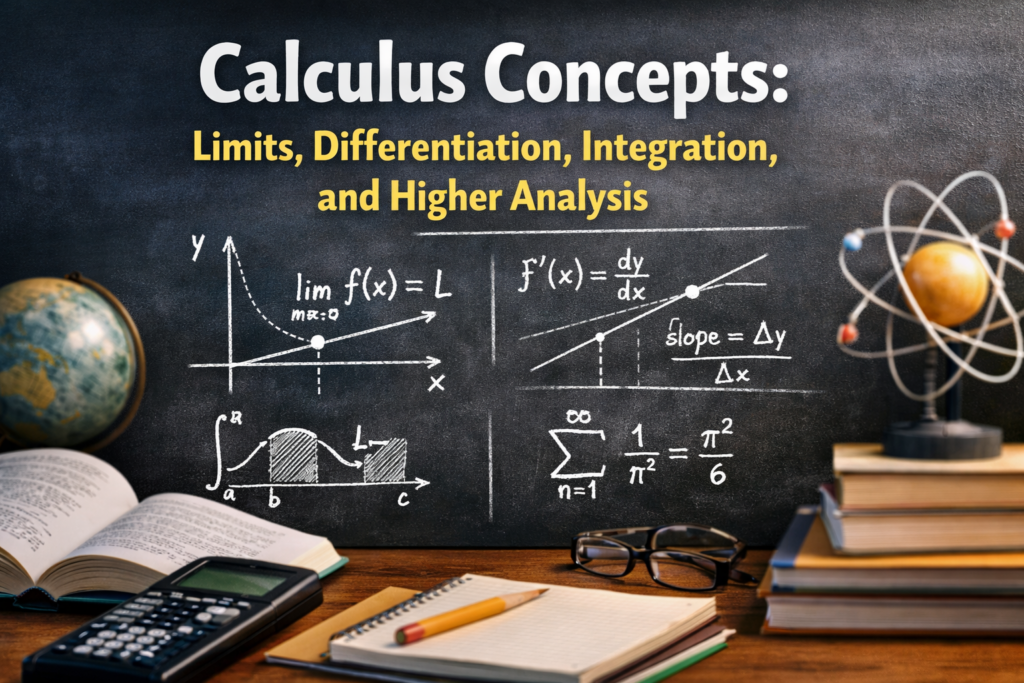
Calculus is a fundamental branch of mathematics that plays a critical role in science, engineering, economics, and many other fields. Understanding key calculus concepts helps build a strong mathematical foundation and improves problem-solving skills. By mastering these core ideas, students can better analyze change, motion, and complex systems in both academic and real-world contexts.
Table Of Content
Limits and Continuity
One of the most essential calculus concepts is the idea of limits. A limit describes the value that a function approaches as the input gets closer to a specific point. This concept forms the basis for defining derivatives and integrals.
Continuity is closely related to limits. A function is continuous if it has no breaks, jumps, or holes in its graph. Understanding limits and continuity helps students grasp how functions behave and prepares them for more advanced topics in calculus.
Derivatives and Rates of Change
Derivatives are another key component of calculus concepts. A derivative measures how a function changes as its input changes, essentially representing the rate of change. For example, in physics, derivatives are used to calculate velocity and acceleration.
Learning how to compute derivatives allows students to analyze trends, optimize functions, and solve real-world problems. This concept is widely applied in fields such as engineering, economics, and data analysis.
Applications of Derivatives
Beyond basic calculations, derivatives have practical applications that strengthen mathematical understanding. They are used to find maximum and minimum values, which is essential in optimization problems. Businesses use these techniques to maximize profit or minimize costs.
Derivatives also help determine the slope of curves and analyze motion. These applications make calculus concepts more meaningful and show their relevance in everyday situations.
Integrals and Accumulation
Integrals are another cornerstone of calculus concepts. While derivatives focus on rates of change, integrals deal with accumulation. An integral calculates the total value of a function over a given interval.
For instance, integrals can be used to find the area under a curve or determine the total distance traveled over time. Understanding integrals provides insight into how quantities build up, which is important in physics, engineering, and economics.
Fundamental Theorem of Calculus
The Fundamental Theorem of Calculus connects derivatives and integrals, showing that they are essentially inverse processes. This theorem is one of the most important calculus concepts because it simplifies complex calculations and provides a deeper understanding of how these two ideas relate.
By mastering this theorem, students can solve problems more efficiently and gain a clearer perspective on the structure of calculus.
Functions and Graphical Interpretation
A strong grasp of functions is necessary to understand calculus concepts. Functions describe relationships between variables and are often represented graphically. Visualizing functions helps students interpret slopes, curves, and areas more effectively.
Graphical interpretation also makes it easier to understand abstract concepts such as limits, derivatives, and integrals. This approach enhances comprehension and supports problem-solving skills.
Sequences and Series
Sequences and series extend calculus concepts into the study of patterns and infinite sums. A sequence is an ordered list of numbers, while a series is the sum of those numbers.
These concepts are important for understanding convergence and divergence, which determine whether a sequence or series approaches a specific value. They are widely used in advanced mathematics, physics, and computer science.
Importance of Mastering Calculus Concepts
Mastering calculus concepts provides a strong foundation for higher-level mathematics and technical disciplines. It improves analytical thinking, logical reasoning, and the ability to model complex systems.
Students who understand these concepts are better prepared for careers in science, technology, engineering, and finance. Additionally, calculus enhances problem-solving skills that are valuable in everyday decision-making.
Conclusion
Building a solid understanding of core calculus concepts is essential for academic success and practical applications. With consistent practice and the right resources, students can develop confidence and proficiency in calculus, especially when supported by modern tools like learning apps for kids. From limits and derivatives to integrals and sequences, each concept contributes to a deeper understanding of how mathematics explains change and relationships.






No Comment! Be the first one.