



For years, content operations followed a predictable structure. SEO teams gathered keywords, outlined a topic, assigned a target word count, and passed the brief to a writer. The writer produced the article, an editor refined it, and the content went live.
Table Of Content
- Why Traditional SEO Briefs Often Produce Average Results
- What Cognitive Intelligence SEO Adds to Content Briefing
- The Difference Between Informational Content and Cognitive Alignment
- Why Search Intent Alone Is No Longer Enough
- Exploratory State
- Evaluative State
- Confirmatory State
- Urgent Problem-Solving State
- How Better Briefs Improve Writer Performance
- The Role of Research in Cognitive SEO Brief Creation
- Why AI Search Systems Favor Cognitively Structured Content
- The Long-Term Advantage of Smarter Content Briefing
That workflow still exists across most organizations — but the search environment surrounding it has changed dramatically.
Modern search systems are no longer evaluating content purely on keyword relevance or surface-level topic coverage. AI-driven search ecosystems increasingly prioritize signals tied to expertise, trust, contextual understanding, and behavioral engagement. This shift is forcing content teams to rethink not just how they write content, but how they prepare writers before the writing even begins.
At ThatWare LLP, cognitive intelligence SEO is becoming a foundational layer in modern content briefing because it addresses the deeper question most traditional briefs ignore:
“How does the reader actually think, feel, and behave while searching for this information?”
Why Traditional SEO Briefs Often Produce Average Results
Most standard briefs are structurally focused rather than psychologically focused.
A traditional SEO brief usually includes:
- Primary keyword
- Secondary keywords
- Word count range
- Competitor URLs
- Basic heading suggestions
- Internal linking notes
- Tone recommendations
This structure was effective during earlier stages of search optimization because ranking algorithms primarily rewarded topical matching and keyword alignment.
But modern search evaluation systems increasingly analyze content quality through broader signals such as:
- Depth of expertise
- User engagement behavior
- Query satisfaction
- Information sequencing
- Contextual usefulness
- Human-centered communication patterns
Writers cannot naturally produce those qualities from a purely mechanical brief.
Without deeper context, even skilled writers often create content that is technically optimized but emotionally flat and strategically generic.
What Cognitive Intelligence SEO Adds to Content Briefing
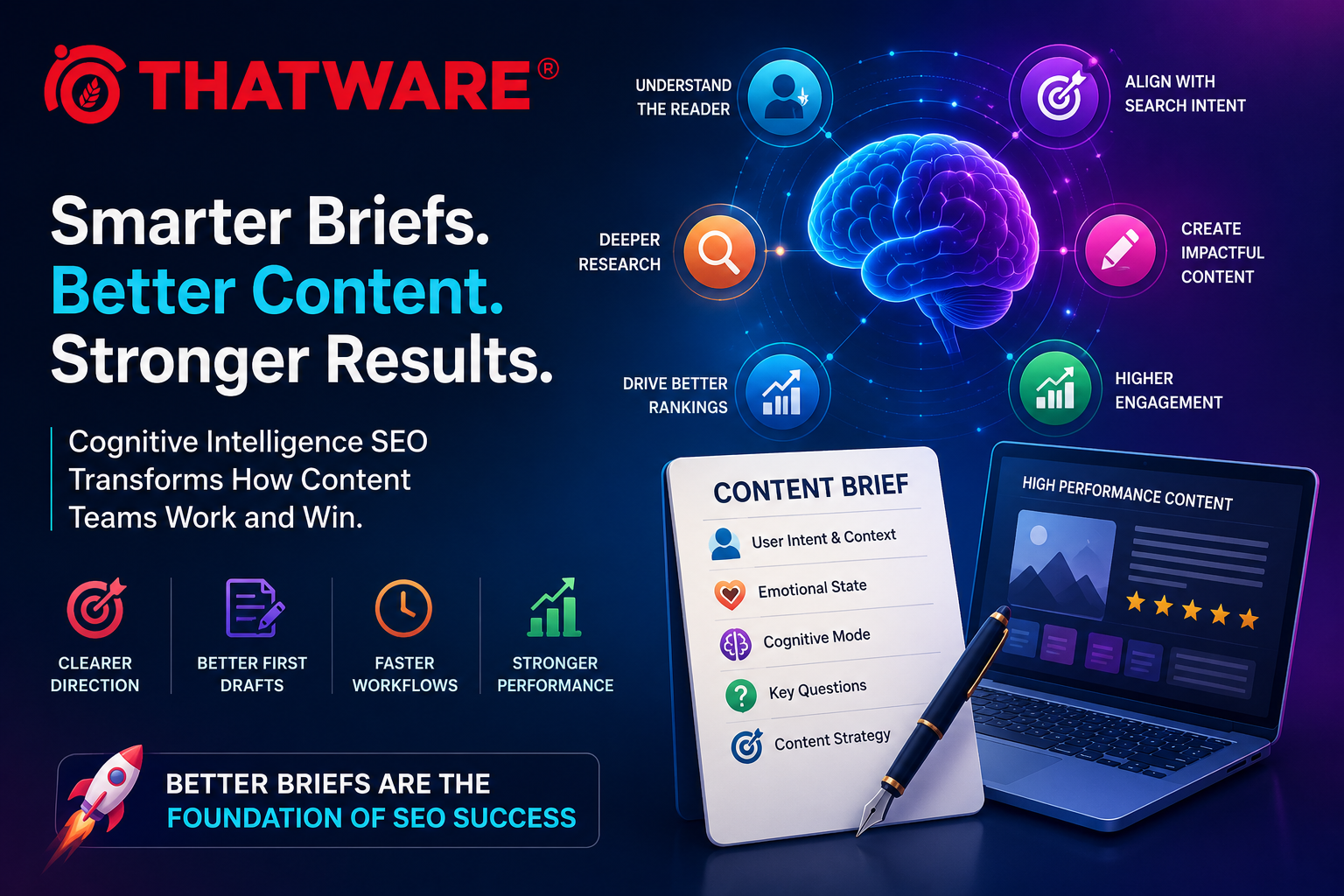
Cognitive intelligence SEO expands the role of the brief from a keyword instruction sheet into a behavioral strategy document.
Instead of only defining what content should discuss, the brief defines:
- Who the reader is
- What triggered their search
- What emotional state they may be in
- What uncertainties they’re experiencing
- What knowledge level they currently possess
- What objections or fears exist
- What cognitive path the content should guide them through
This transforms the writer’s role entirely.
The writer is no longer simply covering a topic. They are guiding a human decision-making process.
At ThatWare LLP, this approach helps produce content that feels more personalized, context-aware, and behaviorally aligned with modern search intent patterns.
The Difference Between Informational Content and Cognitive Alignment
Two articles can technically cover the same subject while producing completely different user experiences.
For example:
A standard brief may instruct a writer to create content about “AI automation tools for small businesses.”
A cognitively optimized brief approaches the same topic differently:
“Write for a small business owner overwhelmed by repetitive manual tasks who is worried automation software may be too expensive or technically difficult to implement. The reader wants efficiency improvements but fears operational disruption.”
That single change alters the entire execution strategy.
The content now naturally prioritizes:
- Simplicity over complexity
- Reassurance before technical explanation
- Practical examples over abstract concepts
- Trust-building language over aggressive sales messaging
- Gradual education rather than information overload
The topic remains identical.
The user experience becomes dramatically more effective.
Why Search Intent Alone Is No Longer Enough
Traditional SEO frameworks rely heavily on search intent categorization:
- Informational
- Transactional
- Navigational
- Commercial investigation
While useful, these categories are often too broad to guide high-performing content execution.
Cognitive intelligence SEO goes deeper by identifying the reader’s mental processing state during search.
For example:
Exploratory State
The user is learning broadly and wants possibilities explained without pressure.
Evaluative State
The user is comparing options and needs structured frameworks for decision-making.
Confirmatory State
The user has nearly decided and seeks reassurance that their choice is correct.
Urgent Problem-Solving State
The user needs clarity and action quickly because they are under pressure.
Each state requires a different content structure, tone, pacing, and information hierarchy.
Advanced briefs specify these conditions upfront.
How Better Briefs Improve Writer Performance
One of the most overlooked benefits of cognitive SEO briefing is its impact on the writing process itself.
Writers perform better when they understand:
- The reader’s situation
- The emotional context behind the search
- The strategic objective of the content
- The intended behavioral outcome
Instead of guessing tone or structure, they can make intentional communication decisions throughout the article.
This often leads to:
- Stronger first drafts
- Faster editing cycles
- More consistent messaging
- Better engagement quality
- Higher conversion potential
Many content teams discover that improving briefing quality has a larger impact on output quality than constantly replacing writers or adding more editorial layers.
The Role of Research in Cognitive SEO Brief Creation
Creating advanced cognitive briefs requires deeper research methods than traditional keyword analysis alone.
At ThatWare LLP, cognitive-focused briefing strategies may incorporate insights from:
- Community forums
- Reddit discussions
- Customer support conversations
- Sales call transcripts
- Product reviews
- User feedback patterns
- Behavioral analytics
- AI-assisted intent mapping
These sources reveal how real users phrase concerns, where confusion occurs, and what emotional patterns repeatedly emerge around a topic.
That information becomes the foundation for more strategically aligned content creation.
Why AI Search Systems Favor Cognitively Structured Content
AI-driven search environments increasingly evaluate content through contextual understanding rather than isolated keyword relevance.
Large language models can recognize:
- Content coherence
- Expertise depth
- Information flow quality
- User-centric structuring
- Semantic relationships
- Conversational relevance
Content built from cognitively informed briefs tends to perform better because it naturally reflects more authentic human communication patterns.
It feels less engineered purely for algorithms and more genuinely useful to readers.
Ironically, that human-centered quality often improves algorithmic performance as well.
The Long-Term Advantage of Smarter Content Briefing
Content quality is rarely accidental. In most cases, high-performing content originates from high-quality strategic direction long before the writing process begins.
The compounding benefits of cognitive intelligence SEO briefing include:
- Better content scalability
- Stronger topical authority
- Improved user engagement
- More efficient editorial workflows
- Higher search visibility stability
- Better conversion performance
- More differentiated brand positioning
As AI-driven search systems continue evolving, the advantage will increasingly belong to organizations capable of producing content that combines semantic expertise with cognitive relevance.
At ThatWare LLP, this shift represents more than a content trend — it represents a structural evolution in how modern search communication is designed, executed, and optimized for both machines and humans simultaneously.







No Comment! Be the first one.