



Invoice Trading in India: Meaning, Process, Benefits & How It Works (2026)
You delivered the goods. You raised the invoice. And now you wait — 60, 90, sometimes 120 days — while your rent, salaries, and vendor payments don’t care about your buyer’s payment...

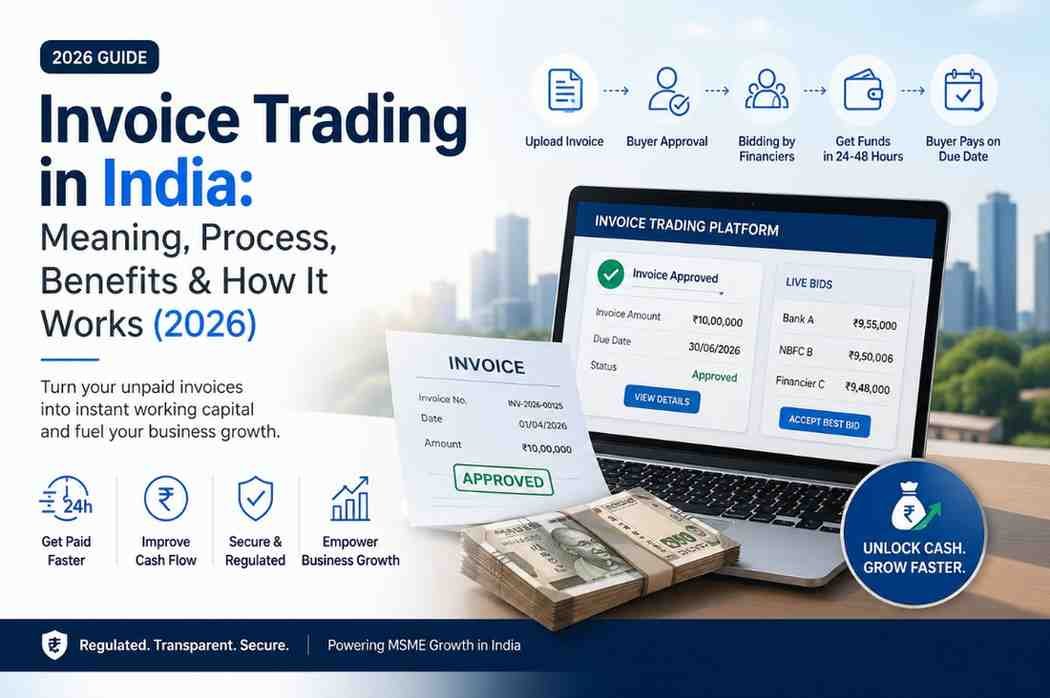
You delivered the goods. You raised the invoice. And now you wait — 60, 90, sometimes 120 days — while your rent, salaries, and vendor payments don’t care about your buyer’s payment cycle. Sound familiar? That’s the daily reality for millions of Indian MSMEs.
Top Content
- What Is Invoice Trading? (Simple Definition)
- How Is Invoice Trading Different from Invoice Discounting and Factoring?
- How Does Invoice Trading Work in India? (Step-by-Step Process)
- Step 1: Raise and Upload the Invoice
- Step 2: Buyer Approval
- Step 3: Competitive Bidding by Financiers
- Step 4: Seller Accepts the Best Bid
- Step 5: Funds Disbursed — Often Within 24 Hours
- Step 6: Buyer Repays on the Due Date
- Who Can Use Invoice Trading in India?
- What Are the Key Benefits of Invoice Trading for Indian Businesses?
- Instant Access to Working Capital
- No Collateral. No Equity Dilution.
- Competitive, Market-Driven Rates
- Improves Financial Ratios
- No Recourse in TReDS Transactions
- Fully Digital and Transparent
- What Is TReDS and Why Does It Matter for Invoice Trading in India?
- Which Are the Top Invoice Trading Platforms in India in 2026?
- RXIL — The Pioneer TReDS
- M1xchange
- Invoicemart
- KredX
- Recur Club, CredAble, and Drip Capital
- What Are the Risks and Limitations of Invoice Trading?
- How to Get Started with Invoice Trading in India?
- Is Invoice Trading Regulated in India? What Does the RBI Say?
- Conclusion
Invoice trading is the financial tool that turns that waiting game into instant cash. Instead of staring at a pending invoice, you sell it to an investor at a small discount and walk away with funds in your account — sometimes within 24 hours.
India’s invoice trading ecosystem in 2026 is one of the most sophisticated in Asia, backed by RBI regulations, government mandates, and a growing network of fintech platforms. This article breaks down everything you need to know — simply, clearly, and without the financial jargon.
What Is Invoice Trading? (Simple Definition)
Invoice trading means selling your unpaid business invoices to a third-party investor or financier in exchange for immediate cash. The investor pays you a large portion of the invoice value upfront — typically 80–95% — and collects the full payment directly from your buyer when the invoice is due.
Think of it like this: you have a ₹10 lakh invoice due in 90 days. Instead of waiting, you sell it to an investor today for ₹9.5 lakh. You get cash now; the investor earns ₹50,000 as a return when your buyer pays up. Everyone wins.
Key fact: Invoice trading is not a loan. There is no EMI, no debt on your balance sheet, and no collateral needed. You are simply converting a future receivable into present cash.
How Is Invoice Trading Different from Invoice Discounting and Factoring?
These three terms often get used interchangeably, but they are meaningfully different — and the difference matters when you are choosing a financing solution.
In invoice trading, invoices are listed on a marketplace where multiple investors bid to fund them. It is competitive, transparent, and typically results in better rates for the seller. The risk of buyer default may or may not transfer to the investor depending on the platform structure.
Invoice discounting is more like a secured overdraft — you borrow money against your invoices but retain the responsibility of collecting payment. Your buyer may not even know you have used the invoice as collateral. This is common with banks and NBFCs.
Invoice factoring, on the other hand, involves selling both the invoice and the right to collect payment from the buyer. The factor (usually a financial company) takes over the collections process entirely. It is more hands-off for the seller but can sometimes affect buyer relationships.
Bottom line: Invoice trading is the most market-driven and transparent version of receivables financing, especially on regulated platforms like TReDS.
How Does Invoice Trading Work in India? (Step-by-Step Process)
The process is cleaner than most people expect — especially on India’s regulated TReDS (Trade Receivables Discounting System) platforms. Here is how a typical invoice trading transaction unfolds:
Step 1: Raise and Upload the Invoice
The supplier (usually an MSME) delivers goods or services to a large corporate buyer and generates a GST-compliant invoice. This invoice is then uploaded to a digital platform — either a TReDS exchange or a fintech marketplace.
Step 2: Buyer Approval
The corporate buyer logs into the platform and approves the invoice, confirming that the goods or services were received and the amount is payable on the due date. This is a critical step — financiers only bid on buyer-approved invoices, which significantly reduces risk.
Step 3: Competitive Bidding by Financiers
Once approved, the invoice goes live on the marketplace. Banks, NBFCs, and other registered financiers place bids, offering to fund the invoice at various discount rates. Because multiple financiers compete, the seller usually gets the best possible rate — market forces work in their favor here.
Step 4: Seller Accepts the Best Bid
The MSME reviews the bids and accepts the most favorable one. No lengthy paperwork. No branch visits. The entire process is digital and auditable.
Step 5: Funds Disbursed — Often Within 24 Hours
After acceptance, the funds are transferred directly to the supplier’s bank account. Platforms like M1xchange and RXIL are known to disburse funds within one to two working days — a sharp contrast to the 60–90 day wait that was previously the norm.
Step 6: Buyer Repays on the Due Date
On the invoice due date, the corporate buyer pays the full invoice amount directly to the financier. The transaction closes cleanly. The MSME has already moved on — with working capital in hand.
Who Can Use Invoice Trading in India?
Invoice trading is primarily designed for B2B businesses — companies that sell goods or services to other businesses and raise formal invoices. Here is who benefits most:
- MSMEs (Micro, Small and Medium Enterprises) supplying to large corporates or government entities
- Manufacturers, logistics companies, IT service firms, and healthcare suppliers
- Exporters using ITFS (International Trade Finance Service) platforms for cross-border invoices
- Startups with enterprise clients — provided the buyer is creditworthy and registered on the platform
Regulatory nudge: As per Budget 2026, all Central Public Sector Enterprises (CPSEs) have been mandated to make vendor payments through TReDS platforms. Additionally, companies with a turnover of ₹250 crore or more are required to register on TReDS. This means if you supply to a large corporate, chances are your buyer is already on the platform.
What Are the Key Benefits of Invoice Trading for Indian Businesses?
The benefits go beyond just getting paid faster. Here is what invoice trading actually does for your business:
Instant Access to Working Capital
The most obvious benefit — and the most impactful one. Instead of waiting 60 to 90 days for payment, you get 80–95% of the invoice value credited within 24–48 hours. For a business running on thin margins or managing seasonal demand, this is transformational.
No Collateral. No Equity Dilution.
Unlike a bank loan, invoice trading does not require you to pledge property, machinery, or any fixed asset. Unlike venture funding, you do not give away equity. The invoice itself is the asset — and you created it by doing honest business.
Competitive, Market-Driven Rates
Because multiple financiers bid for your invoice on TReDS platforms, the discount rate is determined by competition — not by a single banker’s discretion. This structural advantage often results in more favorable pricing compared to traditional financing options.
Improves Financial Ratios
Invoice trading converts receivables into cash, which strengthens your current ratio and reduces your debtor days. For businesses planning to raise additional credit or prepare for fundraising, cleaner books matter — and invoice trading helps achieve that without additional debt.
No Recourse in TReDS Transactions
On RBI-regulated TReDS platforms, invoice trading is typically structured as ‘without recourse.’ This means if the buyer defaults, the risk lies with the financier — not the MSME. This is a significant protection for small businesses that cannot afford bad debt exposure.
Fully Digital and Transparent
Gone are the days of physical documents, branch visits, and relationship banking. On modern platforms, the entire journey — from invoice upload to fund disbursement — is digital, auditable, and can be completed from a laptop or phone.
What Is TReDS and Why Does It Matter for Invoice Trading in India?
TReDS stands for Trade Receivables Discounting System. It is an RBI-regulated digital marketplace specifically designed to help MSMEs unlock working capital through invoice trading. Launched under the Factoring Regulation Act, 2011, TReDS platforms are the gold standard of invoice trading in India.
The RBI has licensed three TReDS platforms in India as of 2026: M1xchange (promoted by Mynd Solutions), RXIL (set up by SIDBI and NSE), and Invoicemart (a joint venture between Axis Bank and mjunction services). Each of these is a regulated market infrastructure institution — not just a fintech startup.
Scale fact: M1xchange alone has facilitated trade receivables financing worth over $21 billion (approximately ₹1.7 lakh crore), supporting more than 50,000 MSMEs across 2,200+ cities in India. That is not a small pilot program — it is real, working infrastructure at national scale.
The key advantage of TReDS over other platforms is the auction mechanism. When your invoice goes live, banks and NBFCs compete to fund it. The lowest discount rate wins — and you benefit from that competition every single time.
Which Are the Top Invoice Trading Platforms in India in 2026?
Choosing the right platform depends on your business size, buyer relationships, and whether you need domestic or international invoice financing. Here is a quick guide to the key players:
RXIL — The Pioneer TReDS
RXIL (Receivables Exchange of India Limited) was India’s first TReDS platform, established by SIDBI and NSE in 2014. It offers invoice discounting, bill discounting, and factoring services. RXIL Global IFSC Limited extends its services to cross-border trade finance, benchmarked against global best practices.
M1xchange
M1xchange is RBI-licensed and has onboarded 66+ banks, 2,500+ corporates, and 50,000+ MSMEs. It operates an auction-based model where financiers bid in real-time. Funds are typically disbursed within 24 hours of invoice acceptance. Best for MSMEs with large corporate buyers already on the platform. Its subsidiary M1 NXT also handles international invoice financing.
Invoicemart
Invoicemart is a TReDS platform backed by Axis Bank and mjunction services. It is known for fast payment cycles — typically within 24 hours of buyer acceptance — and a straightforward digital onboarding process. It caters strongly to manufacturing and logistics sector MSMEs.
KredX
Founded in 2015 in Bengaluru, KredX is India’s most prominent invoice discounting platform outside the formal TReDS structure. It connects businesses holding invoices from creditworthy buyers with institutional investors. KredX is better suited for mid-market companies that may not qualify under TReDS eligibility or need more flexibility.
Recur Club, CredAble, and Drip Capital
These fintech platforms offer invoice financing alongside other working capital products. Recur Club focuses on startups and growth-stage companies. CredAble is strong in supply chain finance for large enterprises. Drip Capital specializes in export invoice financing and is particularly useful for small exporters dealing with international buyers.
What Are the Risks and Limitations of Invoice Trading?
Invoice trading is not a magic bullet. Like any financial product, it comes with limitations worth knowing before you commit.
Discount costs are real. Even competitive rates mean you receive less than the full invoice value. For businesses operating on very thin margins, the cost of financing needs to be factored into pricing decisions upfront.
Eligibility depends on your buyer, not just you. The creditworthiness of your buyer — not your own CIBIL score — drives the discount rate and eligibility. If your buyers are small companies or individuals, most TReDS platforms will not finance those invoices.
TReDS is MSME-only on the seller side. If your company has outgrown MSME classification (i.e., your investment and turnover exceed the MSME thresholds under the MSMED Act), you cannot participate as a seller on TReDS. You would need to use fintech platforms instead.
Not suitable for B2C businesses. If you sell to consumers — a retail shop, a restaurant, an e-commerce seller — invoice trading is not designed for your revenue model. It is exclusively a B2B financing tool.
How to Get Started with Invoice Trading in India?
Getting started is more straightforward than most business owners expect. Here is a practical path to follow:
First, confirm your buyer is registered on a TReDS platform or is open to joining one. Without buyer participation, the TReDS route is not available — though fintech platforms like KredX have more flexibility.
Second, register your business on the platform of your choice. You will need your MSME registration (Udyam certificate), GST registration, bank account details, and basic KYC documents. Most platforms complete digital onboarding within a few days.
Third, raise a GST-compliant invoice for your buyer after delivery. Upload it on the platform and wait for buyer approval — this is the step that unlocks financing.
Once the buyer approves and financiers bid, you accept the best offer and receive funds. The entire active effort on your part takes minutes on a digital platform. The waiting — 60 to 90 days — becomes someone else’s problem.
Is Invoice Trading Regulated in India? What Does the RBI Say?
Yes, and robustly so. TReDS platforms in India operate under the Factoring Regulation Act, 2011 and are governed by the Reserve Bank of India. They are classified as Non-Banking Financial Companies and must adhere to strict regulatory standards, data security norms, and participant eligibility criteria.
Fintech platforms that are not TReDS-licensed typically operate as NBFCs or partner with registered lending institutions. They are regulated by RBI under the NBFC framework, though with a different (and somewhat less structured) oversight regime compared to TReDS.
2026 Update: Budget 2026 mandated that all Central Public Sector Enterprises must route vendor payments through TReDS platforms. This significantly expands the pool of eligible invoices for MSMEs supplying to government-linked buyers — a major positive development for the ecosystem.
Conclusion
If you are a B2B business — supplying goods or services to corporates, PSUs, or government buyers — and you regularly deal with long payment cycles, invoice trading is one of the most powerful, low-friction financing tools available to you in India today.
It is not a loan. It is not equity. It is your own money — unlocked faster, through a regulated, digital marketplace that is backed by the RBI and used by tens of thousands of MSMEs across the country.
The infrastructure is built. The regulations are clear. The platforms are live. The only question is: how much working capital are you leaving on the table by not exploring this?


No Comment! Be the first one.